Ancient Irish history spans over 33,000 years of human activity, progressing through the Mesolithic, Neolithic, Bronze, and Iron Ages. This guide traces the island’s evolution from post-glacial hunter-gatherers to the arrival of Christianity. Explore a timeline of archaeological sites, material culture, and the lived experience of Ireland’s ancient communities through evidence-based research.
Timeline of Ancient Ireland
- 33,000-8,000BC PALAEOLITHIC Evidence of human activity at Castlepook Cave, County Cork, pushes back the arrival of humans in Ireland by 20,000 years, establishing a much deeper prehistoric origin than previously accepted.
- 8,000–4,000BC MESOLITHIC Seafaring hunter-gatherers establish Ireland’s first sustained settlements, notably at Mountsandel, County Derry. Expertise in seasonal resource management is evidenced by the 7,000-year-old Clowanstown fish trap.
- 4,000–2,500BC NEOLITHIC The arrival of farming introduces settled villages and monumental architecture. Builders construct world-renowned megalithic sites like Newgrange (c. 3200 BC) and the Céide Fields, which predate the Pyramids of Giza.
- 2,500–500BC BRONZE AGE Metallurgy revolutionises society as copper and gold are mined and traded through networks reaching Britain. Large-scale settlements emerge, such as Corrstown village with its dozens of timber roundhouses.
- 500BC–400AD IRON AGE Gaelic-Celtic culture flourishes, organised into tribal tuatha ruled by kings. High-status ceremonial centres like Dún Ailinne and Navan Fort dominate the landscape, while Ogham—Ireland’s first script—appears near the era’s end.
- 400–800AD+ EARLY MEDIEVAL Christianity arrives in the 5th century, transforming Ireland into a ‘land of saints and scholars’ with monastic sites like Nendrum. Viking raiders arrive by c. 800 AD, eventually founding the first permanent towns like Dublin.
Mesolithic Period 8,000-4,000BC
We’ll jump straight to 8,000BC because, while evidence exists of human activity in Ireland as far back as 33,000BC, Ireland didn’t exist as the island we’d recognise today until possibly as late as 12,000-10,000BC. Which brings us to the early hunter-gatherers. Now it’s very easy to imagine a lush paradisical land ripe for these early settlers, but the reality was likely much harsher.
Life was harsh. Bears, wolves, lynx, and wild cats still roamed the island. Weather ruled everything. A cold winter or a failed hazelnut crop could threaten survival. Rivers flooded. Storms battered the coast. Ireland’s early forests had not yet closed in, leaving people exposed to the elements. Yet these communities adapted. They moved with the seasons and learned how to exploit rivers, shorelines, and forest edges. Their knowledge of place was not written down, but it shaped the routes and landscapes that later generations inherited.
One leading academic estimates Ireland’s population would have been around 3,000 during this period, mostly in small communities.1 One of the best examples is the settlement of Mountsandel which dates to 8,000BC. This small community, survived on a varied diet and likely even had a developed culture. Trade can be traced to the distribution of polished axes and other goods, reflecting a clear movement of goods and peoples even in this period. But it’s only once we get to the Neolithic that we begin to see the ancient monuments that we all know and love.
Related Posts: Mesolithic Ireland
Neolithic Period: 4,000-2,500BC
Neolithic Ireland was defined by the transition from nomadic hunter-gatherers to settled farming communities, introducing monumental stone architecture and complex agricultural systems. This era saw the arrival of the “Neolithic Package”—pottery, cereal cultivars, and domesticated livestock—transforming the island into a canvas for some of the world’s most sophisticated prehistoric engineering.
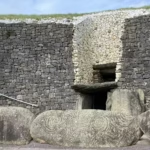
The crowning achievement of this period is the Newgrange passage tomb within the Brú na Bóinne complex. Built around 3200 BC, this 200,000-tonne structure predates the Pyramids of Giza by five centuries. It features a precise solar alignment where the winter solstice sunrise illuminates a 19-meter passage through a unique “roof-box”. The logistical effort was massive; Neolithic builders transported white quartz from the Wicklow Mountains (70km away) and dark granite from the Mournes (50km away) using only stone and timber tools.
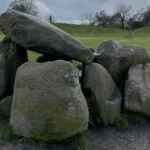
But Newgrange was one of many types of monuments which were built. For instance, henges – like the huge 200m-wide one now know as the Giant’s Ring outside Belfast – indicate huge social enterprises which were probably used for ritual and social gatherings. And there were literally 100s of such monuments built across the island. These monuments were likely symbols of power and prestige, and reflected the technologies available during this time. That is until the advent of bronze.
Related Posts: Neolithic Ireland
Bronze Age: 2,500-500BC
The Bronze Age in Ireland marks the shift from stone to metal, with copper and later bronze tools transforming daily life. Farming expanded and woodland clearance accelerated. This was also the age when Ireland entered long-distance trade for the first time. Copper mining began at Ross Island in County Kerry and at Mount Gabriel in west Cork. These mines supported a surge in craft production, especially in gold. Irish goldworkers created lunulae, torcs, and discs in vast quantities.
New communities appeared along coasts and fertile lowlands. One of the most striking settlements lies near Portrush, where excavations revealed more than seventy timber roundhouses joined by cobbled paths. This scale hints at growing social organisation. The same period saw a dramatic rise in monument building. While rock art continued older Neolithic traditions, the Bronze Age added thousands of standing stones and stone circles across the countryside. Power also moved to defensible and strategic locations such as on the Aran Islands, where the clifftop fort of Dún Aonghasa dominates Atlantic sea routes and reflects increasing social hierarchy.
Burial practices changed too. Instead of large communal tombs, people now used stone cists and small earthen barrows. These graves often held individual bodies with weapons or ornaments. They point to the rise of a warrior elite and sharper social divisions. By the end of the Bronze Age, Ireland was no longer a world of scattered farming families. It had become a connected, stratified society shaped by metal, trade, and control of the land.
Related Posts: Bronze Age Ireland
Iron Age: 500BC-400AD
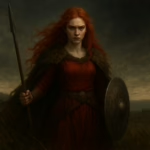
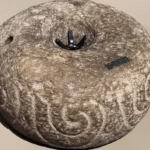
Iron working reached Ireland around 600 BC and reshaped both technology and identity. Tools and weapons became harder and more durable. Farming improved and forests fell back further. At the same time, Gaelic culture took clearer form. Society organised itself into small kingdoms known as tuatha, each ruled by a local king whose power rested on cattle, followers, and ritual authority. This period also saw the growth of heroic storytelling. Tales later written down in the Ulster and Mythological cycles draw on Iron Age values of honour, status, and warfare. Ogham script appeared toward the end of the period, carved along stone edges as a new way to record names and lineage.
Power centred on a small number of vast ceremonial landscapes known today as royal sites. In Leinster, the great earthwork at Dún Ailinne formed a thirteen-hectare ritual enclosure linked with kingship ceremonies and large feasts. In Meath, Tara stood as the symbolic heart of the island and the seat of the High Kings, home to the Lia Fáil or Stone of Destiny. The west revolved around Cruachain in Connacht, the legendary court of Queen Medb. In Ulster, Emain Macha, now known as Navan Fort, functioned as the northern capital. These were not towns in the Roman sense. They were seasonal centres where law, kingship, and myth intertwined.
Away from these royal landscapes, everyday life followed strict social codes. Clothing signaled rank through colour, weaving, and ornate metalwork, as I explore in my post on Iron Age clothing. Wealth rested on cattle, not coin. Diet was seasonal and tied to large communal feasts, a theme I return to in my post on Iron Age food and drink. People built crannogs in lakes and timber roundhouses on dry land. The Iron Age feels legendary because it was. Yet it was also practical, harsh, and deeply rooted in place.
Related Posts: Iron Age Ireland
-

Macha: Irish Goddess of War, Horses and Fate
-
Iron Age Food and Drink: History and significance of diet in ancient Ireland
-
Roman Influence on Ireland: Trade, Culture and the Limits of Empire
-
St Patrick: History, Mission and Legacy in Early Ireland
-
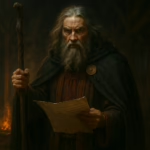
The Brehon Laws: How Ireland’s Ancient Legal System Really Worked
-
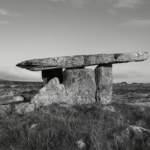
Irish Megaliths: Henges, Portal & Passage Tombs & Stone Circles
Early Medieval: 400-800AD+
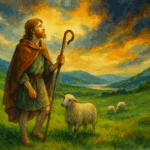
Early medieval Ireland spans roughly from AD 400 to the early tenth century. It marks the island’s shift from a prehistoric, oral culture into a literate Christian society. Tradition places the arrival of Patrick in AD 432, though Christianity spread gradually through local elites rather than by mass conversion. Monasteries soon replaced royal sites as centres of influence. These were not quiet retreats. They were busy communities that shaped law, learning, and technology across the island.
Large monastic complexes such as Clonmacnoise and Bangor Abbey became international centres of scholarship. They trained scribes, produced illuminated manuscripts, and attracted students from Britain and the Continent. At Nendrum in Strangford Lough, archaeologists uncovered a seventh-century tidal mill, one of the earliest known in Europe. It shows the technical skill that underpinned spiritual life. Figures such as Columba of Iona spread Irish learning across Scotland and northern England, while the legend of Brendan’s Atlantic voyage captured the medieval imagination. I explore many of these sites in my posts on Bangor Abbey and Cashel, where learning and power met.
The rhythm of monastic life changed forever in AD 795 with the first recorded Viking raid on Rathlin Island. Raids soon followed along the coasts and rivers. What began as seasonal attacks evolved into permanent Norse settlements. Dublin, Waterford, Wexford, Cork, and Limerick all trace their origins to Viking longphuirt. Monasteries responded with new architecture. Round towers, such as those at Antrim and Devenish, combined defence and devotion, offering refuge for people and relics alike. By the ninth century, Norse and Gaelic cultures had fused into a hybrid world of trade, towns, and shared traditions that carried Ireland into the medieval age.
Related Posts: Early Medieval Ireland
-
Antrim Round Tower: History of Antrim’s medieval monastic site
-
St Patrick: History, Mission and Legacy in Early Ireland
-
Nendrum Monastic Site: History, Tidal Mill & Irish Monastic Life
-
Ballyaghagan Cashel: Belfast Hills Stone Ringfort Guide
-
Dunluce Castle: Gaelic Fortress that Shaped Ulster’s Medieval History
Book Reviews
- Book Review: Ireland’s Animals by Niall Mac Coitir – Myths, Legends & FolkloreIreland’s Animals gathers folklore, natural history and morality tales for 56 Irish species—from the otter who baptised St Colmcille to the ‘loyal’ red deer of Ossory. Mac Coitir’s clear prose and Gordon D’Arcy’s ink drawings turn backyard wildlife into mythic companions; here’s why the 2010 Collins Press book still earns shelf space.
- Book Review: A smaller social history of ancient Ireland, P.W. JoyceI recently discovered that my 1 year-old daughter has already chosen her favourite book, one she undoubtedly picked for the colourful flaps and dynamic dinosaurs. When I ask what she wants to read, she has no hesitation, through pointing and screaming, which… Read more: Book Review: A smaller social history of ancient Ireland, P.W. Joyce
- Book Review: The Celts, Barry CunliffeSome historians are born academics, their work is thorough, detailed, and completely incomprehensible. But there are a rare few, of whom we will have all heard of (e.g. Tom Holland, Anthony Beevor), who manage to bridge that great divide, turning facts into… Read more: Book Review: The Celts, Barry Cunliffe
- Book Review – Ancient Ireland by Laurence FlanaganArchaeology can often feel as dry and dead as the very artifacts it unearths. Debates around dating methodologies, discoveries of inane objects of little to no importance, or merely terminology so densely formulated in ‘isms’ and ‘tions’ that no lay-person has a… Read more: Book Review – Ancient Ireland by Laurence Flanagan
- Book Review: The Oldest Irish Tradition, Kenneth JacksonI can’t count the times I’ve prayed for the dull, droning monotony of a lecture to end. We will all be able to remember a talk we wished we could escape, a pointless meeting, or a seemingly unending work presentation. I resent… Read more: Book Review: The Oldest Irish Tradition, Kenneth Jackson
Further Resources
My research draws on a mix of academic research, archaeological reports, primary source material, and site visits. But the world of ancient Irish history is much bigger than I could ever hope to cover. So for those who want to delve deeper, please see these top 5 resources I’d recommend:
1. Irish History Online
A continuously updated electronic bibliography hosted by the Royal Irish Academy, providing detailed references to publications on Irish history, making it an invaluable research tool.
2. FutureLearn – Irish History Courses
In collaboration with leading universities, FutureLearn offers free online courses that explore key events from early settlements to modern times, allowing learners to analyze historical events from diverse perspectives.
3. The Brehon Academy
Dedicated to reviving and teaching ancient Irish culture and society, this platform offers courses on early Irish law, culture, and societal structures, providing a deep dive into Ireland’s historical legal systems.
4. Corpus of Electronic Texts (CELT)
Hosted by University College Cork, CELT is an online database of contemporary and historical documents related to Irish history and culture, providing access to a wealth of primary sources.
5. Digital Medievalist – Learning Old Irish
For those interested in the linguistic aspects of ancient Irish history, this resource offers guidance on learning Old Irish, including recommended dictionaries and texts.
- J.P. Mallory (2013) The Origins of the Irish. ↩︎