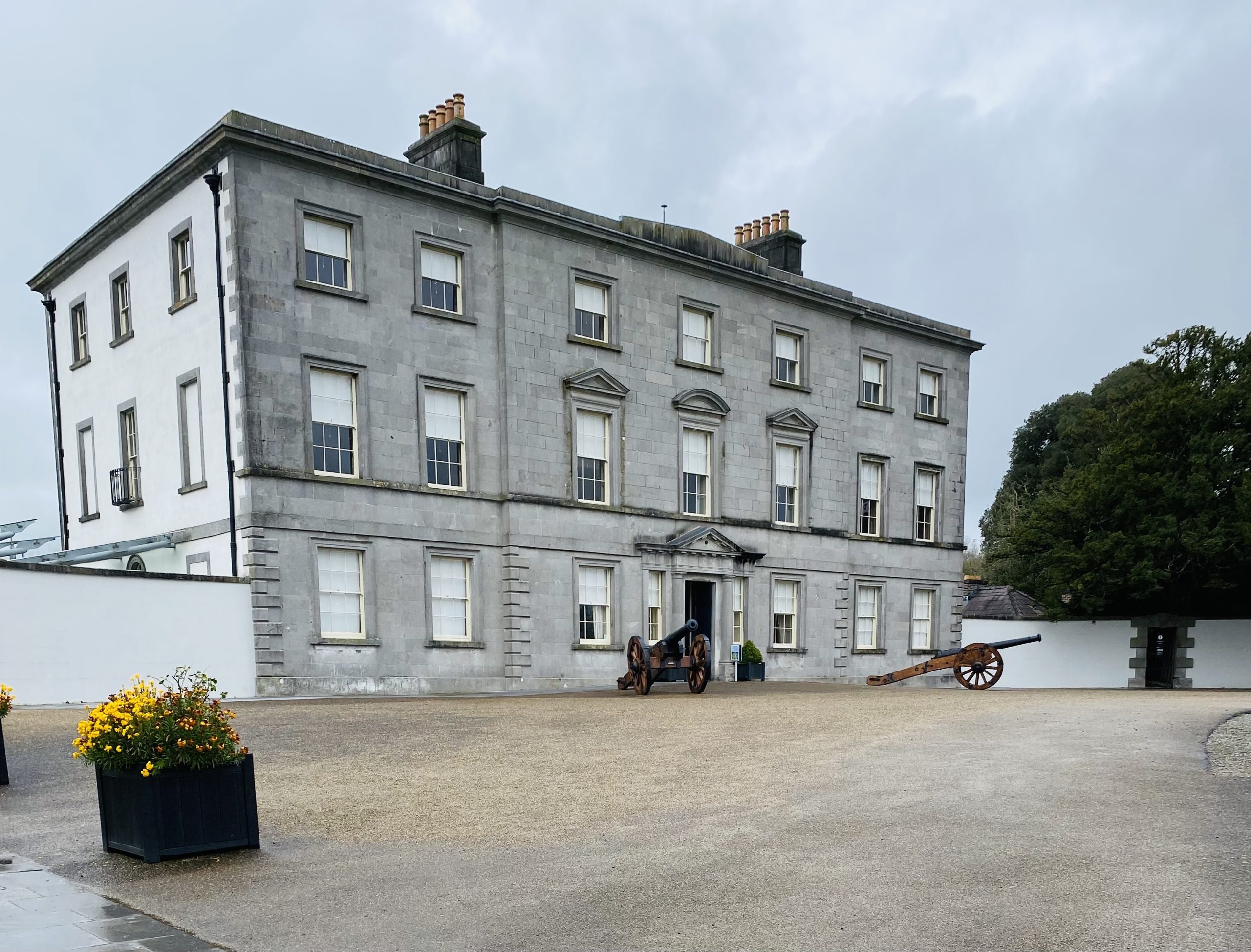
Growing up in Northern Ireland, for many around me the infamous Battle of the Boyne was more akin to a religious doctrine than a historical event. Many worshiped this mysterious figure on a white horse much like they did their saints, more so even. But like any historical event which becomes a political narrative, the historical facts are much more rewarding than their politicised counterpart. This is why I felt it necessary to review the Battle of the Boyne Visitor Centre.
A Battle for Peace
It is because of the politics surrounding this history, that the Visitor Centre on the site of the Battle of the Boyne serves such an important role. It is much more than a mere tourist attraction. It’s an embodiment of the peace that Ireland has long sought. Indeed, recent announcements of further expansion of the site are set to capitalise on this promising legacy.1
But before getting into any of that we must first understand what the Battle of the Boyne was and why it continues to matter today. For it does, and not only for those on the island of Ireland, but right across the world. So, first we need to go back to 1690.
Battle of the Boyne (brief) History
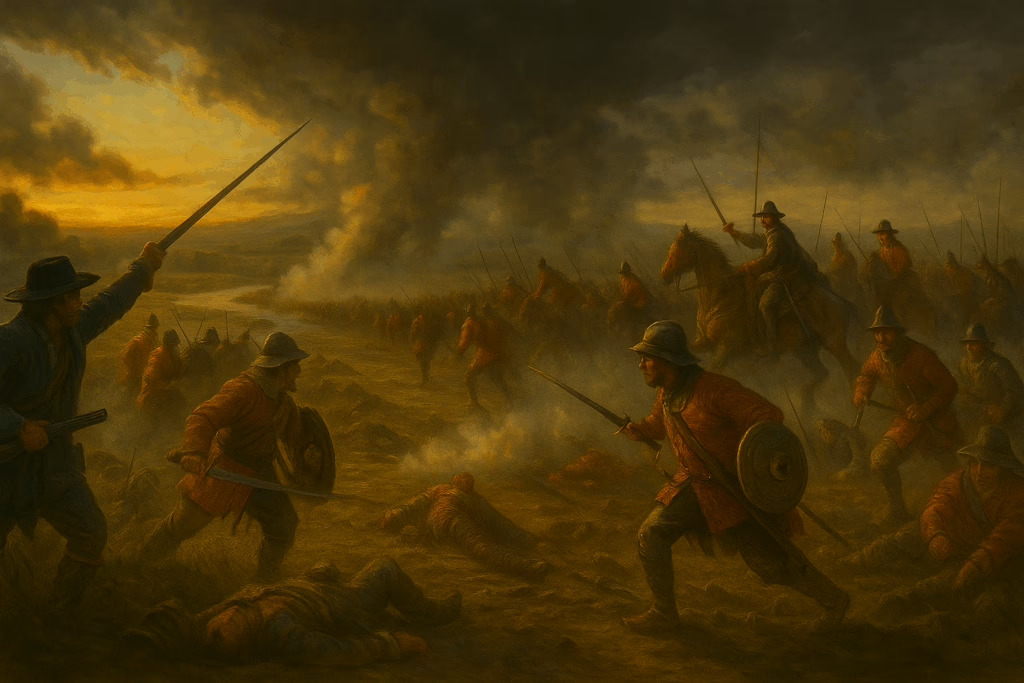
The Battle of the Boyne took place on 1 July 1690 between the Protestant King William (ascended to King of England and Scotland in 1989) and Catholic King James II (deposed as King of England and Scotland in 1989). The two sides fought close to the River Boyne in Ireland, near what is now the site of the Centre.
The battle was significant in Irish history for many reasons, but the immediate strategic significance was that King James II fled Ireland after his defeat and his forces abandoned Dublin. This was considered a critical turning point in the war which many historians consider as the beginning of the end of King James and ultimately for Catholic forces within England.
Jonathan Bardon sums up the impact very clearly:
“James…could no longer think of Ireland as a springboard for recovering his throne; for the English the Glorious Revolution and parliamentary rule were made secure; for the Old English in Ireland the defeat dashed hopes of recovering their estates; and for Ulster Protestants the battle ensured the survival of their plantation and a victory for their liberty to be celebrated from year to year.”2
Review: Battle of the Boyne Visitor Centre
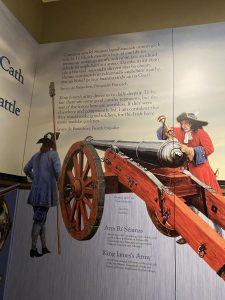
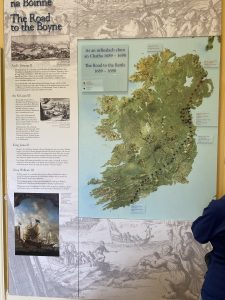
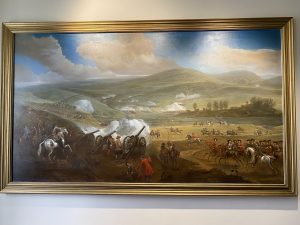
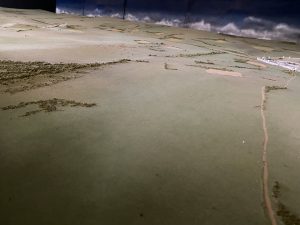
The centre is very simple. There are three main exhibits which detail the before, during and after of the battle. Each provide a concise context, without the usual politically fraught biases, and give visual examples to illustrate what this meant: maps of the political allegiances; the dress and types of soldiers; quotes from key individuals involved in the battle. I particularly enjoyed the physical model which used lasers to show the troop movements during the battle. This was probably one of the best visual representations of a battle I’ve seen. You just have to forgive the cringy scenes in the video reenactment.
But the reason this exhibition was so impactful was the simple approach to history, dispelling the many myths which have surrounded the battle, instead letting the facts – as we know them – speak for themselves. It is dispassionate, wonderfully so. For me this was exactly what I needed and will have a far more enduring impact than any attempt to reshape history to suit contemporary politics. I am grateful for this and I’m sure many of you will be too.
Advice to visitors: Great cafe and lots of good walks. Exhibition is buggy friendly. The walled gardens not so (I felt like I was pushing a steamroller up the gravel paths!). Also note it closes at 4 so time your visit accordingly.
For more on the centre see here.
Frequently Asked Questions: Battle of the Boyne Visitor Centre
Daily 09:00–16:00 from October–April and 10:00–17:00 from May–September. Closed 24–26 Dec.
As of 2025 Adult €5 · Senior/Group €4 · Child/Student €3 · Family €13. Grounds and walled garden are free.
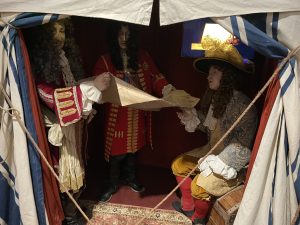
A 15-min film, life-size musketeers, original and replica weaponry, a laser battlefield model and touchscreen timelines.
The exhibition floors are step-free and an accessible path circles the walled garden; some riverside trails are gravel. Though I did struggle around the walled garden with a buggy.
Yes—the Boyne Visitor Centre is 3.8 km from Brú na Bóinne; allow 20 min drive. However, given the time required for Newgrange I’d suggest taking the time to do both on separate days.
- https://www.newsletter.co.uk/retro/calls-for-all-ireland-military-museum-at-battle-of-boyne-site-955006 ↩︎
- Bardon, Jonathan, A History of Ulster. Belfast: The Blackstaff Press, 2001. Page 164. ↩︎
YOU MAY ALSO LIKE
 Was the Hill of Tara Ireland’s Seat of High Kings?
  Who was St Patrick? Life, Miracles & Lasting Legacy
  Ballyaghagan Cashel: Belfast Hills Stone Ringfort Guide
  Book Review: A smaller social history of ancient Ireland, P.W. Joyce
  Iron Age Clothing in Ireland: What People Really Wore
  Ancient Celtic Festival Calendar: 8 Key Dates
  How old is Newgrange and who built it?
  Who was the Irish goddess Brigid? Goddess of Fire & Fertility