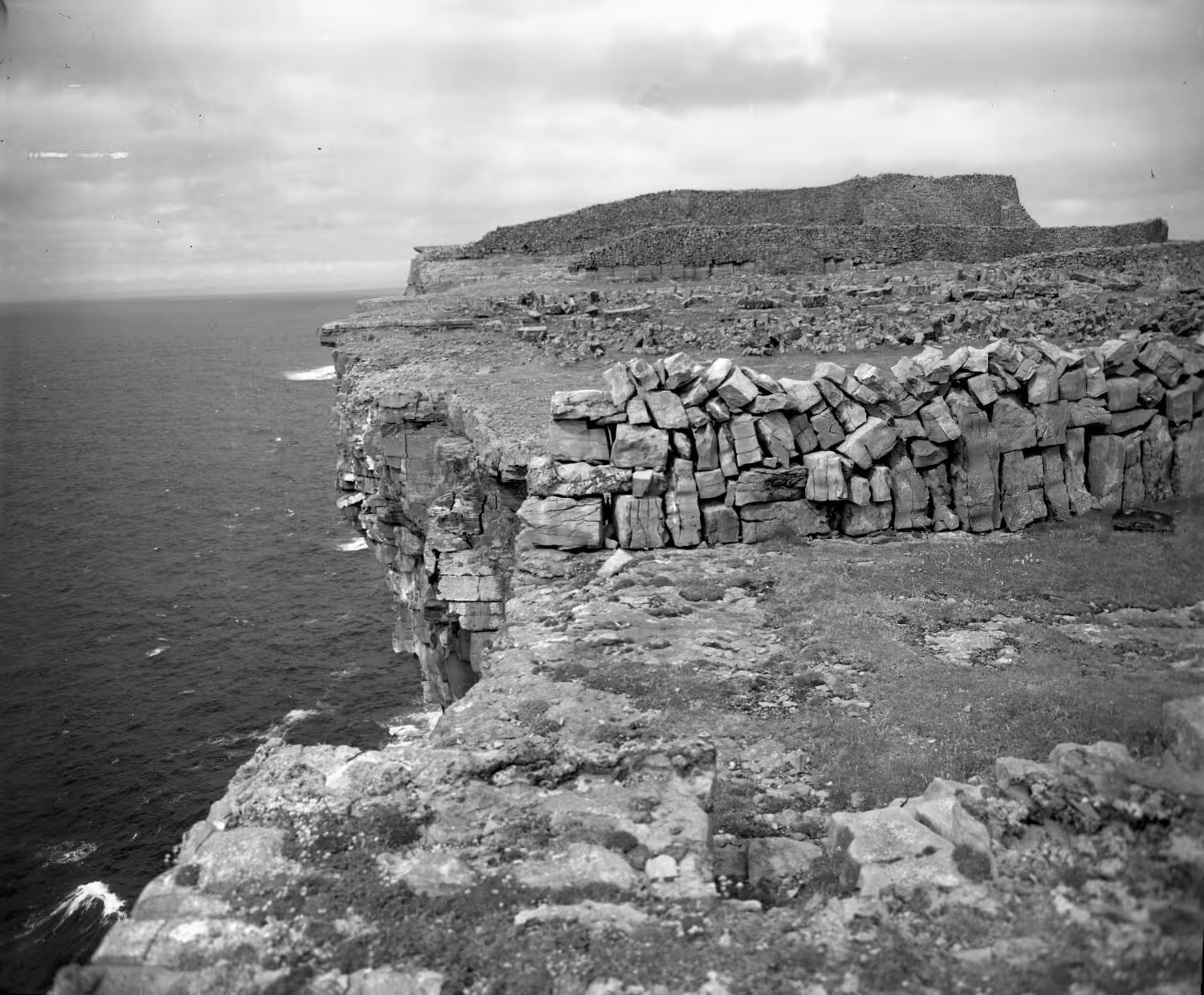
There are few more exhilarating sites that standing on Ireland’s west coast and staring out across the seemingly endless ocean before you. The chill breeze, pungent smell of kelp, cawing of gulls, and sound of crashing waves. It’s a scene that has stood still for millennia; a frozen tableau that Ireland’s ancient forbears would have enjoyed as much as we today. And it’s the scene that greets you at one of Ireland’s most remarkable sites: the Dun Aengus Fort (Dún Aonghasa).
Dún Aonghasa is located on the Arran Islands off the West coast of Ireland near Galway on the island of Inishmore. The original hillfort was constructed around 1000BC and there’s evidence of habitation right through the Bronze Ages, Iron Age, and into the early Medieval period up to the 10th century AD.
Historical Timeline of the Dun Aengus Fort
| Period / year | Event |
|---|---|
| c. 1100 – 800 BC | First inner enclosure constructed; charred timbers & pottery give Late Bronze-Age horizon. |
| 500 – 200 BC | Outer walls and chevaux-de-frise added; sling-stone dumps imply Iron-Age conflict. |
| AD 500 – 700 | Re-occupation; hearths cut into earlier debris; glass beads & bone comb suggest high-status use. |
| 1684 | Roderick O’Flaherty’s Ogygia first antiquarian description; fort called “Dun Ængus”. |
| 1880 | State guardianship (Board of Works) begins; minor consolidation. |
| 1992 – 1995 | Claire Cotter leads Western Stone Forts Project excavations & conservation. |
| 2005 – 2007 | OPW installs cliff safety barrier, paths & visitor centre. |
| 2023 | Digital photogrammetry survey published (Heritage Ireland) – updated 3-D model online. |
Mythical beginnings
Dún Aonghasa, meaning ‘Fort of Aonghas’, likely refers to King Aonghus mac Úmhór who ruled the ancient Fir Bolg peoples of Connacht. After the Fir Bolg were defeated by the invading Tuatha De Danann, legend states, King Aonghus built this fortress for his people as they settled of the coast of Connacht.1
“The Fir Bolg fell in that battle all but a few, and they went out of Ireland in flight from the Tuatha De Danann, into Ara, and Ile, and Rachra and other islands besides….[F]rom them are named those territories…[including] the Fort of Oengus in Ara from Oengus.”2
While the myths tell us little about the actual composition or history of the hillfort, it does reinforce its significance. For the fort, like those other ancient sites of Tara, Rathcroghan or Emain Macha, was of sufficient political importance to be placed within the earliest mythological narratives of Ireland. To understand the wider context of these myths then requires turning to the archaeological evidence.

Archaeology of Dun Aengus: Formidable fortification
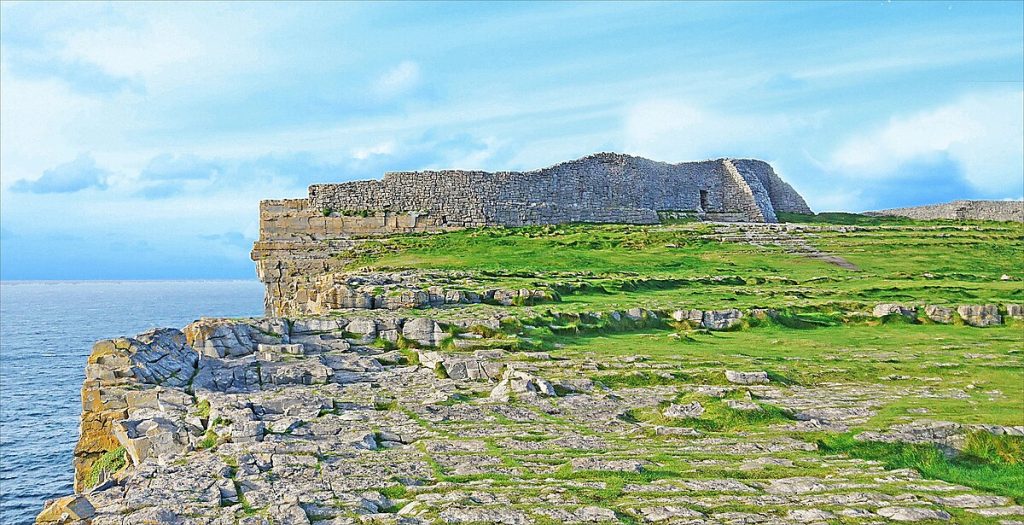
The hillfort would have required significant labour to build as “a costly signal of power of the local elite”.3 Consisting of three walled fortifications containing a mixture of domestic structures, the fort was one of the largest in Ireland. The outer, middle and inner walls form three semi-circular enclosures which terminate abruptly at the cliff-edge; a sheer 100m high drop today. Some have estimated – due to lower sea levels at the time of construction, that the cliffs may have once been an incredible 1000m high, though I personally find this unlikely for many ecological and geological reasons.
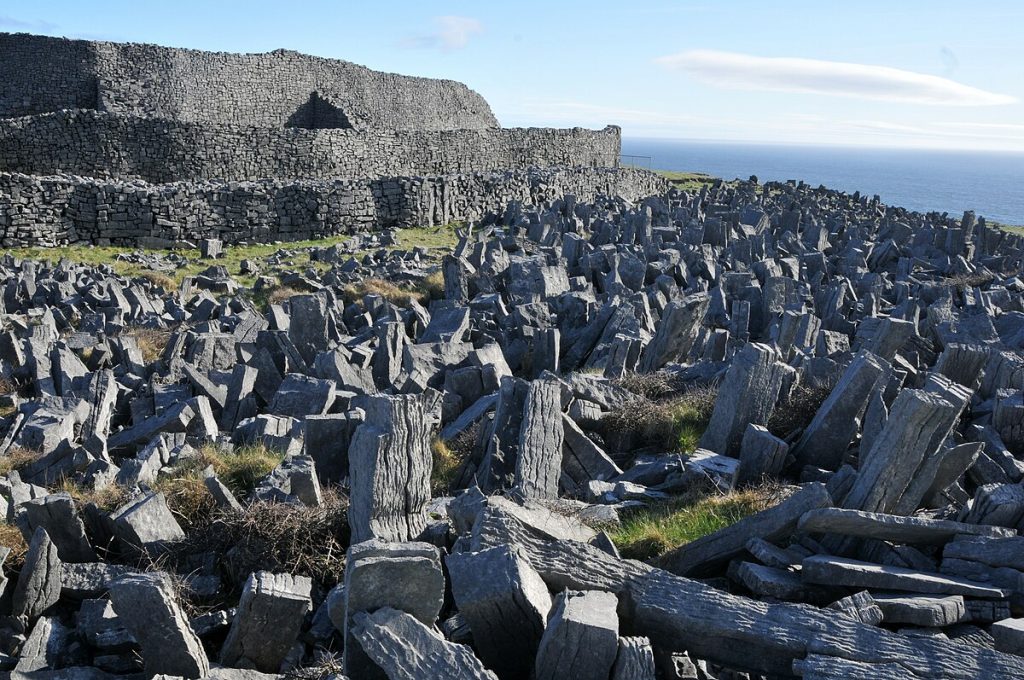
Besides its breathtaking location against the cliffs, the fort has a series of remarkable stonework defensive features. An array of stone slabs have been set in place around the middle enclosure, some as large as 2m tall. As a result, any approaching army would have been forced to break apart their shieldwall greatly undermining their defensive advance. The technical term for such a feature is a chevaux de frise, meaning Frisian horse, as such structures have historically been employed as anti-cavalry defences right up to the 19th century (think of barbed wire barriers). To have gone to the effort of constructing such an impressive defensive feature suggests this was both a deeply contested territory and one worth protecting.
Comparison between Dun Aengus and other Hillforts
| Fort | Secure date-range | Notable feature(s) |
|---|---|---|
| Dún Aengus | c. 1100 BC (LBA) → additions up to early medieval | Cliff-edge truncation, Western Stone Forts excavation (1992-95) |
| Staigue Fort | 300 – 400 AD (radiocarbon charcoal) | Intact stairways; surrounding ditch absent |
| Grianán of Aileach | Built 6th–8th c.; rebuilt 1870s | Triple wall passages; royal inauguration site |
| Dún Dúchathair | Iron Age (c. 500–200 BC) | Interior terracing, twin gateways |
| Caherconnell | 10th–12th c. (AMS dates) | Evidence for metal-working & cattle corrals |
Copyright: Tuoermin
Ancient trade hub
It was strategically placed to control Atlantic maritime trade corridors, some consisting of long-distances far beyond the Irish shores as far afield as Northern Italy.4 Examples include “Beads made from Baltic amber” and a wide variety of exotic bronze objects.5 The hillfort’s location was strategically placed to “dominate seagoing traffic and serve as an economic hub for maritime exchange along the west coast”.6 In other words, it acted as an ancient Irish market-town. Travelling merchants would have been able to rest and recuperate at hostels and lodgings, trading their goods at local markets, before then moving on.
Notably, there were a range of moulds discovered on site alongside metalworking debris which indicate metalworking on the island itself on an industrial scale. Many of these objects were likely produced, not merely for the immediate locality, but as part of a thriving trade network with Europe. Indeed, the archaeological excavations at the site have identified an incredible array of over 2,900 artifacts.
Archaeological Finds at Dun Aengus
| Find category | Quantity / items | Date attribution |
|---|---|---|
| Coarse-ware pottery sherds | 176 stratified fragments | Late Bronze Age |
| Glass beads (blue & amber) | 5 complete; 3 frags. | Early Iron Age |
| Bronze socketed spearhead tip | 1 fragment | c. 800–600 BC |
| Bone points & needles | 22 | LBA–IA |
| Hammer-stones & pounders | 47 | Multi-phase |
| Charred barley & emmer grains | 310 grains (multi contexts) | 14C 920–810 BC |
| Sheep/goat, cattle, pig bone | 4.8 kg assemblage | LBA core |
Regional centre of power
Hillforts located on neighbouring islands show remarkable similarities but all on a much smaller scale. This has led archaeologists to suggest that Dún Aonghasa was likely a regional power centre over this network of small islands and nearby coastland.7 Interaction between regional chiefs would have been episodic, likely at important festivals and religious occasions. Evidence of feasting at the site indicates it had a “ritual significance”.8 For instance, pig bone found on site indicates it was imported (given the island hadn’t the tree coverage to support a pig population) and so was brought possibly by other elites “for communal feasting events”.9
Given its economic importance as a trade hub and industrial centre (at least in metalworking), alongside its strategic defensive importance at the boundaries between the Kingdoms of Connacht of Munster, it would have undoubtedly played a critical role in the politics of the wider region. Whatever chief ruled there would have profound implications on much further afield than the islands and coastland. And the remaining walls and scale of the site today only serves to reinforce this impression.
Dún Aengus Today
Since 1880 the Irish Government has taken over the management of the site and it is now open to the public to visit. Ferries run regularly to the island and there’s a variety of accommodation available to stay on site. For more visitor information see here.
Frequently Asked Questions: Dun Aengus
Radiocarbon and artefact evidence place initial construction in the Late Bronze Age (c.1100 BC), with Iron-Age and early-medieval modifications.
A dense band of tall, sharpened upright stones encircling the fort to slow attackers—unique among Irish ringforts.
Approximately 100 m (330 ft) above sea level at its seaward edge.
Claire Cotter directed major excavations in the 1990s under the Western Stone Forts Project.
Yes—managed by the Office of Public Works; adult admission €5 as of 2025.
Dún Aonghasa stone fort, pointcloud < 1% by The Discovery Programme on Sketchfab
- DALTON, J.P., 1928. Who built Dun Aengus?. Journal of the Galway Archaeological and Historical Society, 14(1/2), pp.52-77. ↩︎
- Extract from the Lebor Gabála Érenn: The Book of Invasions. Available at: https://www.maryjones.us/ctexts/lebor3.html ↩︎
- Quinn, C.P., Kuijt, I., Goodale, N. and Néill, J.Ó., 2019. Along the margins? The later bronze age seascapes of Western Ireland. European Journal of Archaeology, 22(1), pp.48. ↩︎
- O’Driscoll, J., 2017. Hillforts in prehistoric Ireland: a costly display of power?. World Archaeology, 49(4), pp.10. ↩︎
- Quinn et al., 2019:57. ↩︎
- Quinn et al., 2019:59. ↩︎
- Quinn et al., 2019:60. ↩︎
- O’Driscoll, 2019:11. ↩︎
- O’Driscoll, 2019: 12. ↩︎
YOU MAY ALSO LIKE
 Ancient Irish Society: Language, Law & the Structures of Kinship
 Iron Age Clothing in Ireland: What People Really Wore
 Iron Age Trade in Ireland: Networks, Imports, and Economic Life
 Iron-Age Hillforts in Ireland: Daily Life, Purpose & Key Sites
 Irish Festival Names Explained: The Etymology of Samhain, Imbolc, Bealtaine and Lughnasadh
 Ogham Tree Alphabet: Irish Script, Meaning & Origins
 Ancient Roads of Ireland – 5 Slíghe (Highways) Radiating from Tara
 Who was St Columba? Missionary, Monk, and Legend of Iona