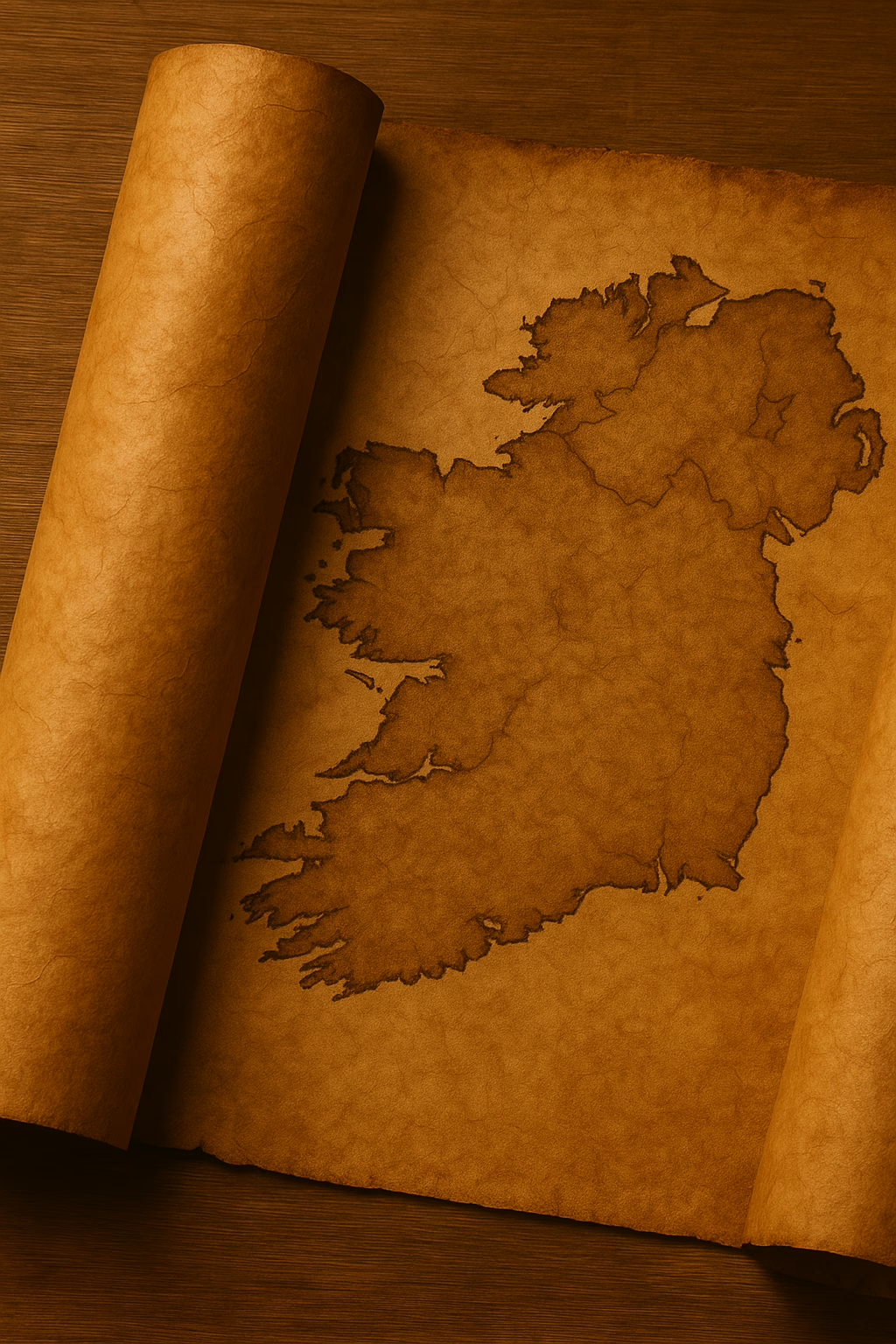
In Ireland every and hill, every town and settlement, carries a name that echoes history. Irish placenames (logainmneacha in the Irish language) often preserve layers of pre-Christian, medieval, and mythology in a single word. In many cases a place-name name literally describes an ancient feature or tells a story. Whether it’s the Hill of Tara’s name Teamhair na Rí (“Tara of the kings”) reflecting its status as the inauguration site of legendary High Kings or Rathcroghan (Ráth Cruachan, “fort of Cruachan”) preserving the name of an ancient sovereignty goddess and royal seat in Connacht, these placenames reflect the ancient history and mythology of Ireland.
Being based in the structure of language, however, they present an incredible codex to understand Irish ancient history, like a form of linguistic archaeology. For – when you understand the rules – you can unlock a whole world of understanding which lies hidden in plain sight.
Ancient Origins and Functions of Irish Placenames
Almost all modern placenames in Ireland derive from Irish Gaelic. Today’s English or Anglicised names are simply adaptations of older Irish terms. As a result, the study of toponyms1 reveals much about Ireland’s history and geography. During the early Gaelic period, there were very few large towns, so villages and fields were usually named after prominent features of the landscape – hills, rivers, woods or forts.
Later, with the coming of Christianity and the Anglo-Normans, names also commemorated churches, saints, castles or families – my own surname is a good example of this albeit of Scot’s Gaelic rather than Irish (Church of St. Patrick). In Irish, the element cill (anglicised kill- or kil-), meaning “church”, appears in hundreds of placenames (for example, Kildare = Cill Dara, “church of the oak”). Similarly, dún (“fort” or “stronghold”) appears in names like Dun Laoghaire or Dungannon, and rath (“ringfort”) and lios/lis (fort/enclosure) mark the many early medieval fortified settlements. Each of these Gaelic elements reflects how communities lived and defended themselves in the past.
Placenames and the Natural World
Apart from human settlements, many placenames simply describe natural geography. Common prefixes include cnoc (anglicised knock-, meaning “hill”), gleann (glen-, “valley”), inis *(Inch- or Inis-, “island”), port- (“landing place”), ard (“high, height”) and mullach (mull/, “bare summit”). For example, Knocknarea (Cnoc na Riabh, “speckled hill”) in Sligo and Glendalough (Gleann Dá Loch, “valley of two lakes”) in Wicklow contain such elements.
Even tree-names survive: doire (Derry, “oak wood”) and coill (Cool, “wood/forest”) mark sites of former woods, even where the trees are long gone. These descriptive elements ensured that placenames served as practical guides to the land. The table below summarises some of the most common Irish place-name elements, showing the Anglicised form, the original Irish word, its meaning and examples.
Table: Irish Placename Elements in Irish and English with their Meanings
| Element (Anglicised) | Irish | Meaning | Example(s) |
|---|---|---|---|
| Bally-, Bal- | baile | town, homestead | Ballymena (maighean, “plain”), Balgriffin |
| Kill-, Kil- | cill | church | Kildare (Dara, “church of the oak”), Kilkenny |
| Dun-, Doon- | dún | fort, stronghold | Dun Laoghaire, Dungannon |
| Rath- | rath | ringfort, enclosure | Rathmines, Rathkeale |
| Lis-, Liss- | lios | fort, enclosure | Lisburn, Lissan |
| Knock- | cnoc | hill | Knocknarea, Knockmore |
| Glen- | gleann | valley | Glendalough (Dá Loch, “of two lakes”), Glenmalure |
| Ard- | ard | high, height | Ardglass, Ardagh |
| Carrick- | carraig | rock, rocky outcrop | Carrickfergus, Carrick-on-Shannon |
| Inch-, Inis- | inis | island | Inchicore (Inis Cór), Inisheer |
| Drum-, Drim- | druim | ridge, back | Drumcondra (Droim Conrach), Drumkeeran |
| Cool-, Cúl- | coill, cúl | wood, corner, nook | Coolavanny (Coill an tSaithne), Culdaff (Cúl Dabhach) |
These examples illustrate how settlement terms (e.g. baile “town”, cill “church”, dún “fort”) combine with topographic words (cnoc “hill”, gleann “valley”, etc.). Together they reflect how early Irish people named places for both practical features and cultural significance. For instance, “bally-*” (< baile) heads thousands of village names (over 6,000 survive), while rath and lis mark the abundance of medieval ringforts.
In these ways, Irish placenames function as geographic and social signposts, recording the features of the physical landscape (hills, valleys, forests, waterways) and human activity (churches, forts, farms). Therefore, once you understand these simple linguistic ‘rules’ it unlocks a whole layer of understanding. But to fully appreciate this, we need to turn to their role in archaeology.
Irish Placenames & the Archaeological Record
Irish placenames often serve as linguistic signposts to ancient sites, guiding archaeologists toward prehistoric forts, ritual centres, and ceremonial landscapes. I often wonder at the history as I drive around and see signs for ‘rath’, ‘dun’, or ‘cairn’, each denoting a particular historical feature. But rather than document all of these placenames which others have already done, here we consider two examples to illustrate how names preserve echoes of ancient Irish history and even mythology.
Dún Aonghasa – A Bronze‑Age Promontory Fort
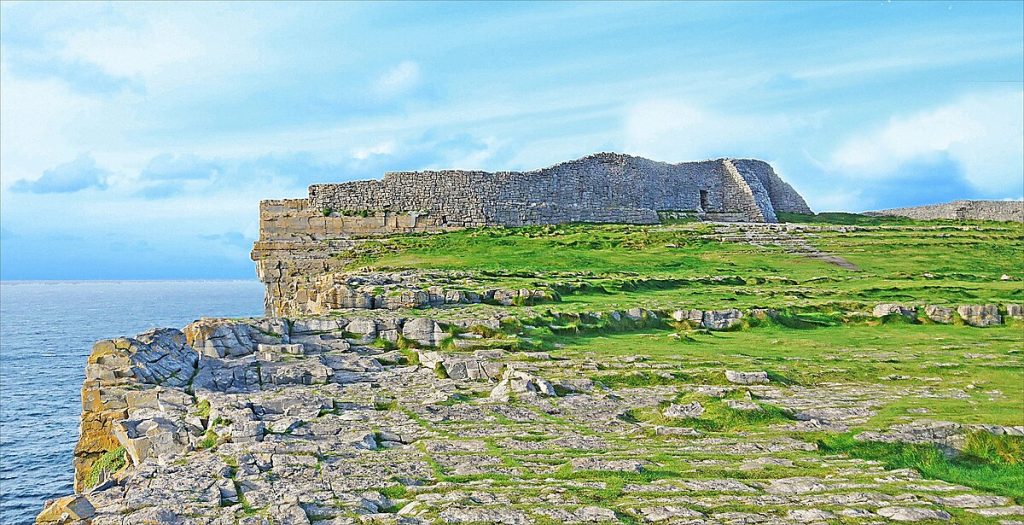
Perched dramatically on a 100 m cliff on Inis Mór, County Galway, Dún Aonghasa is one of Ireland’s most iconic Bronze Age promontory forts. Its name, Dún Aonghasa, means “Fort of Aonghas” — a reference believed to preserve either the pre‑Christian god Aonghus or the mythic Fir Bolg king Aonghus mac Úmhór. The Gaelic term dún signifies a fortified enclosure, a detail that aligns with its archaeological reality.
Excavations reveal that its earliest walls date to 1100 BC, constructed by erecting upright stones capped with rubble. Around 500 BC, the fort was significantly expanded, gaining three concentric dry-stone defensive walls, each up to 4 m thick, while a chevaux de frise—an ancient hedge of upright stone slabs—bolsters its fortifications.2 Artefacts such as an Iron‑Age fibula, burnt mounds and evidence of bronze‑casting moulds testify to the site’s prolonged use and complex function. Today, restored sections – clearly distinguishable by mortar – still stand, offering a vivid lens into prehistoric construction and ritual practices.
The very name, Dún Aonghasa, is a linguistic time capsule. The prefix dún flags a defensive purpose, while the personal name Aonghas links the site to pagan belief and possibly mythic leadership. This connection suggests the site held ritual significance, not just military utility — a hypothesis confirmed through its elaborate defences and archaeological finds that go beyond simple fortification.

Rathcroghan – The Royal and Ritual Landscape of Connacht
Located near Tulsk, Rathcroghan (Ráth Cruachan) is a vast archaeological and mythological complex said to have served as the ancient capital of Connacht. Its Irish name translates to “Fort of Cruachan,” and the landscape, covering nearly 6 km², contains over 240 identified monuments — 60 of which are designated national monuments. These range from Neolithic passage tombs (c. 4000 BC) to ringforts, burial mounds, linear earthworks, and medieval field enclosures. In Irish myth, Rathcroghan is intimately tied to the sovereignty goddess-queen Medb (Maeve) and serves as a site of ceremonial inauguration.
Linguistically, the prefix rath denotes a ringfort, a common structure in early medieval Ireland. The specific name Cruachan carries deep mythic resonance — the Dindshenchas and Ulster Cycle preserve tales of foes and fairs held at Cruachan. Archaeological exploration has reinforced this connection; for instance, the stone inauguration mound at Carnfree aligns with medieval historical accounts of royal enthronement at Rathcroghan, mirroring its legendary status.
Table: Placenames and the meanings for Prominent Ancient Irish sites
| Site (English Name) | Irish Placename | Meaning |
|---|---|---|
| Hill of Tara | Teamhair na Rí | “Sanctuary/height of the kings” |
| Rathcroghan | Ráth Cruachan | “Ringfort of Cruachan” |
| Dún Aonghasa | Dún Aonghasa | “Fort of Aonghas” |
| Emain Macha | Emain Macha | “Macha’s Twins” or “Macha’s Place” |
| Newgrange | Sí an Bhrú | “Fairy mound of the palace” |
| Loughcrew | Slíabh na Caillí | “Mountain of the Hag/Witch” |
| Knocknarea | Cnoc na Ríabh (likely) | “Hill of the speckled/striped ones” |
| Uisneach | Uisneach | (Possibly) “High place” or “Place of knowledge” |
| Dún Dealgan | Dún Dealgan | “Fort of Dealgan” |
| Cashel | Caiseal Mumhan | “Stone fort of Munster” |
By examining logainmneacha [placenames] such as these, we see that the language anticipates archaeological discovery. Terms like dún and rath reliably point to structural remains, while the attached proper names preserve essential aspects of myth, ritual and identity long after physical evidence might have eroded. This synergy between place‑name and physical archaeology confirms how language is intimately woven into the fabric of Ireland’s ancient heritage.
Mythology & the Place‑Name Tradition
Irish placenames often convey mythological narratives – embedding the deeds of gods, heroes and supernatural events into physical locations. Central to this tradition is the Dindshenchas (literally “Lore of Places”), a medieval compendium of verse and prose prosegea tracing the origins of more than 200 placenames, many steeped in pre-Christian mythology. Compiled between the 11th and 12th centuries, and surviving in manuscripts such as the Book of Leinster, the Dindshenchas remain an essential resource for scholars of Irish mythology and toponymy alike.
The texts of the Dindshenchas are carefully crafted as mnemonic guides—not objective historical records, but narratives woven to elucidate why a place bears its name. One example recounts how Loch Gabhar—often understood as “lake of the two goats” or “lake of the two horses”—gained its name after King Eochu’s horses drowned there. This story – preserved in the Metrical Dindshenchas – corresponds with a known crannóg at Lagore, where excavations have revealed early medieval royal occupation and artefacts such as the prestigious Lagore Brooch.
Mythical Places in Ireland
Many placenames similarly preserve stories of individuals or supernatural events. Croagh Patrick, originally called Cruachán Aigle (“Aigle’s little stack”), has its naming attributed to Aigle, a tragic Connacht prince, according to medieval lore. Though later Christianised as Cruach Phádraig, the mountain’s earlier pagan significance endures. Archaeology confirms this with Bronze Age cairns, ritual alignments and early remains—such as those at the Boheh Stone—showing it had spiritual importance long before Saint Patrick’s arrival.
Similarly, Mullaghmast (Mullach Maistiu) features in the Dindshenchas as the “summit of Maistiu,” named after Maistiu’s husband Dáire Derg, who was said to be betrayed there. Archaeologists have identified prehistoric standing stones and signs of later royal assembly, confirming its longstanding ceremonial significance.
Other toponyms evoke divine patronage or supernatural guardianship. Names like Cashelmanannan and Carrickmannon, translating respectively to “Manannán’s fort” and “Manannán’s rock,” link landscapes to the sea‑god Manannán mac Lir. These sites—found along Irish, Isle of Man, and Scottish coasts—suggest that local communities attributed sacred or protective qualities to them, a belief reinforced when stone forts and natural outcrops coincide at these locations.
Table: Prominent Irish placenames with Mythological Roots
| Placename (English) | Irish Name | Meaning | Mythological Reference |
|---|---|---|---|
| Emain Macha | Emain Macha | “Twins of Macha” or “Macha’s place” | Named for Macha, a sovereignty goddess who cursed the men of Ulster |
| Ráth Cruachan | Ráth Cruachan | “Ringfort of Cruachan” | Named for Cruachan, an Otherworld queen/goddess; seat of Queen Medb |
| Dún Aonghasa | Dún Aonghasa | “Fort of Aonghus” | Fort linked to Aonghus Óg, god of love and youth in the Tuatha Dé Danann |
| Brí Léith | Brí Léith | “Hill of Lugh/Leith” | Associated with Lugh, god of light and skill, and Lughnasadh festival traditions |
| Cashelmanannan | Caiseal Manannáin | “Fort of Manannán” | Named for Manannán mac Lir, god of the sea and guardian of the Otherworld |
| Sí Femen | Sí Femen | “Fairy mound of Femen” | Mound associated with Fand and the Tuatha Dé; Otherworld site in the Tochmarc Emire |
| Lios Dána | Lios Dána | “Fort of the Poetic Art” | Refers to the Tuatha Dé Danann, often called the aos dána (“people of art”) |
| Ben Bulben | Binn Ghulbain | “Peak of Gulban” | Mythic name linked to warrior Diarmuid Ua Duibhne in the Fenian Cycle |
| Carn Manannán | Carn Manannáin | “Cairn of Manannán” | Burial or sacred site associated with Manannán mac Lir, often found in Manx lore |
| Dún Sobhairce | Dún Sobhairce | “Fort of Sobhairce” | Named after Sobhairce, a mythological High King of Ireland (Fir Bolg tradition) |
Interpreting Irish Placenames Today
Irish placenames (logainmneacha) do far more than serve as simple labels. In embracing and decoding them, we gain a multi-layered view of the past—one that links ancient landscapes, settlements, and mythology. These names invite us to look not merely at where we are, but who we were, how we lived, and what we revered. They remain among our most valuable tools for reading the landscape and understanding the history of ancient Ireland.
For those who want to explore more about Irish placenames, I’d strongly recommend delving into the Placenames Database of Ireland (logainm.ie). For more on ancient Irish history or mythology, please check out my other posts, or signup to my monthly newsletter below.
Frequently Asked Questions: Links between Irish Placenames and Ancient Irish History and Mythology
Many Irish placenames directly preserve mythological names—such as Dún Aonghasa (“Fort of Aonghus”) and Cashelmanannan (“Fort of Manannán”). These names often mark sites linked with deities or legend figures and align with tales compiled in medieval sources like the Dindshenchas, underscoring their deep archaeological and narrative significance
Not all. While a significant number preserve myth names or legendary origins, most placenames are descriptive of geography or medieval land use—such as Gleann (valley), Cnoc (hill) or Baile (homestead). Nevertheless, even these descriptive names often reflect centuries-old human interaction with the landscape, offering layers of cultural insight.
The Placenames Database of Ireland (logainm.ie) is the most authoritative source. It provides bilingual entries, historical forms, etymological explanations, audio pronunciations, and map references for tens of thousands of Irish and English names.
The Dindshenchas (“Lore of Places”) is an 11th–12th-century anthology of verse and prose explaining the origins of Irish placenames. These stories blend mythological tales with geography, helping to toponymically anchor legendary events and figures to specific landmarks—like the naming of Loch Gabhar (“Lake of the Two Goats”) after a mythic drowning event.
Gaelic place-name elements like dún (fort), rath (ringfort), and cill (church) often denote early defensive, residential, or ecclesiastical sites. Modern archaeology has repeatedly discovered Bronze-Age forts, Neolithic tombs, and early medieval monasteries at locations predicted by such names—validating their use as practical indicators of ancient activity.
- This is the study of a place name, particularly those which denote a physical feature like a hill or river. ↩︎
- For more background see: https://irisharchaeology.org/dun-aonghasa/ ↩︎
YOU MAY ALSO LIKE
 Etymology of Irish Festivals
  Irish Hillforts: Ancient Fortifications of Ireland
  How old is the Rock of Cashel?
  Book Review: A smaller social history of ancient Ireland, P.W. Joyce
  What were the Irish war chariots?
 How old is Newgrange and who built it?
  Tuatha Dé Danann: The 12 Legendary Irish Gods