Last Updated: 10 September 2025
Life in an Iron Age hillfort in Ireland is hard for us to picture today. With some 1,500 years of history in between, it’s difficult to underestimate the great social chasm that time lays between us and our ancestors. And yet, for any who have the eyes to see, all around us stand ancient monuments to this forgotten past.
These hillforts stand as great oddities within our cities and towns, towering over urban and rural landscapes alike. But if we but take a moment to pause and consider what they represent, we may yet discover much more about ourselves than we realise. To do that, we need to wind the clock back some 2,500 years, to the zenith of the Irish Iron Age hillfort.
Morning: The Hillfort At First Light
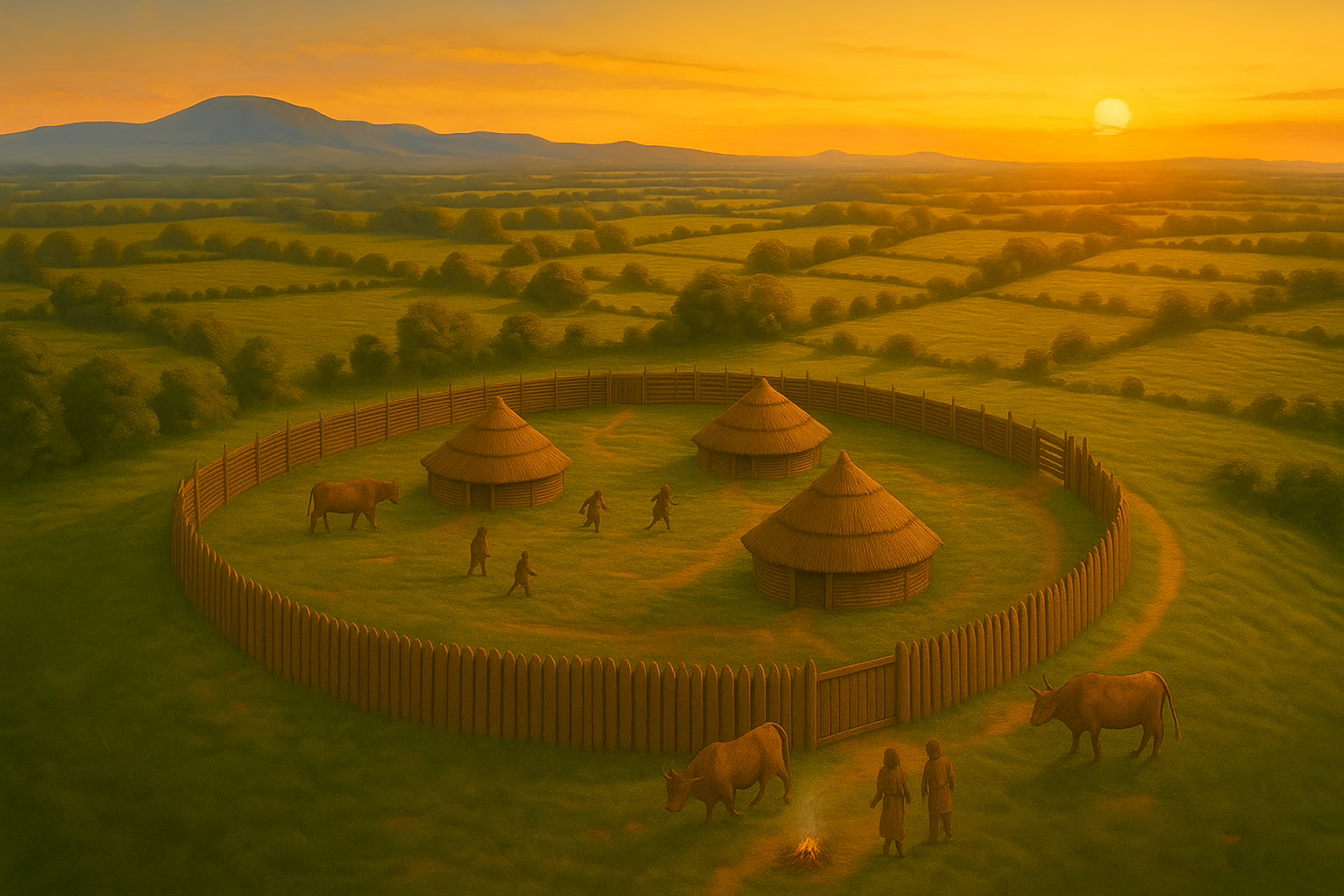
2,500 years ago, standing atop the fort’s gateway platform, you can see a beautiful panoramic scene before you. Immediately outside lies open pasture, forests cleared to provide the abundant resources needed to build your home. Where these dense forests once stood, now herds of cattle can be seen grazing lazily in the open pasture. The bubbling waters of a nearby river can be heard, the main fording point strategically located just by the fort. Water-gatherers are making the journey down to the river-bank, while fishermen are laying traps. Traders are carefully traversing the stepping stones at the ford, before making their way to the fort for rest and shelter.
Raising your eyes a little further, you can see the outlines of neighbouring forts with their signal fires ready to herald danger. Off to the east and west these neighbouring forts rise, a phalanx of wooden sanctuaries to deter the ever-present threat of cattle-raiding. You glance down to check that your warriors are at their post in the gateway. No-one comes in without their appraising consent.
A chill wind blows past. As you pull your cloak more tightly around you, you thank the gods that down in the fort it is at least protected from these gales. With the buildings and the fort itself all facing east, you know the worst of the wind-bite cannot penetrate its protective walls. But from your vantage-point on the fort’s walls, there is no such luxury.
Hillfort Industry: Trade and Craft
Then the sound of iron being worked rings out, drawing your attention to life inside. Fainter, but still distinct, are the hammer-strikes of the carpenters and bone-workers, each fashioning the daily essentials for the settlement. Your hand instinctively goes to the armlets encircling your wrist. Their cold faces feel reassuring, each a symbol of your power and position.
You smell the acrid smoke from homestead cooking fires which seem to be ever smouldering. Shouts of children playing with hurley sticks rise and fall, as fights break out and break up. You just pray your own son has more sense.
At the fort’s centre stands your home, a great oak hall befitting your reputation and honour. Last night’s guests are still sleeping off the banquet. Your own mind feels groggy from all the ale and wine before you remember that’s why you came up here in the first place – to clear your head. Only then do you see the smoke rising on the horizon and realise the significance of what this means.
Martial Life in the Iron Age Ireland
Popular imagery of ancient Ireland typically commits one of two errors: either it portrays Ireland as this peace-loving pagan wonderland, or as a European wild-west where the only law was the sword. Both have some truth, but are also equally misleading. For the evidence we are getting from archaeology and historical research is much more nuanced, and Irish hillforts are a good illustration of this.
Historically the hillfort, by its very name, has been equated with a military fortification. Indeed, our understanding of fortifications conjures up the modern notions of large-scale wars and battles. But in ancient Ireland, the greatest physical threat was from cattle-raids and sea-raiders. And the greatest commodity in Ireland was their cattle. These forts, in effect, became a sort of prehistoric ‘bank’. They were a way of securing your investment and wealth against the threat of raids, not war.
Communal Defence of Iron Age Hillforts
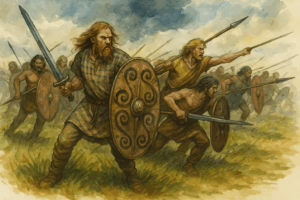
The first sign of raiders would have resulted in all cattle being herded inside along with any locals. The gate would have been barred and slingers posted to defend the walls. But even if they were unable to get the cattle inside, forts were often built within sight of each other. If one were attacked, the others would be able to react before they too fell victim to the same raid. Alongside closing up their defences, they could combine forces and come to their neighbour’s aid.1 This form of ancient collective defence, is much like a localised version of NATO – strike one and you strike them all. The ancient Irish had a wonderfully advanced approach to deterrence which contemporary strategists could learn much from. But this is where the application stops, for raids are very different to wars and battles.
A concerted effort to take a hillfort, even the most well-defended one, would take but a few days at most. Wooden palisades burned. Irish hillforts typically were not large enough to support a significant fighting force to repel attackers. To house and provision a standing army was beyond the means of nearly all chiefs (except perhaps the Kings). Only a small household guard would have been retained.
These sites were not, therefore, primarily defensive fortifications as much as they were settlements and manifestations of political and economic power.
Functions of Irish Iron Age Hillforts
| Hypothesis | Supporting evidence | Counter-arguments |
|---|---|---|
| Permanent defensive settlements | Ramparts, strategic heights | Few storage pits; seasonal house footprints |
| Seasonal assembly & feasting centres | Massive middens; absence of winter refuse | Still need defence vs raiders |
| Ceremonial / kingship inauguration | Timber temples at Knockaulin; weapon deposits | Not all forts show ritual layers |
| Craft / industrial hubs | Bloomery slags, crucibles at several forts | Craft also exists in lowland farmsteads |
Building Iron Age Hillforts
If cattle could be protected, this allowed for a concentration of economic power. So protecting your herd meant protecting your political status and that of your region. Nearly all ancient Irish myths and stories describe wealth in terms of the size of cattle herds. The ancient Irish Brehon laws refer to cattle as a measure of trade. Restitution was measured in cattle. In this way, Irish hillforts were a way of consolidating your political and economic power. They symbolised and realised your status and position.2
But they were also much more. Placed strategically at key fording points and passes, hillforts controlled access to important trade routes and resources. By doing so, they protected these critical routes from raiders, bandits and rivals. It’s been well-established now that ancient Ireland had thriving trade with the rest of Europe as well within the whole of Ireland. Free, unencumbered travel was essential for this. Traders had to know they would be safe travelling through territory, otherwise they wouldn’t risk their wares. Securing strategic locations therefore fostered this to develop, as well providing the necessary hostels and resting points travelers would require.
Irish Hillforts: Archaeological Evidence
Understanding Irish hillforts today requires considering the emerging archaeological evidence and historical record.3 Considerable academic and political attention is revealing fascinating new discoveries.
Ramparts and plans. Most forts occupy natural knolls and enclose 1–13 ha behind one to three concentric ramparts. Freestone Hill (Co Kilkenny) has a single earthen bank and fosse 90 m across; Rathgall (Co Wicklow) and Ballylinan employ drystone walls, while Dún Aengus (Inis Mór) adds a chevaux-de-frise—upright stones that impeded attackers.
Internal structures. At Rathgall, sub-floor slot trenches and stake-rings indicate roundhouses 6–8 m in diameter, yet hearth dumps and arc-shaped gullies suggest these buildings were occupied only seasonally. Knockaulin (Dún Ailinne, Co Kildare) produced rings of 200–300 post-holes interpreted as successive timber temples rather than dwellings, reinforcing a ceremonial function.
Artefacts and diet. Middens inside Rathgall’s innermost wall yielded over 18 kg of butchered cattle and pig bone and carbonised barley—all summer/autumn kill-off—pointing to periodic feasting. Freestone Hill’s ditch produced 256 La Tène brooches, a copper-alloy sword pommel and Roman glass, indicating elite display and long-distance contact. Dún Aengus yielded cobalt-blue glass beads and bronze cauldron fragments; slag and tuyère fragments at Caherconnell show on-site iron smelting.
Taken together, the securely dated layers point to irregular assembly sites—part refuge, part arena for feasting, exchange and sovereignty rites—rather than permanently inhabited hill-top settlements.
Table of Archaeological finds linked to Iron Age Hillfort functions
| Category | Indicative activities | Example forts |
|---|---|---|
| Domestic structures | Cooking, sleeping, craft | Rathgall, Freestone Hill |
| Craft & metallurgy | On-site iron/bronze working | Caherconnell, Knockaulin |
| Feasting debris | Seasonal communal events | Rathgall, Dún Aengus |
| Imports / prestige | Long-distance exchange, status display | Dún Aengus, Freestone Hill |
| Ritual deposits | Ceremonial offerings, kingship rites | Knockaulin, Tara (comparative) |
Why Iron Age Hillforts Matter Today
Understanding how our ancestors lived gives us a mirror to look at how we live today. It lets us step into their lives and meet ordinary people who left no diaries or castles—only bones, beads, and burnt hearths.
Their choices shaped today’s landscape: cattle trails became townlands, cleared hilltops still crown our skylines, and long-ago feasts echo in modern community fairs. Understanding how these early farmers shared food, forged alliances, and worshipped the natural world, reminds us that cooperation and celebration are as old as the hills themselves.
Frequently Asked Questions: Life in Iron-Age Hillforts in Ireland
A defended settlement with earthen or stone ramparts built on a height for security, ceremony and display, typical of c. 800 BC – AD 200 in Ireland.
Excavations at Rathgall and Freestone Hill show seasonal roundhouses and large feasting middens, suggesting some may have seen periodic rather than year-round occupation.
Recent research sees them as tribal centres—part ritual arena, part political hub—rather than purely military forts.
The Atlas of Hillforts lists just over 500 Irish examples, far fewer than Britain’s 2,500+.
Yes—there are countless ones open to the public, but notable ones include Dun Aengus (Aran Islands) and Rathgall (Co. Wicklow) which have public access with interpretive panels.
- M, Stout., 1997. The Irish Ringfort. Dublin: Four Courts Press. ↩︎
- O’Driscoll, J., 2017. Hillforts in prehistoric Ireland: a costly display of power?. World Archaeology, 49(4), pp.506-525. ↩︎
- One of the most exciting examples is the Atlas of Hillforts discussed here: https://www.archaeopress.com/ArchaeopressShop/DMS/A72C523E8B6742ED97BA86470E747C69/9781789692266-sample.pdf ↩︎
YOU MAY ALSO LIKE
 What is the history of Rathcroghan?
  How old is the Rock of Cashel?
  Corrstown Bronze Age Village: Ireland’s Largest Settlement
  How old is Newgrange and who built it?
 Ancient Roads of Ireland – 5 Slíghe (Highways) Radiating from Tara
  Irish Hillforts: Ancient Fortifications of Ireland
  What is the history of Dunseverick Castle?