Last Updated: 14 October 2025
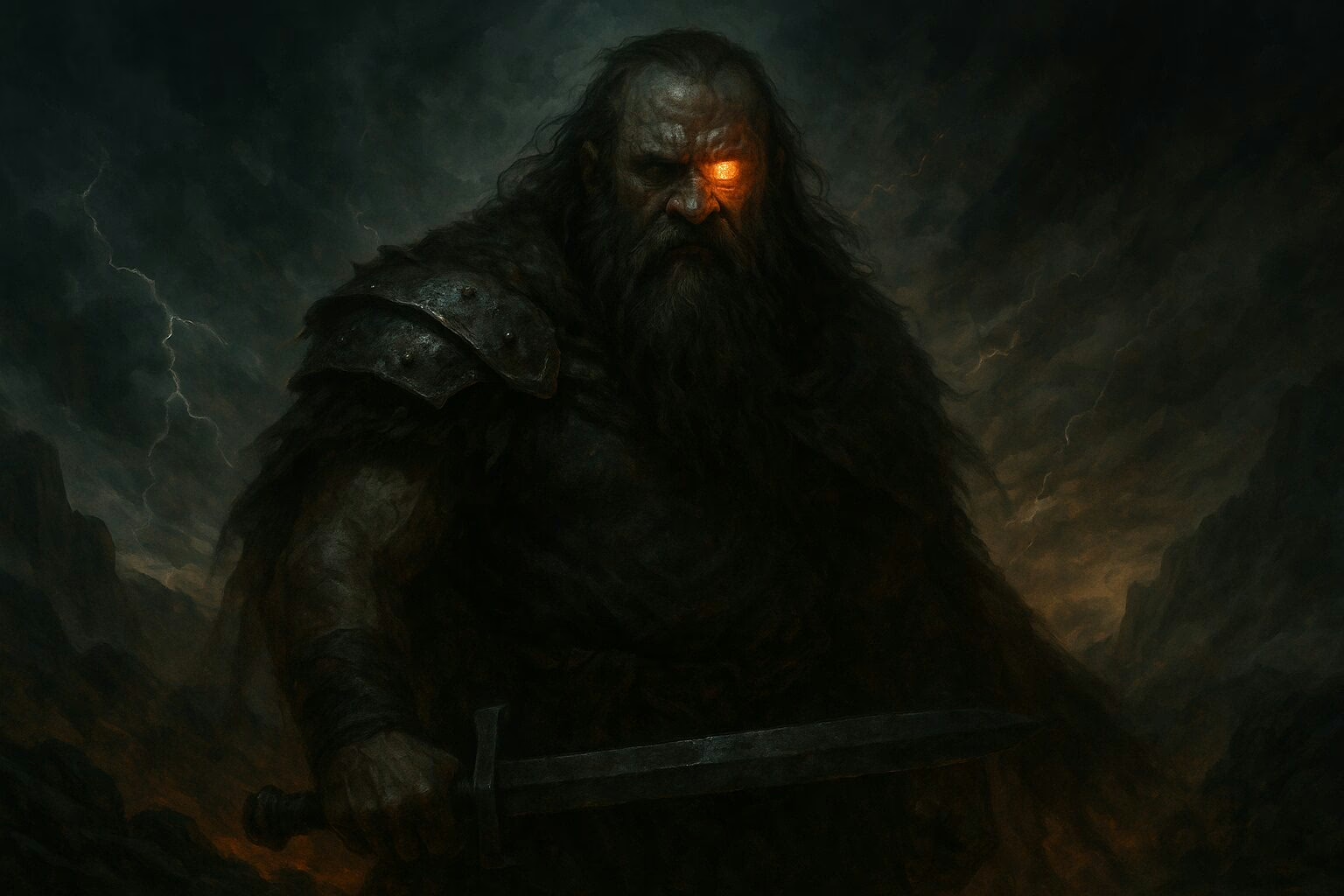
Right now you are reading these words using your eyes, embodying the many proverbs about how our eyes are a ‘window into the soul’. What we see quickly shapes what we become. And the ancient Irish had a sophisticated metaphor for this truth, embodied in the Irish god of destruction – Balor of the Evil Eye. A monstrous being of immense power, Balor was king of the Fomorians — the ancient race of chaos and oppression who stood in opposition to the Tuatha Dé Danann. His name evokes terror, and his gaze was said to bring death itself. In many ways, he is the epitome of evil and antithesis of wisdom.
Unlike the radiant gods of skill, craft, or healing, Balor embodies raw, ruinous force. His eye — a single, lid-bound orb — required multiple warriors to open, and when unveiled, it scorched battlefields and annihilated life. In myth, this eye is not just a weapon but a symbol of fear, of the destructive power of tyrannical rule, and of an ancient world on the cusp of being overturned.
In this post I explore the mythology of Balor: his origins, role as a god of destruction, and the enduring myth and meaning that surrounds his gaze. In doing so, we get a glimpse into how the early Irish understood wisdom, fate, and the dangers of unbridled power.
Balor’s Etymology
Names are a fantastic place to start when trying to understand the meaning and context for these ancient characters, and Balor is no exception. The name Balor (Irish: Balar) remains somewhat uncertain in origin. Linguists have proposed several interpretations, reflecting the complexity and ancient origins of the character. One widely cited explanation connects the name Balor with the Old Irish bal–ni, meaning “death”. This interpretation fits aptly with his destructive power, particularly his notorious “evil eye,” capable of causing death and ruin simply by opening.
Another interpretation suggests a possible relationship to the Proto-Celtic root *bel-, meaning “bright” or “shining,” which interestingly contrasts his darker destructive traits. This root appears in various Celtic names and terms relating to brightness, fire, or brilliance. Given Balor’s association with a fiery, devastating gaze, this etymology aligns with his mythic imagery. Though I’m less convinced by this line of argument as it is typically associated with the figure of Belanus or Bel himself.
Thus, while the exact etymology remains open to scholarly debate, both suggested interpretations—the destructive “bal” and the fiery “bel-“—highlight Balor’s fundamental character as a figure who embodies both death and destruction through a powerful and terrifying gaze.
Who is Balor? Mythological Origins and Lineage
In Irish mythology, Balor belongs to a dark and ancient bloodline. He is said to be the son of Buarainech (meaning ‘cow-faced’), a shadowy figure among the monstrous Fomorians. Balor takes Cethlenn (meaning ‘of the crooked teeth’) as his consort—herself a formidable being whose name echoes in Irish placenames like Inis Ceithleann (Enniskillen).1
Balor himself is one of the most prominent leaders of the Fomorians, often portrayed as monstrous sea beings or deformed giants. They are neither wholly gods nor demons but represent primordial forces—chaos, darkness, famine, and the untamed elements of nature. Where the Tuatha Dé Danann brought knowledge and order, the Fomorians embodied brutality, hardship, and shadow. However, it’s worth noting that while the Fomorians are often described as grotesque or violent, figures like Elatha or Bres hint at more complexity—suggesting intermarriage, diplomacy, and shared ancestry between mythic peoples.
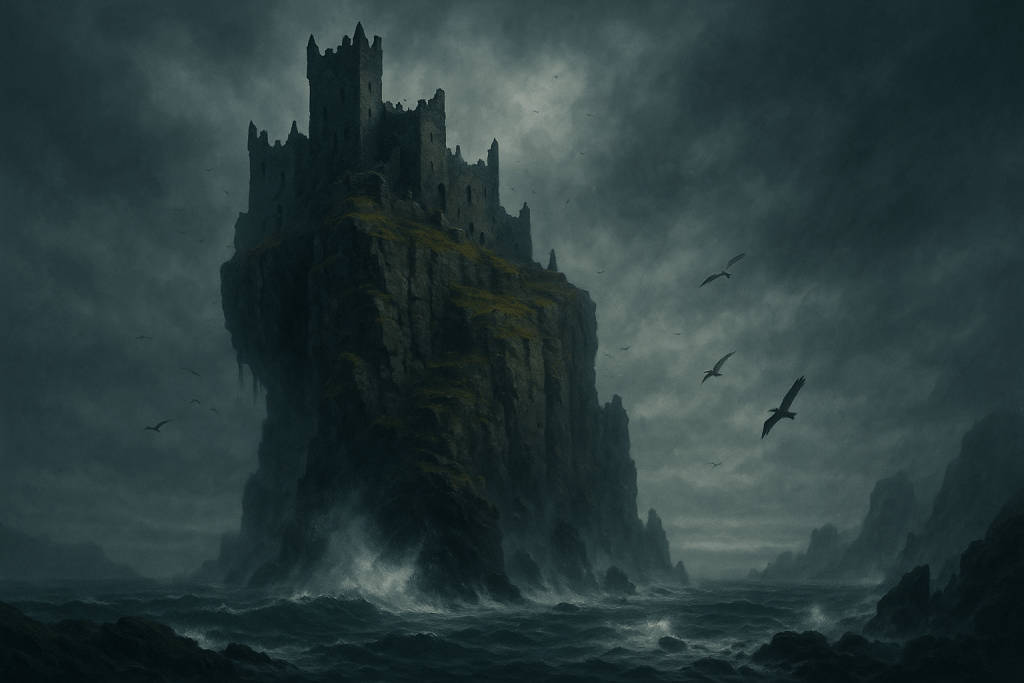
Balor ruled the Fomorians from Tory Island, an isolated, storm-battered rock off the coast of Donegal. This setting — remote, perilous, and steeped in folklore — reinforces his status as an outsider to the ordered world of Ireland.
While the Tuatha Dé Danann represent the flowering of civilisation, sovereignty, and skill, Balor and the Fomorians symbolise the raw, ancestral forces that must be overcome to achieve balance and renewal. As king of the Fomorians, Balor stands as their most fearsome embodiment: violent, resistant to change, and fated to fall. No where is this clearer than in the tragic tale of his daughter Ethne.
Table: Lineage and familial links to Balor
| Relation | Name | Description |
|---|---|---|
| Father | Buarainech (or Doit) | A shadowy Fomorian figure; not well attested outside genealogical mention. |
| Spouse / Consort | Cethlenn (Ceithleann) | A fierce Fomorian woman; her name survives in Irish toponyms like Enniskillen. |
| Daughter | Ethniu (Ethne) | Locked in a tower by Balor due to a prophecy that her son would kill him. |
| Grandson | Lugh | Hero of the Tuatha Dé Danann; slayer of Balor in the Second Battle of Mag Tuired. |
| Son-in-law | Cian | A member of the Tuatha Dé Danann; father of Lugh through Ethniu. |
Balor, Ethlinn, and the Birth of Lugh
It all begins with a prophecy. Warned that he will be killed by his own grandson, Balor seeks to control the future through confinement, locking away his only daughter, Ethlinn (also spelled Eithne or Ethne), in a tower or glass fortress on Tory Island. In some versions, the tower is guarded by twelve women; in others, by magical protections meant to keep all men away.
Yet, as is common in mythic traditions, the very act of trying to escape fate ensures its fulfilment. Ethlinn is discovered by Cian of the Tuatha Dé Danann, often with the aid of the druidess or enchantress Biróg, who uses magic to reach the tower. Cian and Ethlinn unite, and she bears triplets — a clear signal of divine consequence.
When Balor discovers the birth, he orders the children drowned. Two are cast into the sea, but one survives: Lugh, rescued by Biróg and fostered by Manannán mac Lir or Gavida the smith, depending on the version. The child is raised in secret, far from Balor’s knowledge.
Lugh’s survival marks a turning point in this tale. He is the light that escapes the shadow, the future that refuses to be buried. In defying prophecy, Balor ensures its truth. And in doing so, he becomes not merely a figure of dread, but a symbol of how the past, when it tries to suppress the future, must eventually fall.
One cannot help but be reminded of the Irish proverb:
Is fearr súil romhainn ná dhá shúil i ndiaidh.
“Better one eye ahead than two eyes behind.”
The Second Battle of Mag Tuired
The confrontation between Balor and Lugh reaches its inevitable conclusion during the Second Battle of Mag Tuired (Cath Maige Tuired), a mythic war between the Tuatha Dé Danann and the Fomorians for control of Ireland.
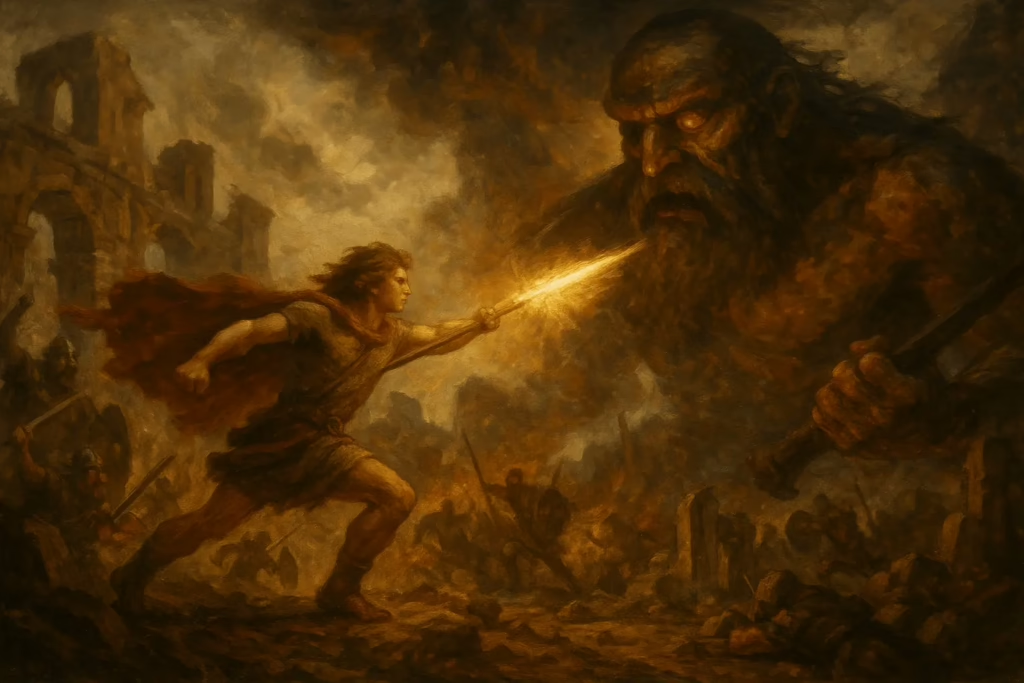
Balor, as king of the Fomorians, leads his force against the Tuatha, who serve under the leadership of Nuada, and later Lugh. When Balor enters the field, his monstrous eye is kept covered — a weapon of last resort. According to the myth, when the lid is finally lifted, the eye wreaks devastation across the Tuatha Dé Danann ranks. It is a moment of sheer destructive power, but also one of overreach — because in that moment, Lugh takes aim.
In various versions of the tale, Lugh uses a sling-stone, a spear, or his own brilliant skill in combat to strike Balor in the eye. In some accounts, the blow pierces the Evil Eye and drives it through Balor’s skull, causing it to turn inward and destroy the Fomorian army behind him. The prophecy is fulfilled, and with Balor’s death, the tide of the battle turns.
Comparative Mythology: Balor and His Parallels
Balor’s myth — a monstrous figure doomed by prophecy to fall to his grandson — is far from unique with many interesting parallels across ancient mythologies.
The clearest analogue lies in Cronus, the Greek Titan who swallowed his children to prevent the rise of Zeus. Like Balor, Cronus is a fear-driven patriarch, desperate to preserve his reign. And like Balor, he fails. His fear of the future does not avert fate — it ensures it. Both are ultimately defeated by grandsons raised in secrecy, who return to establish a new cosmic order.
Another familiar comparison is Polyphemus, the one-eyed Cyclops from Homer’s Odyssey. While less tyrannical than Balor, Polyphemus shares the trait of monstrous vision: a single eye tied to brute power, yet ultimately vulnerable. In both myths, sight becomes a weakness — a point through which the monstrous can be outwitted or brought low.
In Norse mythology, the fire giant Surtr offers another parallel. A being of destruction fated to play a role in the end of the world, Surtr — like Balor — is more force than character. He exists to mark a threshold moment: the end of one age and the violent birth of another.
Table: Comparison between Balor and other ancient gods
| Name | Culture | Role / Attributes | Comparison to Balor |
|---|---|---|---|
| Balor | Irish (Fomorian) | Giant with a deadly, poisonous eye; prophesied to be slain by his grandson Lugh | Embodiment of chaos and death; monstrous ruler; vision-based destruction |
| Cyclops (Polyphemus) | Greek | One-eyed giant; son of Poseidon; blinded by Odysseus | Similar single eye; destructive but not prophetic; primal and violent like Balor |
| Surtr | Norse | Fire giant who will destroy the world at Ragnarök with a flaming sword | End-of-world destroyer figure; chaos and fire symbolism like Balor’s apocalyptic eye |
| Tiamat | Mesopotamian | Primordial chaos goddess/dragon; slain by Marduk | Cosmic adversary; chaos incarnate; defeated by storm/hero deity (parallel to Lugh) |
| Typhon | Greek | Giant monster, father of many beasts; fought and defeated by Zeus | Titanic chaos figure; poses threat to the divine order; similar scale and ferocity |
| Humbaba | Mesopotamian (Akkadian) | Guardian monster with a terrifying face and breath; slain by Gilgamesh | Visually monstrous; destructive force subdued by a culture hero, as with Balor |
| Fafnir | Norse | Greedy dwarf turned dragon; killed by Sigurd | Symbol of greed and death; prophetic doom through lineage (similar to Balor’s fate) |
| Ravana | Hindu (Ramayana) | Ten-headed demon king of Lanka; ultimately defeated by Rama | Powerful, tyrannical ruler fated to fall to a divine champion—parallel to Lugh vs Balor |
Balor’s Legacy: Placenames and Literature
Though Balor’s appearances in surviving mythology are limited, his presence endures as one of the most vivid and menacing figures. As the monstrous king of the Fomorians, his name has echoed through oral tradition, folklore, and literature, long after the heroic cycles were first committed to manuscript.
In folklore, Balor is still associated with Tory Island, where stories of his towering strength and deathly gaze continue to shape local identity. Some versions say that his eye burned a hole in the earth when he died, forming a lake or crater — a geographical feature with mythic explanation, much like the stories tied to Lugh and the Hill of Uisneach. Others tales link him to the ‘poison glen’ in Donegal, where the dramatic barren landscape is said to have been another victim of his eye.
In modern literature and media, Balor has undergone transformation. He has been reinterpreted in fantasy fiction, where he appears as a demonic or godlike figure — notably in games like Dungeons & Dragons, where the “Balor” demon borrows his name, if not his myth. These reinterpretations, while often unfaithful to the original lore, speak to the enduring power of the image: the one-eyed destroyer, ancient and unstoppable.
Table: Placenames and Locations associated with Balor
| Placename or Feature | County / Location | Connection to Balor legend |
|---|---|---|
| Tory Island (Oileán Thoraigh) | County Donegal | Legendary base of Balor; he imprisoned his daughter Ethniu in a tower there |
| Dún Bhaloir (“Balor’s Fort”) | Tory Island | Fort atop cliffs identified as Balor’s stronghold, possibly the tower where Ethniu was kept |
| An Eochair Mhór (“Balor’s Crown”) | Tory Island | Rocky ridge named “Balor’s Crown”, allegedly referencing his single huge eye or status as Fomorian king |
| Poisoned Glen (Cró Nimhe / Gleann Neimhe) | County Donegal | Named after legend that Balor’s poisonous eye cracked the valley when he was slain by Lugh |
| Loch na Súile (“Lake of the Eye”) | County Sligo (Sligo region) | Said to mark site where Balor’s eye wounded the earth, forming a lake where it fell |
Significance of Balor today
Balor’s story is one of prophecy, fear, and the inescapable grip of fate. As king of the Fomorians, he stands not only as a god of destruction, but as the embodiment of resistance to change — a figure who tries to imprison the future and is undone by it. His Evil Eye is a symbol of unchecked power, and the devastation that comes when fear turns vision into a weapon.
And yet, his fall at the hands of Lugh is not just a tale of victory. It is a turning point in myth — the moment when the old, oppressive order gives way to renewal. The sun rises where the eye once scorched, and from the darkness of Balor’s legacy, a new age begins.
In this way, Balor is both monstrous and meaningful. His defeat is necessary, but his presence vital. Without the shadow he casts, the light of Lugh would have no shape. Irish mythology, like the landscape that cradled it, is a place of contrasts — and Balor, fierce and fated, remains one of its most powerful reminders that even destruction has a part to play in creation.
Frequently Asked Questions: Balor, Irish god of Destruction
Balor is a giant and tyrant king of the Fomorians, known for his deadly Evil Eye and his prophecy-defying death at the hands of his grandson, Lugh.
Balor’s single eye unleashes death and destruction when opened — a supernatural weapon requiring great effort to control.
Balor was killed by Lugh in the Second Battle of Mag Tuired, fulfilling the prophecy that his grandson would be his doom.
Balor is both — a mythological figure blending traits of a destructive god and a monstrous giant from Ireland’s earliest cycles.
Balor was said to live on Tory Island, off the northwest coast of Ireland — a place steeped in folklore and legend.
- It’s not difficult to see the common ugly theme in the naming of Balor’s parents. ↩︎
YOU MAY ALSO LIKE
 Who is the Irish ‘good god’ the Dagda?
  Iron Age Clothing in Ireland: What People Really Wore
  Who was the Irish goddess Brigid? Goddess of Fire & Fertility
  What were the Irish war chariots?
  Etymology of Irish Animal Names: Myth & Language Revealed
  Who was the Irish war goddess The Morrigan?
  What did people eat and drink in Iron Age Ireland?