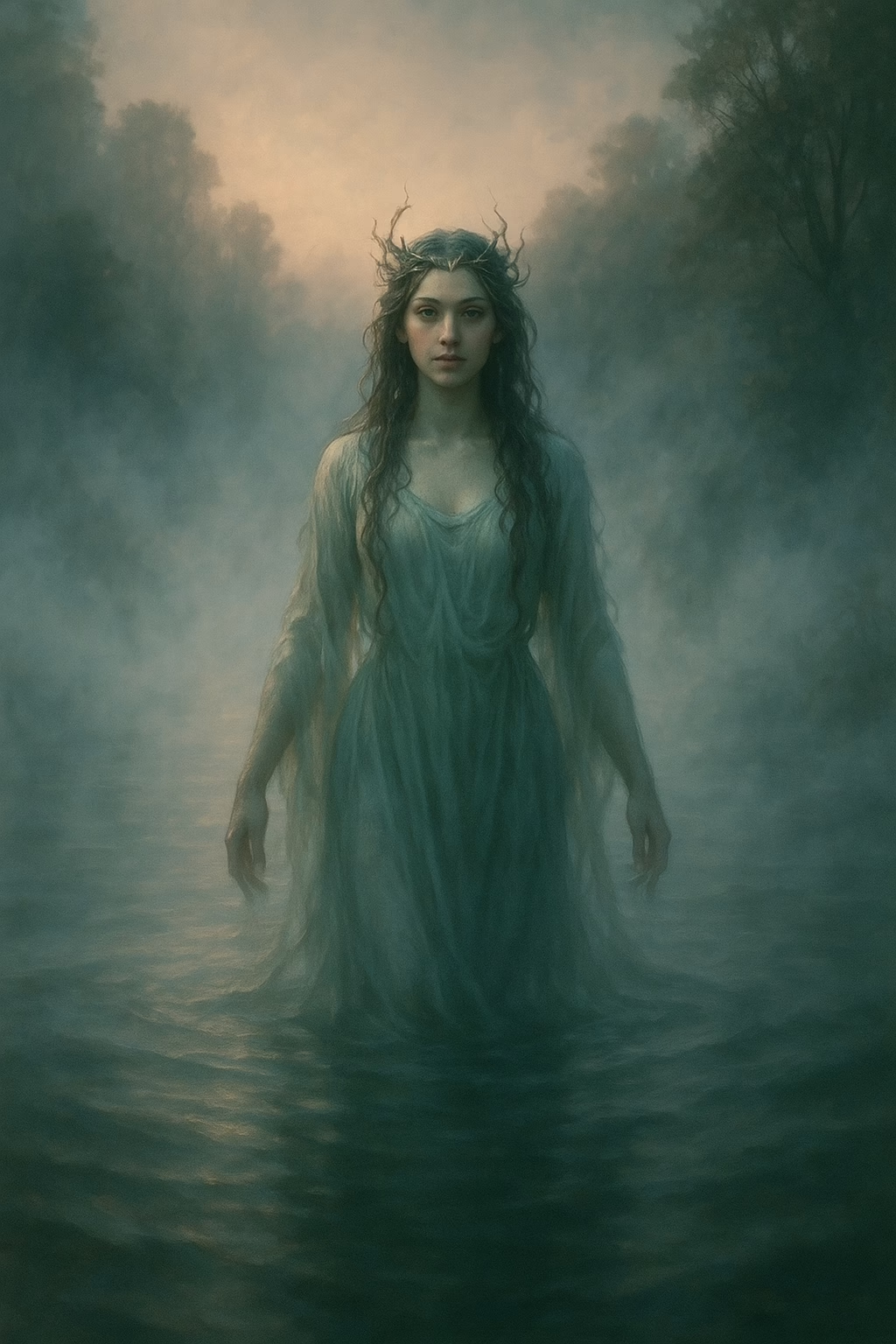
I genuinely enjoy researching and writing about ancient Ireland. But occasionally I come across a topic which is stubbornly difficult to get answers on. It’s at these points that you can decide to give up and move on to ‘safer’ ground, or choose to embrace the challenge and flex the analytical muscles you hope still exist. For the ancient legends are frequently dotted with obscure references, signalling some greater truth which is then left hanging in the air. The Irish mother goddess Dana is a perfect example.
The Irish gods are known as the Tuatha de Dannan which means the people of the goddess Dana (otherwise known as Danu or Ana depending on source). It is after her name that the ancient Irish pantheon derives its lineage. Indeed, in one of the greater retellings of ancient Irish myths and legends, the author describes Dana as follows:
“[A]mong the other women there were many shadow-forms and great queens; but Dana, that was called the Mother of the Gods, was beyond them all.”1
Yet this brief and enticing reference is almost all we have to draw on in this great tome of legends. But, like all good mysteries, the answers can be found if we know where to look.
Who is Dana of the Tuatha de Dannan?
The name of Dana is our first clue as to how this goddess might have been worshipped and viewed by the ancient Irish. The primary sources of the Irish legends speak of the tribe or people of Danu. It’s from this that modern writers have naturally inferred the goddess’ existence as the maternal figure to whom all of the Irish gods trace their descent. But, while the link is evident, this is as far as it goes. As one scholar explains: “The first thing to notice when examining Dana’s name is that it can be found nowhere in the Old Irish texts…The Dana entry is not even found in the Dictionary of the Irish Language.”2 So where does it come from? The answer to that question is much more interesting.
Dana the Water Goddess
For any amateur historian like myself, it’s hard not to notice how much of the ancient world can be traced back to this ubiquitous people group – the Indo-Europeans. Nearly all of our modern European languages, alongside Russia and other parts of Asia, all share single linguistic roots going back millennia. And Dana’s name is an excellent example of just how interconnected these linguistic roots are.
Dana appears in various other ancient legends: from the Welsh god Dûn; the Greek goddess Donu; Indian water goddess Danu; and even in Hittite deer cults and across various other Indo-European traditions. I will merely point to the academic debates on the etymology here for those truly interested (see the footnotes), but for the purposes of this post I will jump to their conclusions.
“[T}here was a prehistoric, probably Neolithic tribe, which inhabited an area near a watery place, perhaps a river or stream. This water became personified as a feminine deity, and the goddess gave her name to the tribe. The tribe was probably not Proto-Indo-European but one with which the Proto-Indo-Europeans came in contact early on.”3
They argue that it is likely Dana’s name derives from a water deity which became personified in these Irish legends, perhaps symbolising the arrival of the Tuatha de Dannan from across the sea, or the more embedded symbolism of water with death, life, and fertility. Whatever the case, Dana is almost certainly an adopted god, reflecting a close linkage with European cultures at this time. This is important for it suggests that the Irish religious traditions, while usually seen in relative isolation from their European neighbours, here are rooted in those very neighbour’s beliefs. So it’s worth considering a few moments what these beliefs were.
Table showing Comparisons between Dana and other Goddesses
| Tradition / Culture | Deity & Primary Source | Key Shared Attributes |
|---|---|---|
| Vedic (Early Hindu) | Dānu – Rig-Veda (e.g., RV I.32) | Primordial water goddess; mother of a divine race (Danavas) – parallel to Dana as mother of the Tuatha Dé Danann. |
| Welsh (Brythonic Celtic) | Dôn – medieval Welsh tales (Mabinogi, Book of Taliesin) | Mother of the “Children of Dôn” (Arianrhod, Gwydion, etc.); ancestral mother-deity role mirrors Dana’s in Irish myth. |
| Continental Celtic (Gaulish) | Dea Matrona / Matres Dan(n)u(vi)ae – inscriptions from Gaul and along the Danube | River or fertility goddesses; protectors of tribe and spring waters, akin to Dana’s life-giving aspect. |
| Greco-Roman | Rhea (Greek) / Terra Mater (Roman earth-mother) | Mother of gods (Rhea to Olympians; Terra to all), sovereignty over earth/soil – thematic match to Dana as “mother of the Irish gods.” |
| Norse / Germanic | Jörð (“Earth”) – Prose Edda | Personified earth; maternal figure for a warrior/storm deity – functional parallel with Dana. |
Danu’s Lineage and Mythology
One of the common themes amongst other traditions is Danu representing a sea monster or vengeful water goddess; the enemy or threat to a given people group. In many cases, she is slain by a heroic figure who then frees their people from the monster’s oppression. In India the monster withholds the waters until slain; in Babylonian myths the monsters are birthed from primordial waters; in Greece the sea monster was devastating the land before being slayed by Perseus.4
Applying these myths and traditions directly to the Irish context may suggest that Dana personified an threat or goddess to be defeated. There’s something to this, as the Tuatha de Dannan were invaders of Ireland, defeating the native Firbolg, and eventually to be defeated by the Gaels – those to whom the Irish now trace descent. In this sense, Dana represents a defeated enemy, one the Irish had to overcome to claim what is now their homeland. However, I’m not convinced by this argument for two reasons.
Symbols & Associations of Dana
First, there is considerable evidence that Dana’s children – the Tuatha de Danann – were worshipped by the Irish. If they had been considered enemies, then it would seem very peculiar that they then practiced sacrifice and rituals in their honour. For instance, carved images of the gods appear across various archaeological finds such as stone statues.
Second, where Dana and the other gods are portrayed in Irish mythology, it isn’t as some great people who were evil or oppressive, but rather as supernatural beings worthy of worship. Their traits – albeit often imperfect and highly relatable at times – are clearly seen as proverbial and exemplary. So it seems, sensible to me to see Dana as a coopted god into an Irish tradition, rather than one who was merely copied across. Some aspects of her being would have remained – namely her water aspect associated with life and fertility – while others were discarded. So let’s turn to those aspects that remained.

Dana in Modern Culture
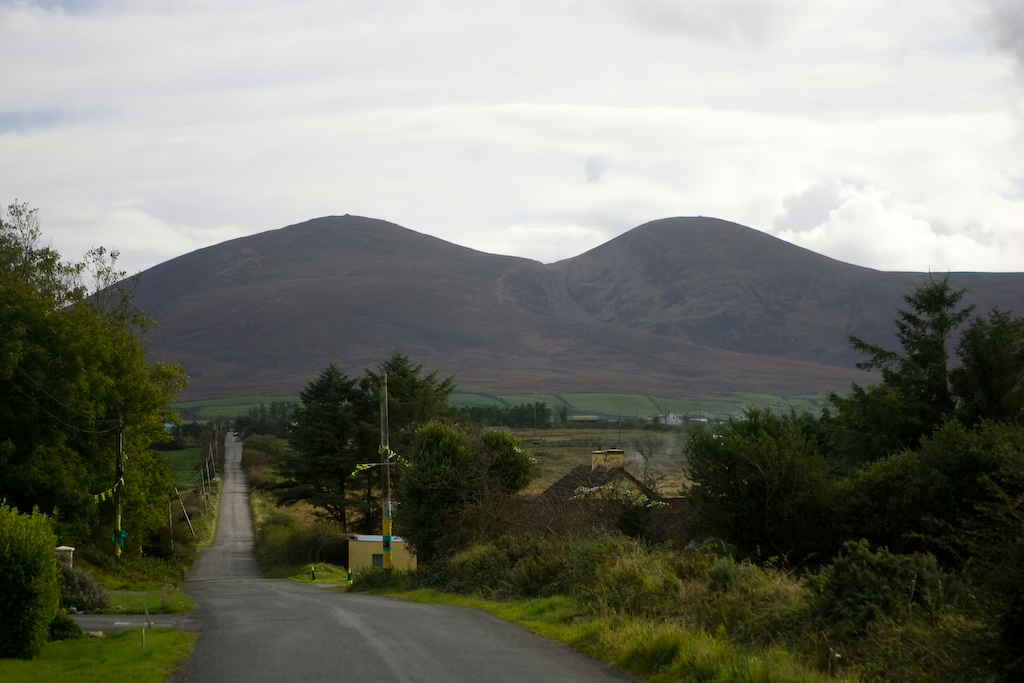
One of the traditions of Dana which has endured is a reference to her symbolism as the ‘mother’ of the gods and association with fertility. The ‘Paps of Dana’ (literally meaning the breasts of Dana) are a pair of mountains in County Kerry, Ireland, which derive their namesake from the goddess. Their significance dates back to prehistory as a ritual site associated with fertility, and it’s possible that so does this association with Dana.
The Irish mother goddess Dana was clearly of significant importance to the ancient Irish, worshipped as a symbol of motherhood and fertility. Later traditions have arguably conflated or coopted her symbolism in other goddess such as Brigit.
From considering her name and where it likely derived from, we can see a fascinating connection between the ancient Irish and other religious traditions from as far away as Iran and India. This remarkable continuity and linkage suggests the ancient Irish were not as isolated as often portrayed. They certainly didn’t let the confines of their island constrain them.
But it’s important not to overstate these points, for Dana remains largely shrouded in mystery. Scant reference to her in ancient texts and archaeological evidence makes it difficult to assess the extent of her cult and worship. For me, that makes her all the more interesting and hopefully for you too.
Frequently Asked Questions: Irish Mother Goddess Dana
Dana (also Danu or Anu) is the primeval earth-mother goddess in Celtic lore. She is honored as the mother of the Tuatha Dé Danann (“people of Danu”) – the tribe of Irish gods. She embodies life, fertility, and abundance.
By myth, all Tuatha Dé Danann deities descend from Dana. The very name Tuatha Dé Danann means “people of Danu”. Legends say Dagda, the chief god, was born from Dana (often in union with the god Bilé). In this way, she is seen as the matron and progenitor of the Irish pantheon.
Dana’s symbols reflect nature and fertility. Common symbols include water (rivers, wells) and earth, representing life and renewals. Other associated motifs are animals (like horses, fish, birds) and the mystical cauldron of plenty held by the gods, symbolizing abundance and rebirth.
Specific ancient temples to Dana haven’t survived, but many Irish sites are linked to her. For example, the Well of Segais (the mythic source of the River Boyne) and the Hill of Tara (ancient kingship site) are traditionally connected to Danu’s worship. The twin Paps of Anu in Kerry are named for her, showing her reverence in the landscape.
Yes. Scholarly sources note “Dana” is an alternate spelling of Danu (also Anu). Over time, multiple Celtic cultures used similar names for the mother goddess. The Irish Danu is essentially the same figure as the Welsh goddess Dôn and the Hindu river goddess Dānu in name and function (mother and fertility).
- Lady Gregory (1905), p27. ↩︎
- Boucherit, Gilles. “Ana/* Danu.” In First European symposium in Celtic Studies,. 2013. ↩︎
- Dexter, Miriam Robbins. “Reflections on the Goddess* Donu.” The Mankind Quarterly 31, no. 1-2 (1990): p58. ↩︎
- Dexter (1990). ↩︎
YOU MAY ALSO LIKE
 Iron Age Clothing in Ireland: What People Really Wore
  Who was the Irish god Nuada of the Silver Hand?
  Who is the Cailleach? Ireland’s Winter Goddess
  Who is the Irish goddess Ériu?
  What were the Irish Brehon Laws?
  Who were the Merrow in Irish Mythology?
  Irish Placenames: Ancient History & Mythology
  Who was the Irish goddess Brigid? Goddess of Fire & Fertility