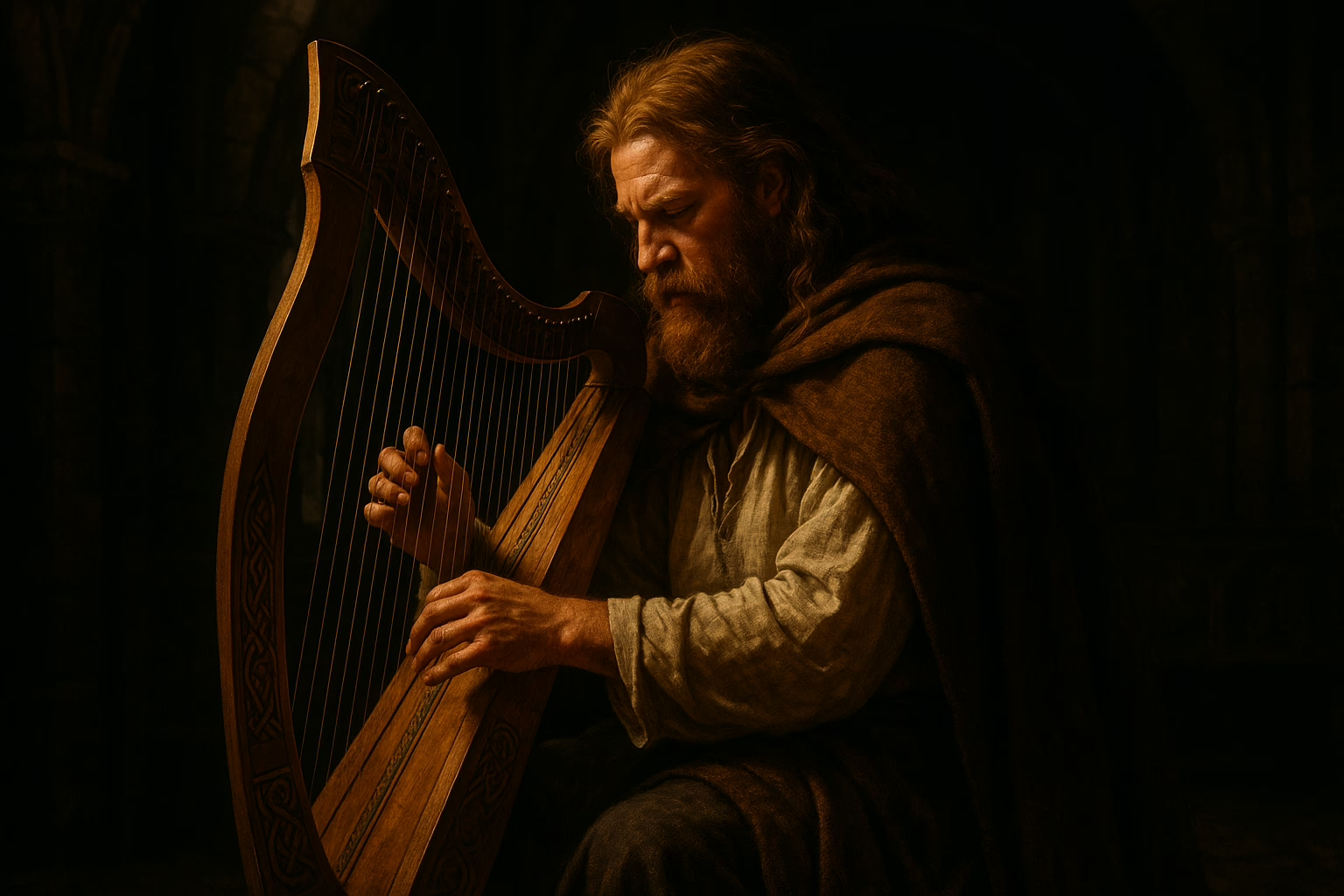
Music is intimately connected with emotion, whether to relax as I drive, or to feel energised on a run. But in ancient Ireland, music was much more than mere songs – it was the source of law, satire, politics, and power. And as the custodian of this trove of treasures, the Irish bards were both revered and feared. For through verse and melody, bards shaped how kings were remembered and how stories were told. Their songs were not just entertainment. They were tools of honour – the pillar of ancient Irish society.
This post explores the role of Irish bards and the music they made. It uncovers the instruments they used, the metres they mastered, and the myths they inspired. Placing them in context — alongside poets of Britain and Gaul, and within the broader world of Celtic oral tradition – we can begin to understand the importance Irish bards both in history and their enduring legacy today.
Who were the Irish Bards?
The word bard comes from Proto-Celtic bardos, meaning a poet or singer. In early Ireland, the term was used alongside fili — a more prestigious role that blended poetry, genealogy, and legal knowledge. While the bard composed and performed, the fili was a ranked poet within the intellectual elite, often trained in a bardic school and entitled to privileges under Brehon Law.
Bards were not mere musicians, they were at the top of the social and political ladder within ancient Ireland. Their closer to our modern tech-CEOs than they are our musicians. For bards—especially those of the highest rank, the ollamh fili—held exceptional privileges under Brehon law. Their legal status was on par with kings and bishops, entitling them to significant protections and a high honour price if wronged.
In return for their services, they were often granted land, a residence, and lifelong patronage by a noble household. Bards were guaranteed hospitality as they travelled—offered food, shelter, and gifts such as cattle, fine cloaks, or ornate jewellery in exchange for praise poetry or genealogical recitation. An ollamh could demand as much as seven milk cows for a composition, while lower grades received lesser but still meaningful rewards.
Beyond material wealth, poets held cultural authority: they preserved history, mediated disputes, and could issue biting satires (áer) capable—according to belief—of bringing shame, illness, or legal penalties upon their target. As educators, ollamhs also ran bardic schools, training new generations in strict syllabic verse and the vast mytho-historical tradition of Ireland. Which brings us to the question of how bards trained.
Bardic Training
The bards were divided into seven grades, the highest being the ollamh file, achieved only after a reported twelve-year curriculum during which a poet mastered more than 300 strict syllabic metres and 350 primary and secondary stories. Each level of skill was carefully graded, from the junior focloc to the seasoned ollamh. Each grade had specific metres (known as dán díreach) they were expected to master.
It’ll not be surprising, therefore, to learn that bardic training was intense, deeply structured, and oral in nature. Aspiring poets lived under the tuition of a master fili, learning through recitation, repetition, and nightly composition. Instruction took place in bardic schools, which were often family-run and maintained by hereditary poetic families. Lessons occurred largely in darkened rooms, where students composed verse aloud to train memory and metre without relying on the written word. The curriculum was steeped in dán díreach (strict verse), requiring precise syllable counts, alliteration, and internal rhyme. Each year of study advanced a pupil through set tasks — from basic genealogies to complex praise poetry and satire.
Like most professions within early Irish society, entry often began in childhood, particularly for the sons of learned families. The pupil would be sent to study under a recognised ollamh, and his progress was evaluated annually. Advancement depended on the mastery of specific metres, memorisation of traditional tales (scéla), and the ability to compose in response to formal themes or patrons’ requests.
Table: Ranks of Irish Bards
| Grade | Training Time | Typical Role or Output | Meaning |
|---|---|---|---|
| Fochloc | 1 year | Learner; memorised verses and began simple compositions | “Under-root” or “foundation” |
| Mac Fuirmid | 2 years | Assistant poet; recited 20–30 verses | “Son of preparation” |
| Dos | 3 years | Recited up to 50 verses | “Bush” or “bundle” |
| Cana | 4 years | Composed basic praise poems, genealogy chants | Possibly from “to sing” or “to chant” |
| Cli | 5 years | Skilled in satire, genealogy, and metres | From clí meaning “fame” or “renown” |
| Anruth | 6–7 years | Composed complex poetry across various metres | “Noble stream” or “noble flow” |
| Ollamh | 12+ years | Chief poet; mastered 300+ metres; satirist, historian, seer | “Great one” or “chief expert” |
Roles of Irish Bards
In an oral society where few could write, stories and poetry were the currency of the day. Verses preserved genealogies. Songs outlined property rights. Lyrics established diplomatic treaties.
Much of this work clearly had to be highly structured. Bardic poems used precise metres with set syllable counts, internal rhyme, and alliteration. The form helped poets memorise large amounts of material, but it also added rhythm and force to what they said. The metre known as deibide was common, as was the chant-like roscad — often used in battle or formal declarations.
Bards had the legal right to recite these records in public. Their words could influence land disputes or confirm royal claims. Because of their extensive training, their memory was trusted where paper could not be. This made them vital in Brehon courts and political councils.
Satire, too, was a form of law. If a bard mocked someone in verse, it could damage that person’s honour. In some cases, it was even considered legal punishment. The belief in áer — a form of poetic curse — was taken seriously. It gave poets a feared authority. Their training gave them the tools to harm or heal a reputation.
Performance was part of this power. Bards were expected to deliver their lines with voice and presence. Which brings us to their music.
Music in Early Ireland
Every skilled bard was trained not only in verse but in voice and rhythm. Musical performance was deliberate and structured — matching sound to poetic form and emotional tone.
The most iconic instrument was the harp, or cruit in Old Irish. It featured a curved wooden frame with strings of bronze or iron, and it symbolised elite learning and status. Harps appear in early carvings such as those at Clonmacnoise and are mentioned frequently in bardic lore. To play the harp was not simply musical — it was to declare one’s place in the hierarchy of learned poets. The bard would pluck it during recitations, using its tones to shape the rhythm of syllables or underscore meaning.
The bronze horn or adarc was another significant instrument, used to produce long, resonant tones. Often cast in intricate spiral designs, these horns could be ceremonial or martial, accompanying processions, royal appearances, or battle chants. While many surviving examples date to the Bronze Age, their presence in medieval contexts suggests continued use in formal or symbolic roles.
The lyre, though less common in the archaeological record, also appears in early literary references. It was a small stringed instrument made of wood and gut or sinew strings, used for accompaniment during quieter, more intimate performances. Its soft sound was suited to personal praise or lamentation, especially indoors or at court.
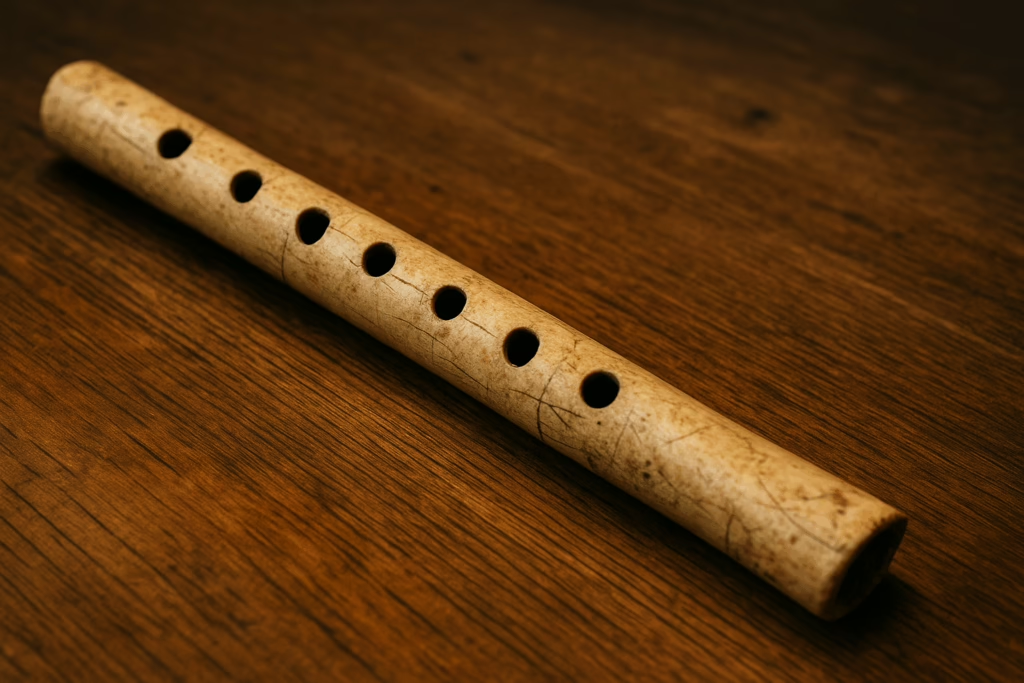
Finally, frame drums and bone whistles provided rhythm and ornamentation. Frame drums, often made from wooden hoops and stretched animal hide, gave a steady beat to chants or poetic cycles. Bone whistles — usually made from bird or deer bones — added high-pitched accents or melodic transitions. Both instruments emphasised timing and precision, traits essential to the strict metres of dán díreach poetry.

Bards in Mythology and Folklore
Irish mythology is full of figures who blend music, poetry, and magic. The Dagda, a god of the Tuatha Dé Danann, played a harp that controlled the seasons. When stolen, the harp flew back to him at his command. With it, he could play three modes – joy, sorrow, and sleep – the triad becoming central to bardic lore.
The sea-god Manannán mac Lir, often depicted as a skilled harper, uses his music to lull mortals to sleep or move them to tears. In several tales, his harp plays and his melodies cross boundaries between worlds – cursing mortals to death and raising them to life.
In the Táin Bó Cuailnge, a beautiful prophetess Fedelm is encountered by Queen Medb on the road to Ulster. Although not called a bard explicitly, Fedelm’s role mirrors that of the highest fili as she recites a poetic vision foretelling bloodshed and ruin. Her story demonstrates the ancient belief that trained poets could see what others could not. Her verses carry weight not just as prediction, but as a declaration of fate.
Even saints recognised this power. Columba, himself trained as a poet, was said to use verse in his missionary work. Others turned the bardic skills to Christian praise — reshaping the form, but keeping its rhythm and force.
Perhaps the best known though is Amergin, the poet of the Milesians, who was one of the earliest bards. He came to Ireland reciting a poem – the Song of Amergin – that claimed the land through verse. I’ve quoted a short section as I feel it provides a beautiful summation of the role of poetry in Irish mythology.
I am Wind on Sea,
I am Ocean-wave,
I am the Roar of Sea,
I am Bull of Seven Fights,
….
Comparison between Bardic Traditions
The bardic tradition in Ireland stood out not only for its cultural importance but for the scale of its institutional development. Yet Ireland was not alone in elevating poets to positions of honour.
In Wales, court bards were central to royal ceremony. Like their Irish counterparts, they preserved genealogies, composed praise poems, and followed strict metrical forms. Their role, however, was typically confined to the court, whereas Irish poets often functioned as legal experts, judges, and historians embedded across society.
In Gaul, Roman writers such as Diodorus Siculus and Strabo described a threefold learned class: druids, vates, and bards. The druids were philosophers and priests; the vates, seers; and the bards, composers of song and story. While the Gaulish system largely disappeared under Roman influence, Ireland preserved and expanded its poetic class well into the medieval period.
What sets the Irish bardic system apart is its formalised structure. Poets here trained for over a decade, ascending through graded ranks, each with defined duties, metres, and legal standing. They were not simply entertainers — they were custodians of tradition, tasked with remembering the past and shaping the legacy of kings. In Ireland, bardic learning became a profession of power: music wedded to memory, art fused with law.
Table: Bardic Schools and their Patrons
| School (modern county) | Patron dynasty | Century active |
|---|---|---|
| Rathcroghan / Ballintober, Roscommon | O’Conor kings of Connacht | 14th–16th |
| Glencolumbkille & Kilmacrennan, Donegal | O’Donnells | 15th–17th |
| North-Munster (Corcomroe & Finavarra, Clare) | Ó Dálaigh family | 14th–17th |
Legacy and Transformation
The bardic tradition lasted for centuries. From Iron Age poets to medieval filí, Ireland’s bards adapted to change while keeping their core purpose — to preserve knowledge in word and song. Bardic schools thrived until the 17th century. These institutions trained poets in strict metres, language, and lore. They were supported by Gaelic lords and kept detailed records in manuscripts. But with the collapse of Gaelic Ireland, the schools faded. English rule, war, and shifting patronage ended the formal tradition.
Today, Irish music and poetry still draw on this legacy. Whether in traditional festivals or contemporary performance, the influence of the bard endures.
But the history of the Irish bards and their ancient music is far more than their symbolism and memory. They represent Ireland’s rich cultural heritage. It’s a land of meritocracy, where hard work was rewarded – even revered. To be an ollamh wasn’t a right, it was earned. Poetry was power. Words were valuable. These are important truths I find reassuring and refreshing – particularly in our culture today.
Frequently Asked Questions: Irish Bards and Ancient Music
Bards were poets, musicians, and record-keepers. They preserved genealogy, law, and history through verse and were key figures in royal courts and public life.
The harp (cruit) was the most iconic, but bards also used lyres, bronze horns, bone whistles, and drums to accompany their verses and chants.
Bards studied for up to twelve years, learning complex metres, oral history, and performance skills. The most advanced poets held the title ollamh file.
While the formal schools declined after the 17th century, bardic influence lives on in Irish folk music, sean-nós singing, and modern cultural memory.
YOU MAY ALSO LIKE
 How did the Romans influence Ireland?
  What is the Ogham Tree Alphabet?
  Etymology of Irish Animal Names: Myth & Language Revealed
  Roots of Language: Irish Tree Mythology, Ogham & Sacred Law
  Etymology of Irish Festivals
  Ancient Irish Proverbs and their Origins: Wisdom in a few Words
  Iron Age Clothing in Ireland: What People Really Wore
  Who was the Irish war goddess The Morrigan?