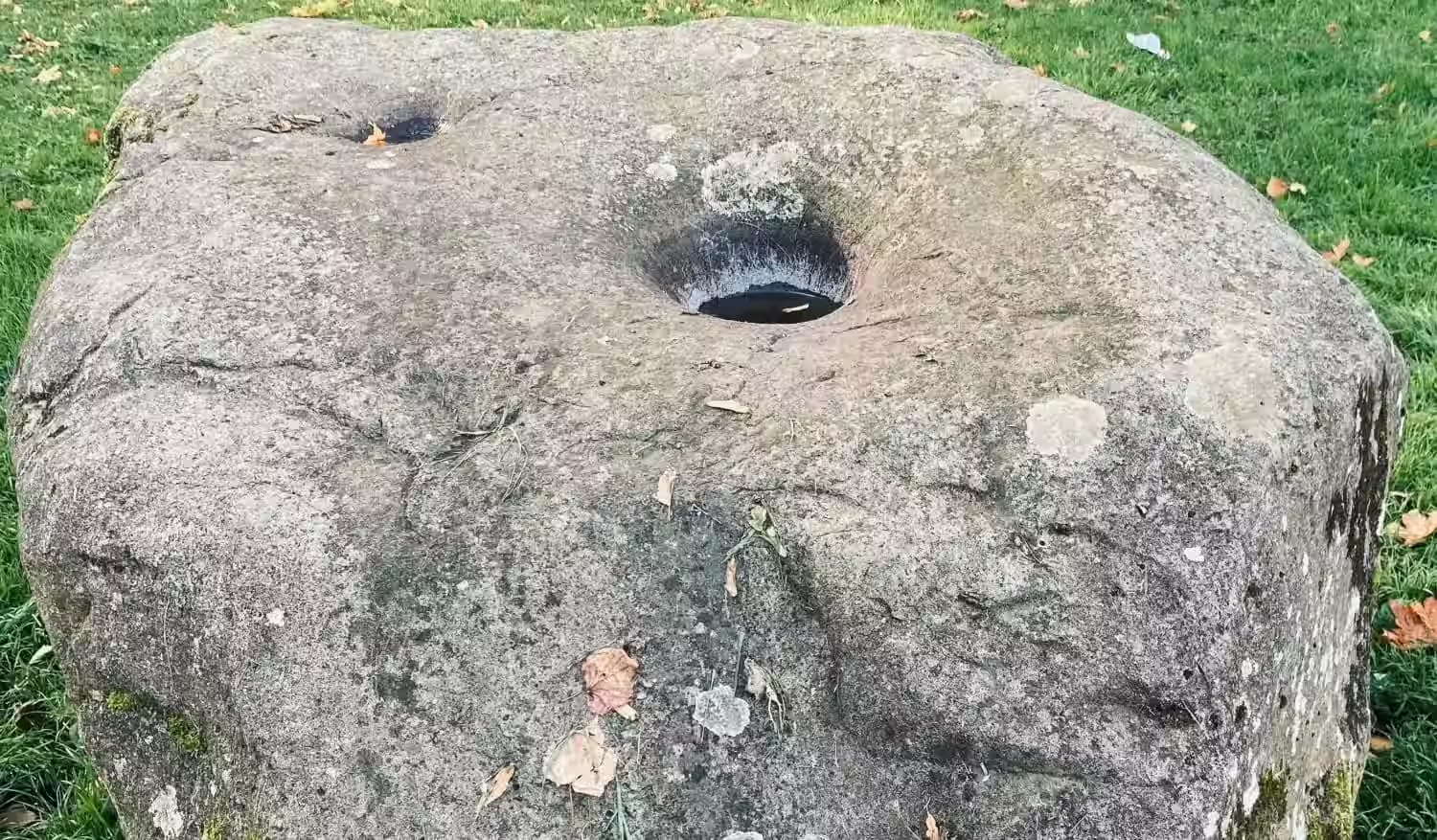
Bullaun stones are a fascinating example of how early Christian beliefs were fused with folklore and Irish culture. But despite there being over 1,800 of them across Ireland, it is likely you’ll have never actually seen one. This is because, unless you know what to look for, you’re likely to walk right by one without noticing.
To address this, in this post I have created an interactive map showing the location of all known recorded Bullaun stones across the whole of Ireland. We then consider what Bullaun stones were and what they were used for. That way you’ll be not only able to identify them, but able to explain why they matter in Irish history and folklore.
Interactive Map of Bullaun Stone Locations in Ireland
Interactive Map of Medieval Sites
This interactive map was created in ArcGIS Online using data from both Government datasets. The datasets were edited and filtered using QGIS. Copyright for the data and basemaps attribution is as follows:
Data Sources
© National Monument Service Historical Monuments
© DfC Historic Environment Division & Ordnance Survey of Northern Ireland Copyright 2006
Map data
© OpenStreetMap contributors, CC-BY-SA, Tiles by OpenStreetMap
What are Bullaun Stones?
Bullaun stones are “are artificial basins or hollows in rocks, boulders and stone.”1 Their name “is derived from an Irish term ballán or bullán, originating in Connacht and referring to round holes in rocks, usually filled with water”.2 There are over 1,800 recorded across the whole of Ireland with a few concentrations which are discussed below.
In most cases, it is likely they were shaped them with stone or metal tools, sometimes deepening natural depressions or cutting entirely new cavities into rocks or slabs. Their size varies significantly with some holding only a few spoonfuls of water, while others form deep basins.
The original purpose of Bullaun Stones is still debated with broadly falling into religious or functional. From a religious standpoint, they may have been “early medieval pilgrimage stations/monuments…[as] the characteristic hollow of the bullaun was created by continuous ritual or devotional turning of stones by pilgrims.” In contrast, the functional explanation is that of “a more practical use, such as grinding metal ores or herbs”.3
Accepting I am certainly no expert, I still find it unlikely they were merely functional given their frequency and close association with early Medieval Christian sites and not more broadly across other categories of ancient monuments. Moreover, there’s ample evidence after this initial period, of religious and ritualistic association with them, much like that of holy wells. So even if they were originally used for simple grinding of materials, they likely then became ritualised later and coopted into Christian practices such as ritual cleaning.
There are further explanations linked to folklore we’ll explore below. But first, let’s consider where you can find them.
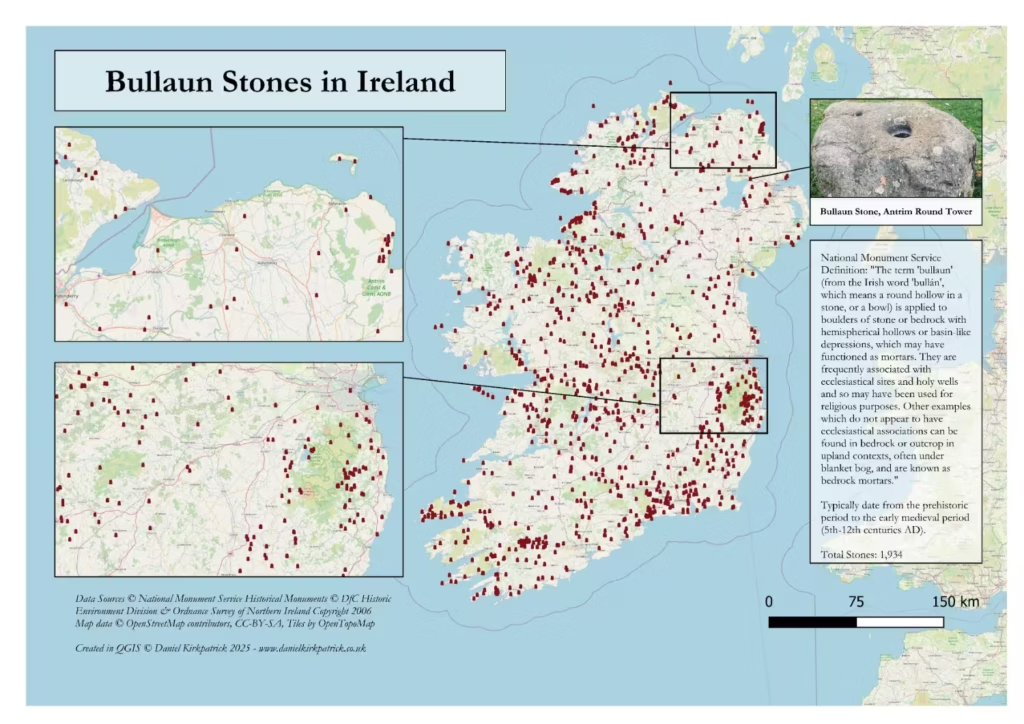
Where can you find Bullaun Stones?
Bullaun stones can be mostly found around early medieval church sites, though they are “often being found on the periphery rather than within them.”4 This suggests they were unlikely part of the day-to-day rituals of these sites, but still important enough to be so commonly used and developed at so many.
If you look at my map above, you can see several concentrations. First is the north-east (near Cushendall and Cushendun in the Glens of Antrim) with 13 in close proximity, which is the largest concentration in Northern Ireland that I can see. But this reflects a much lower density in Northern Ireland in general – albeit this may be due to data quality rather than any statistical distribution.
In the rest of Ireland, the distribution is clearly correlated with key Medieval religious sites. For instance, at Glendalough there are 21 alone and other sites have documented many finds as noted above.
Besides their function and distribution, Bullaun Stones have a whole folklore which has evolved around them which is worth considering itself. Indeed, I suspect it what many of you have heard of before.
Folklore of Bullaun Stones and Cursing Stones
The Bullaun Stone at Antrim’s Round Tower has become known as the Witches Stone. It is so named because a witch was said to have jumped from the summit of the tower in protest at its construction, landing on the stone and leaving the impressions of her knee and elbow. However, given the stone was originally 400m from the tower this can be taken very lightly indeed. But it speaks to the wider superstitions which were often linked to these stones.
More broadly, the rainwater collected in these stones was often thought to have had healing properties or associated with miracles. Again the Witches Stone was believed to never run dry, as a gardener was said to have drained the hollow only to find it filled once more the next day. However, this may say more about the Irish weather than it does miracles.
Then there are the cursing stones. Now some of you may wonder what the difference is between Bullaun and Cursing Stones. Well the National Monument Service provides a helpful distinction in its definition of cursing stones as “usually round, sometimes placed in the hollow of a bullaun stone and turned over or anti-clockwise while a curse is uttered against an offending person”. In other words, they can be added to a Bullaun stone rather than replacing it and reflect the merging of pagan and Christian beliefs, and how these sites often fused multiple beliefs together.
Frequently Asked Questions: Bullaun Stones in Ireland
A bullaun stone is a natural or worked stone with one or more carved hollows, traditionally used to collect rainwater for ritual or healing purposes.
Most surviving examples date to the early medieval period, though some may preserve traditions that reach back into pre-Christian Ireland.
They are commonly found near early churches, holy wells, monastic sites, and in remote upland or coastal landscapes.
People believed naturally gathered rainwater absorbed the sacred power of the site and could cure illness or bring protection.
- Nugent, L., Exploring the Evidence for Early Medieval Pilgrimage at Kilcolman. ↩︎
- Dolan, B., 2012. ‘Mysterious waifs of time’: 1 some thoughts on the functions of Irish bullaun stones. Journal of the Royal Society of Antiquaries of Ireland, pp.42-58. ↩︎
- Nugent, L., Exploring the Evidence for Early Medieval Pilgrimage at Kilcolman. ↩︎
- Warren, G. and McDermott, C., 2012. Excavations at the Upper Lake, Glendalough, Co. Wicklow. ↩︎
YOU MAY ALSO LIKE
 Irish Festival Names Explained: The Etymology of Samhain, Imbolc, Bealtaine and Lughnasadh
 Who was St Columba? Missionary, Monk, and Legend of Iona
 Iron Age Clothing in Ireland: What People Really Wore
 Iron-Age Hillforts in Ireland: Daily Life, Purpose & Key Sites
 Iron Age Trade in Ireland: Networks, Imports, and Economic Life
 Etymology of Irish Animal Names: Myth & Language Revealed
 Ogham Tree Alphabet: Irish Script, Meaning & Origins
 St Brendan of Clonfert: Irish Monk, Atlantic Voyager & Saint