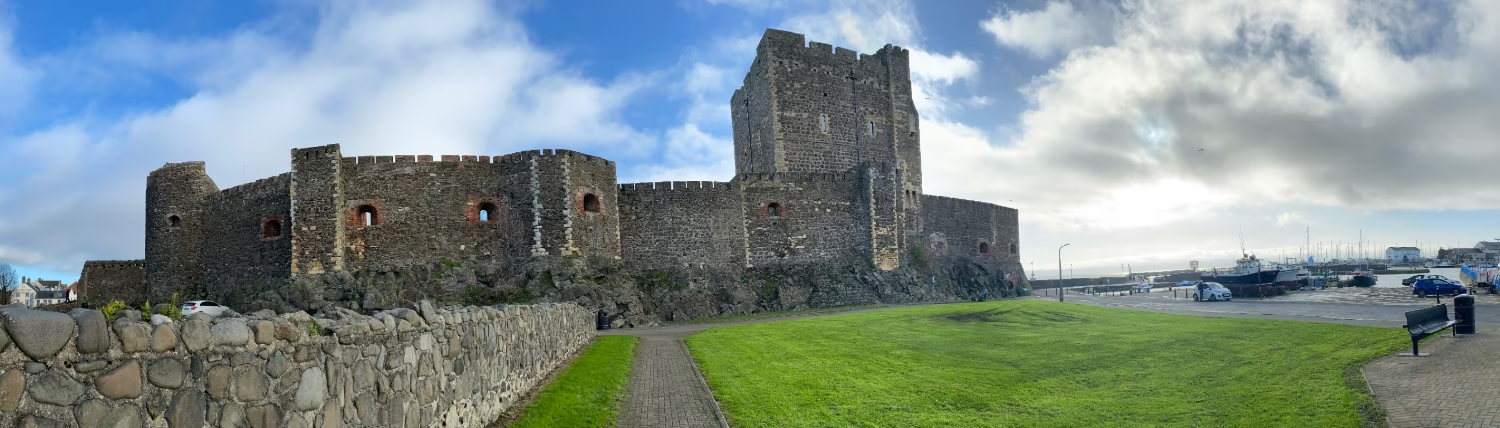
Throughout Ireland, every region has a site which defines a period of history. For medieval Ulster, this is Carrickfergus Castle. Dating to John de Courcy’s conquest of Ulster in the 12th century, this castle has not only witnessed, but played a key role in nearly every conflict and war which has torn Ulster apart since.
Guarding access to the north and acting as a foothold for English rule, perhaps it’s no surprise. But Carrickfergus is much more than a mere fortification. And recent archaeological evidence has revealed how the site’s significance dates much farther back into prehistory.
In this post we will discuss the castle’s origins and its prehistoric context. We will see how it grew into one of Ulster’s most crucial ports and played a key role throughout over 800 years of Irish history.

Before the Castle: Early Settlements at Carrickfergus
Long before Carrickfergus Castle stood watch over Belfast Lough, this stretch of coastline was already a place of human settlement and legend. The area offered a natural harbour, fertile soils, and defensible positions along the rocky headlands — all features that drew early communities to the Antrim coast. We’ll turn in a moment to the archaeological evidence, but first we should consider the legends.
The name ‘Carrickfergus’ comes from the Irish Carraig Fhearghais — “Fergus’s Rock.” Legend claims that its namesake was a 6th century Scottish King, Fergus Mór mac Eirc. He had set sail for Ireland in the hope of finding a prophesised cure for his leprosy at a healing well on the site of where Carrickfergus Castle now stands. But the tale culminates in a tragic ending with Fergus’ ship being wrecked against the rocks and so, in bitter sense, he did get his cure.
Beyond this anecdotal episode, archaeological evidence shows human activity here since prehistoric times. Flint tools and worked stone fragments found near Carrickfergus point to Mesolithic and Neolithic occupation (see the photograph of finds on display in the castle). Later Bronze Age finds, including pottery and fragments of metalwork, suggest a thriving coastal settlement trading along the Irish Sea.
By the early medieval period, this coastal stretch lay within the territory of the Uí Echach Cobo, one of several ruling dynasties of ancient Ulster. Monastic foundations nearby, such as those at Bangor and Antrim, would have linked the area into wider Christian and trading networks across the Irish Sea. So when John de Courcy’s forces landed in the 1170s, this was already a region thriving.
Carrickfergus Castle Phases of Development
| Phase | Period | Key Features |
|---|---|---|
| Inner Ward | Late 12th century (c.1177–1200) | Built by John de Courcy; includes the great keep, curtain wall, and small inner enclosure. Constructed primarily of basalt and limestone. |
| Middle Ward | 13th–14th centuries | Added under later Anglo-Norman rulers; included expanded curtain walls, gatehouse, and residential buildings. Strengthened with towers and improved defences. |
| Outer Ward | 15th–16th centuries (Tudor and early Stuart periods) | Outer defences and gunports added; bastions and artillery positions adapted for cannon warfare. Extended beyond the medieval core toward the harbour. |
The Norman Arrival and Construction of Carrickfergus Castle
The arrival of the Normans in Ulster during the late twelfth century marked one of the great turning points in Irish history. In 1177, the ambitious knight John de Courcy launched an unauthorised campaign into the north, landing near the Antrim coast with a small but highly trained force of 22 knights and 300 foot soliders. Within months he had remarkably seized control of much of east Ulster, establishing his power base at Carrickfergus.
De Courcy recognised what earlier settlers already knew, that the rocky promontory overlooking Belfast Lough offered a commanding position of both sea and land. Here he began construction of Carrickfergus Castle, initially in wood and earth before replacing it with solid stone around 1180. The first phase centered on the inner ward and great keep, whose thick basalt walls and narrow arrow slits still project Norman strength. Over the next century, successive additions — curtain walls, outer wards, and defensive towers — transformed it into one of the most formidable fortresses in Ireland. In the table above, you can see these phases and the changes as the castle developed.
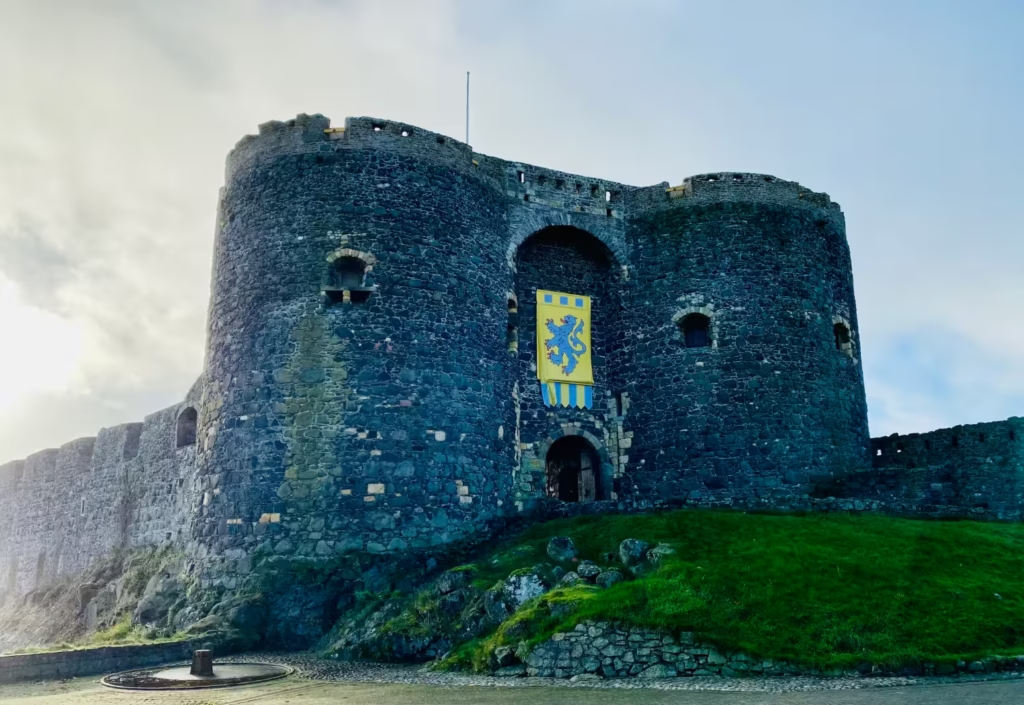
From the outset, the castle served both as a military bastion and administrative centre, anchoring Anglo-Norman authority in a largely Gaelic region. De Courcy minted his own coins here and established Carrickfergus as a hub of trade, taxation, and diplomacy. Merchants from Bristol and Dublin arrived at the harbour, while Gaelic chieftains came to negotiate with the new power in Ulster. The castle’s massive gatehouse, later strengthened under King John and Hugh de Lacy, stood as the literal and symbolic threshold between two worlds — Norman (and later English) ambition and the resilient Irish north.
What was life like in the Medieval Castle?
Looking at the cold, bare stone walls of Carrickfergus today, you could easily be forgiven for thinking this was what life must have looked like too. Austere, violent, hard. And at times it certainly would have been. But history isn’t simply the telling of battles and war, because for the majority of the castle’s existence its inhabitants would have enjoyed peace. Indeed, we can see this when we consider the castle’s design.
First comes the keep structured across four levels. At the base where the kitchens, storerooms, and servant quarters. Above would have been an administration, a waiting area for petitioners. Above was the great hall, where the lord and his retinue dined, held audiences, and administered justice. And above was a large quarters for the lord with a huge fireplace.
Beyond the keep were the essential tradesmen – blacksmiths, carpenters, armourers – a chapel, a garrison, administrative buildings, and stables. There would have been more storehouses, access directly to the harbour for resupply, further lodgings, alongside the many defensive features. At its peak, it’s estimated the castle housed 300 people which, for those who visit, is hard to image within the walls today. But servants would have slept where they worked. Space was at a premium, so every inch would have served a purpose, particularly in times of war.
The Historical Evolution of Carrickfergus Castle
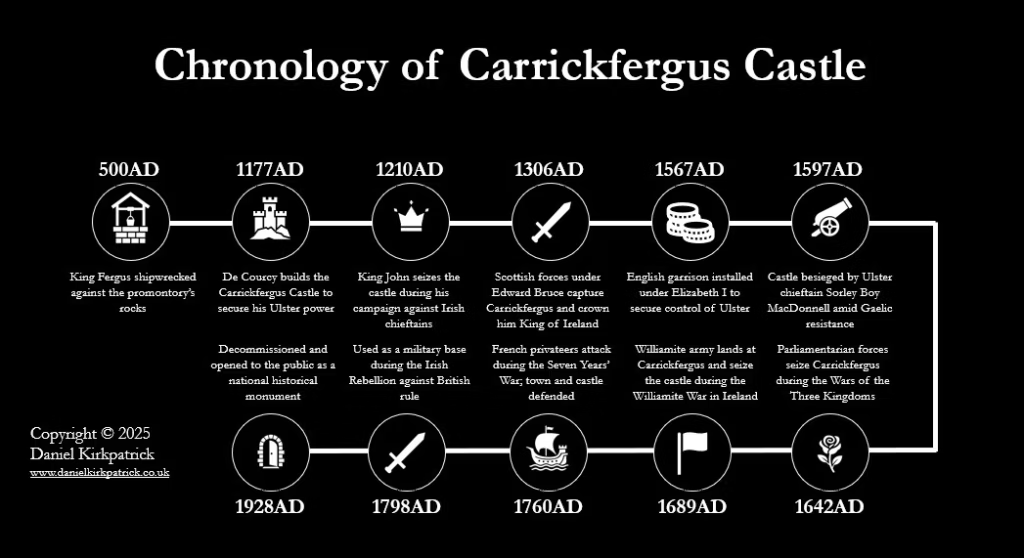
The de Courcy period of Carrickfergus Castle was only beginning. For after his downfall in 1204, another Normal lord by the name of Hugh de Lacy, seized Carrickfergus and expanded the fortifications. The addition of outer wards and a gatehouse transformed the stronghold into one of the most advanced defensive sites in Ireland. And by the early thirteenth century, Carrickfergus had become the principal seat of royal power in Ulster — a status reinforced when King John himself visited in 1210 to secure control of the region.
The thirteenth and fourteenth centuries saw further strengthening of its walls and the construction of a sea gate, enabling supplies and reinforcements to arrive directly by ship. These adaptations reflected Carrickfergus’ strategic role as both fortress and administrative centre — a base for royal officials and a symbol of English authority. Indeed, in 1315AD the Scottish King Edward Bruce was crowned King of Ireland too at Carrickfergus. Though his coronation proved premature with his eventual defeat in 1318AD.
By the fifteenth century, the castle’s military dominance had begun to wane, though it remained a critical outpost in a contested landscape. Then in the 17th century, its fortune – and those of the town – returned with Sir Arthur Chichester who built the medieval town walls, and bolstered the town’s defensives – perhaps prophetically. For the tumultuous 17th century saw the castle play key roles in various conflicts, from the Wars of thr Three Kingdoms to the later Williamite War.
But, where most other Ulster castles then fell into decline – such as Dunluce or Dundrum – Carrickfergus remained and continued to function right into the 20th century. Understanding why requires us to consider the comparison with these castles.

Carrickfergus in the Context of Norman Castles in Ireland
Carrickfergus Castle occupies a special place among the great Norman fortresses that reshaped Ireland’s landscape. When the Normans arrived, they introduced a radically new architectural and political order. Their castles were not merely military structures but instruments of governance — projecting power into newly conquered regions, anchoring trade routes, and securing coastal access.
The earliest Norman strongholds, such as Trim Castle in County Meath and Dundrum Castle in County Down, share much with Carrickfergus in both form and function. All three began as stone keeps, replacing the earlier timber motte-and-bailey designs that had defined the first wave of Norman colonisation. Trim, constructed under Hugh de Lacy in the 1170s, was the administrative centre of the Lordship of Meath, while Dundrum, also attributed to John de Courcy, guarded the approaches to Lecale and Downpatrick. Carrickfergus mirrored these ambitions in Ulster — serving as the northern counterpart to Trim’s political might.
Compared with inland castles like Trim or Carlow, Carrickfergus was both fortress and port. It functioned as a gateway for trade, supplies, and communication with Britain. This maritime orientation placed it in a small group of strategic coastal castles, including King John’s Castle in Limerick and Dungarvan Castle in Waterford, which guarded the western and southern seaways. Carrickfergus commanded the vital northern crossing to Scotland, giving it an enduring importance in both Irish and wider British politics.
Legacy and Visiting Carrickfergus Today
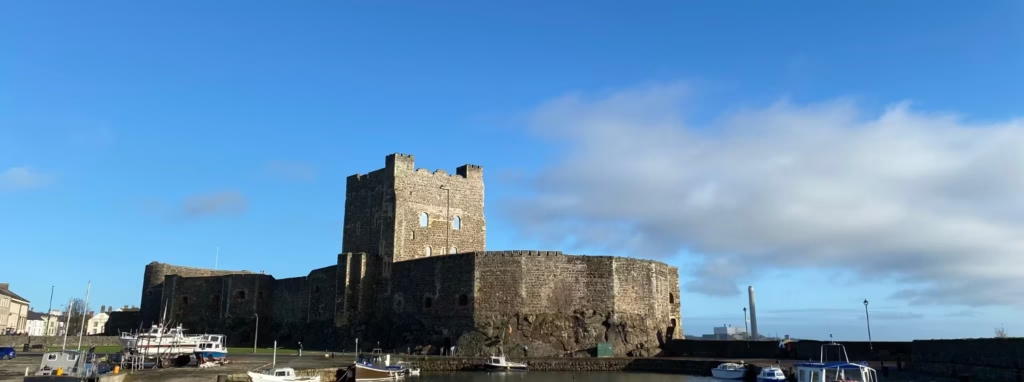
Carrickfergus Castle endures as one of the most complete and evocative Norman fortifications in Ireland. Its massive keep, curtain walls, and sea-battered gatehouse preserve nearly nine centuries of history. Through centuries of siege, repair, and adaptation — from the Anglo-Norman foothold of John de Courcy in the late 12th century to later English garrisons and Tudor refortification — the site has remained continuously occupied and strategically relevant.
Today, visitors can still trace the footprint of the walled town, walk the ramparts overlooking Belfast Lough, and step through chambers once used by Norman lords, Tudor soldiers, and 18th-century governors. While the castle is itself obviously worth visiting – it has notably a great children’s educational room – there is also a hidden harbour entrance worth exploring (just around the base of the castle), the town walls within 5mins walking distance, and the town museum also within 5mins. All can be seen in less than 90mins.
Frequently Asked Questions: Carrickfergus Castle
Carrickfergus Castle was begun around 1177 by John de Courcy, a Norman knight who invaded Ulster from England. It was constructed shortly after his conquest of east Antrim and served as his main stronghold and administrative centre.
Life within the castle walls was a blend of defence and domestic routine. The great hall hosted feasts, court sessions, and religious observances, while the lower wards housed craftsmen, garrison soldiers, and supplies. The adjoining walled town provided markets, workshops, and a harbour.
Its coastal setting made it both a fortress and a port unlike those inland, guarding routes between Ireland, Scotland, and England. Architecturally, it retains more of its original Norman keep and curtain wall than most Irish castles of the same era.
The castle is one of the earliest and best-preserved Norman structures in Ireland. It played a pivotal role in controlling access to Ulster and Belfast Lough, witnessing sieges by Scots, Irish chieftains, English monarchs, and even a French fleet in 1760.
YOU MAY ALSO LIKE
 Bangor Abbey: History & Legacy of the Medieval Monastic Site
 Ballyaghagan Cashel: Belfast Hills Stone Ringfort Guide
![Dun Ailinne Excavation Photograph. Hamish Forbes. Notebook East Area 1975 Book 3 Hamish Forbes Field Notes. Text [Type]. Digital Repository of Ireland (2024) [Publisher]. https://doi.org/10.7486/DRI.ns06j259](https://www.danielkirkpatrick.co.uk/wp-content/uploads/2024/09/Dun-Ailinne-Exacation-Photograph-120x120.jpg) Dun Ailinne: Exploring Leinster’s Ancient Royal Hillfort
Dun Ailinne: Exploring Leinster’s Ancient Royal Hillfort
 Iron Age Clothing in Ireland: What People Really Wore
 Iron Age Trade in Ireland: Networks, Imports, and Economic Life
 Ancient Irish Society: Language, Law & the Structures of Kinship
 Irish Festival Names Explained: The Etymology of Samhain, Imbolc, Bealtaine and Lughnasadh
 Antrim Round Tower: History of Antrim’s medieval monastic site