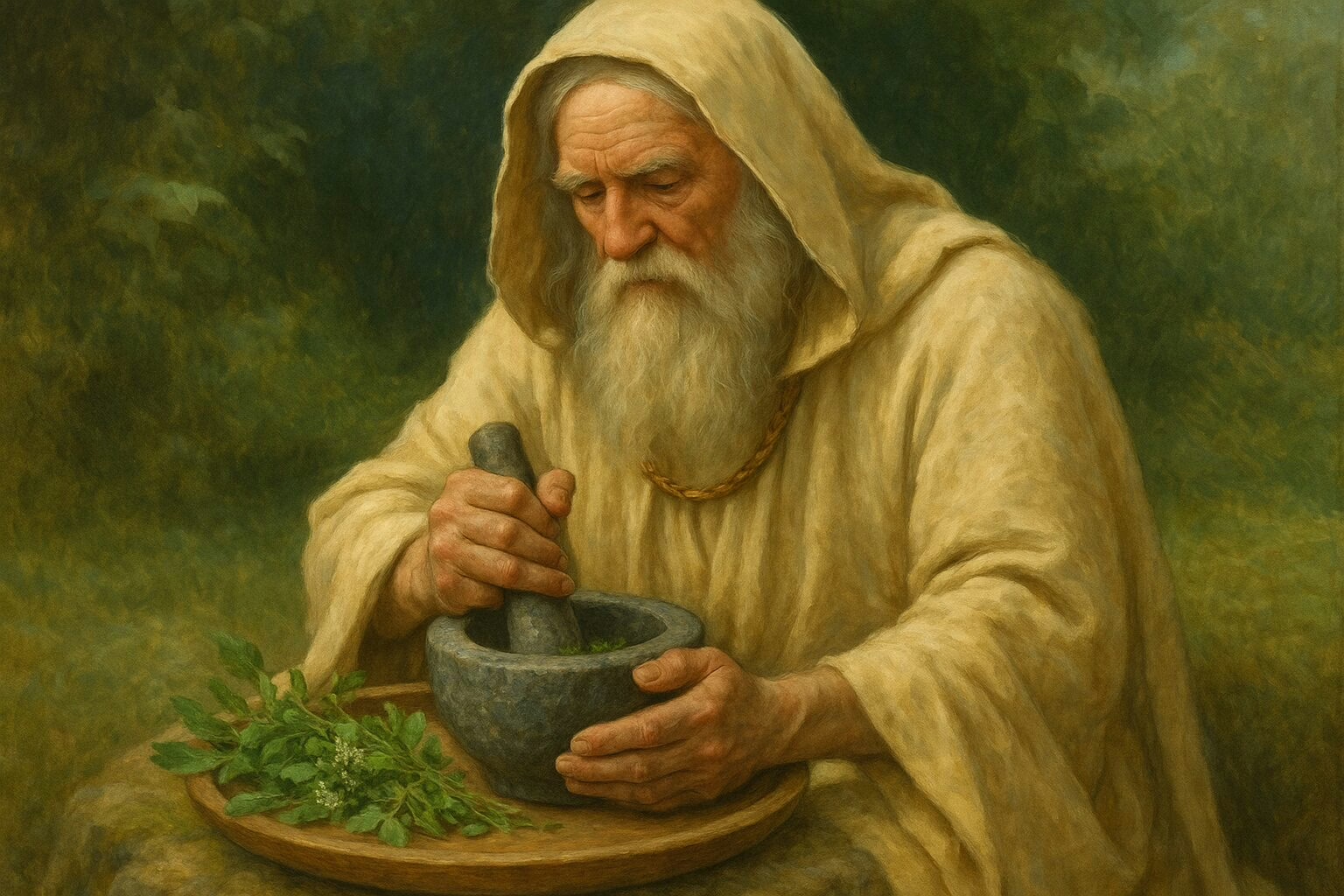
The history of health and medicine is a fascinating subject in its own right. I often take for granted the modern luxuries of penicillin, hospitals, and the healthcare that we all depend upon. And yet, in early Irish society there was an incredible ancient equivalent. Rather than the naive and ignorant portrayals we frequently see, Ireland had a professional class of healers. At the top of this world stood the Ollamhs — master scholars and guardians of wisdom. These figures weren’t just poets or historians. Some were healers, trained in the use of herbs and the cures passed down through generations. Their world was one where poetry, medicine, and myth blended into a single tradition. And in such a world – as is the case today – knowledge meant power.
To understand this incredible role of Ollamh, this post explores the history and archaeology associated with them in ancient Ireland. I focus on their herbal knowledge, how it shaped healing practices, drawing on references from historical texts, etymology, and folklore & mythology. So join me as I consider the power of the ancient Ireland Ollamhs.
Who were the Ollamhs?
The word ollamh (pronounced UL-uv) comes from Old Irish and means “great expert” or “master.” It was the highest rank a learned person could achieve. Ollamhs were part of an elite class that included poets, judges, historians, and physicians. Each type had a specialised role, but all were trained over many years in the oral and written traditions of early Ireland.
Brehon Law recognised the Ollamh’s authority. An ollamh leighis was due respect equal to a nobleman. They were exempt from certain taxes and could carry a staff of office. This status was recognised in law but earned through years of learning and service. It granted them privileges — including land, status, and protection — in exchange for their service to kings and communities. A poet Ollamh, for example, might be expected to compose praise-poems or preserve genealogies. A physician Ollamh, or ollamh leighis, would be consulted for cures and medical advice.
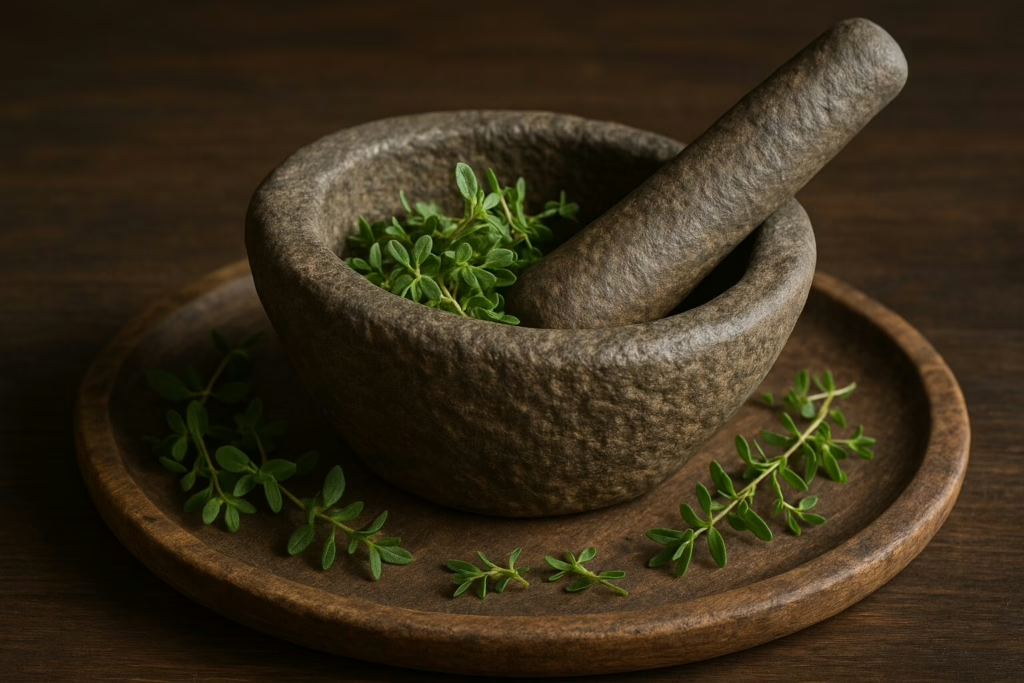
A physician’s toolkit was both mental and physical. They memorised verses detailing plant properties and recorded recipes in ink on vellum. These recipes often mixed native herbs with ingredients brought by trade — such as vinegar or resins. They also treated wounds using honey, moss, or fat — each with its own healing use.
Ancient Healthcare Professionals
Several Gaelic medical schools are recorded in later medieval sources. Places like Aghmacart in Laois and Aghrim in Galway trained generations of doctors (likely 1100-1600AD). Though many of these schools flourished after the Norman arrival, they built on older traditions. Medical manuscripts in Irish and Latin were copied and taught in these centres. Some even borrowed material from Arabic and Greek sources, blending global learning with local cures.
Training could take anything from 5 to over 19 years – far dwarfing even our modern medical degrees. Students memorised thousands of lines of verse, legal rulings, and plant names. They learned by repeating what they heard — a method suited to a society where writing was rare and valued.
Other cultures had similar roles. In Gaul and Britain, druids acted as both priests and scholars. In Rome and Greece, formal schools trained doctors in herbal medicine. But in Ireland, the Ollamh combined many of these traditions into one. Their influence was woven deeply into everyday life — from healing wounds to guiding kings.
This is clearest when we turn to the ancient mythology of Ireland.
Table: Hierarchy of Gaelic Medical Practitioners
| Grade | Training Years | Permitted Procedures | Legal Fee (example) |
| Fisig (Healer) | 5 | Simple wound salves; herbal teas | 1 sheep for herbal poultice |
| Liaig (Physician) | 12 | Bone-setting; blood-letting | 1 milk cow for fracture |
| Ollamh Liaig | 19+ | Surgery; plague response; teaching | 7 milk cows for high-king’s chest wound |
Healing in Irish Myth and Folklore
Healing was never just physical in early Irish thought. It was spiritual, poetic, and often wrapped in mystery. Many myths link healing powers to sacred places or magical objects. These stories helped explain the role of herbs, giving them meaning beyond their chemical properties.
One of the best-known examples is the god Dian Cécht. As the healer of the Tuatha Dé Danann, he used herbs to heal wounds from battle. However, according to Cath Maige Tuired, Dian Cécht’s son Miach restored Nuada’s arm so perfectly that Dian Cécht, consumed by envy, struck him down. From Miach’s grave, 365 herbs sprang — one for every joint and sinew in his body. His sister Airmed tried to gather and organise them, but Dian Cécht scattered them, ensuring that no mortal would ever master them all.
This myth speaks to a wider belief: that herbal knowledge came from the divine. It also shows how healing could be a source of power and rivalry, even among the gods. Ollamhs who dealt in herbs may have drawn status from this sacred tradition.
Folklore collected in later centuries adds to this picture. Certain plants were gathered at specific times — like dawn on May Day — and only with spoken charms. Wells and springs were believed to cure illness if visited with proper rituals. These practices often combined Christian and older beliefs, showing continuity with the world of the Ollamh.
Historical Timeline of the Ollamh Liaig
The documentary arc of the ollamh liaig stretches a full millennium, yet its high points cluster in two centuries before Tudor rule. Below is a consolidated chronology, cross-checked against annals, legal tracts and manuscript colophons; where dates or events remain uncertain, that ambiguity is flagged.
| Century | Milestone | Evidence & Reliability | Counter-Notes |
| 7 th | Senchas Már codifies physician fees; ollamh entitled to land | Survives in 14 th-c. redactions; linguistic archaisms suggest earlier core | Some scholars (Kelly) warn of possible later interpolation |
| 10 th | Ó hÍceadha dynasty first attested in genealogies as liaig to Dál gCais | Book of Ballymote pedigree lists; internal dating c. 1390 | Genealogical top-loading may project lineage backwards |
| 12 th | Mac Duinnshléibhe kings of Ulaid dispossessed; re-emerge as physicians in Connacht | Annals of Tigernach 1170 + Connacht rent-rolls 1231 | Political exile, not medical skill, may have driven migration |
| 1349 | Black Death: annal grants physicians exemption from military levy | Annals of the Four Masters entry; reliable date consensus 1348–49 | Extent of epidemic outside towns still debated |
| 1466 | Compilation of Book of the O’Lees | Colophon in RIA MS 23 P 10 (ii) gives scribe & date | Ink-study ongoing; small chance of later re-date |
| 1538 | Crown Fiant revokes Ó Conchobhair medical freehold at Aghmacart | Fiant Rolls of Henry VIII; State Paper accuracy high | Some lands re-granted 1552—status in flux |
| 1558–1585 | Tudor statutes target “Irish disguised as physicians”; seizure of herb gardens | Statute rolls + Privy Council letters; partial enforcement indicated by tax returns | Gaelic lords continued to employ ollamh privately |
| 1603 | Donnchadh Albanach Ó Conchobhair appointed clan doctor on Skye | Scots Privy Seal register; external corroboration of Irish medical export | |
| 1611 | Dissolution of Aghmacart school; lands leased to English settler | Plantation grants; corroborated by absence of later manuscript colophons |
Herb Lore in Early Ireland – Archaeological & Historical Evidence
The use of herbs in healing was common across ancient cultures, but in Ireland it took on a unique blend of the practical and the sacred. Knowledge of plants — their names, effects, and preparation — was passed from master to pupil, often within learned families.
Archaeological finds suggest the use of herbal remedies long before the written record. Pollen analysis from ancient sites has revealed plants like yarrow, meadowsweet, and chamomile — all known for their healing properties. Literary sources confirm their use. Texts such as the Lebor na hUidre and Táin Bó Cúailnge mention herbs used in battle or ritual.
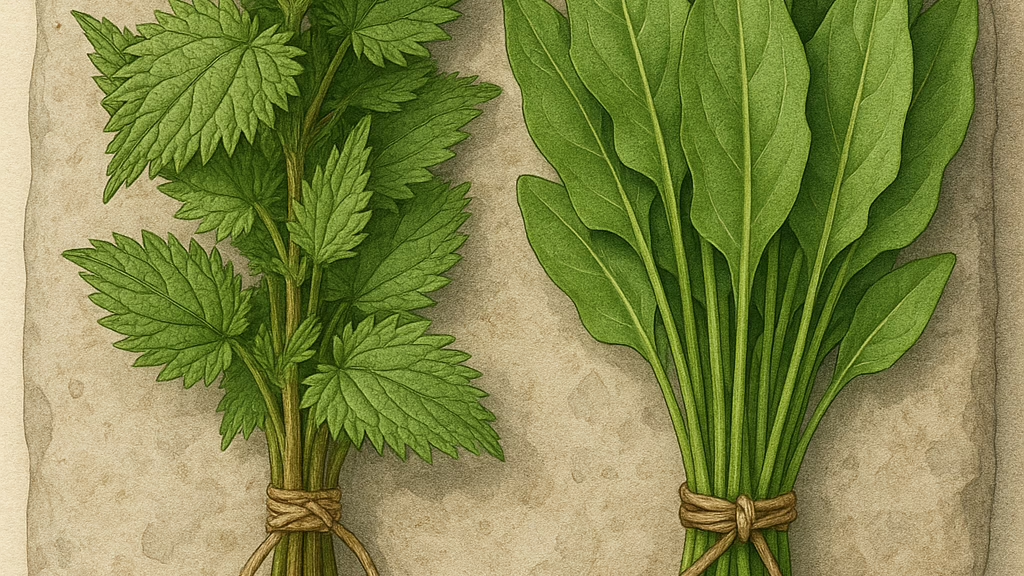
In Brehon Law, fines were assigned for failing to treat wounds properly. This hints at an organised system of care, where trained physicians were held accountable. These practitioners relied on plants to clean wounds, reduce fever, and ease pain. Yarrow (athair thalún), for instance, was known for stopping bleeding. Meadowsweet (cneamh), rich in salicylates, acted as a pain reliever — much like aspirin today.
The Irish names for herbs often reveal their use. Lus na gréine (herb of the sun) may have been associated with vitality. Lus an phiobaire (piper’s herb) hints at connections between plants and the poetic or musical traditions. This link between nature and culture was central to how Ollamhs understood the world.
Table: Five Plants from Gaelic Manuals vs Modern Science
NB: Do not interpret the below as medical advise. Professional medical advise should always be taken before using alternative medicines.
Tadhg Ó Cuinn’s 15th-century Materia Medica lists 282 plants in Latin, Gaelic and vernacular gloss, many native: watercress for liver heat, yarrow for wound stanching, meadowsweet for fevers . Modern pharmacology validates salicylates in meadowsweet, lending retrospective credibility; yet some entries (e.g., raven’s gall for cataracts) reflect dogma, not evidence—reminders that ollamh practice straddled empirical and humoral worlds.
| Gaelic Name | Latin | Prescribed Use (MS) | Modern Active Compound | Modern Verdict |
|---|---|---|---|---|
| Iar-og | Achillea millefolium (yarrow) | Stops bleeding | Alkaloids; anti-inflammatory | Supported |
| Croidh-chugall | Filipendula ulmaria (meadowsweet) | Cools fever | Salicylic acid | Supported |
| Creach-luachra | Myrica gale | Repels worms | Myricetin | Partial |
| Drualus | Digitalis purpurea (foxglove) | Heart weakness | Digitalis | Effective but toxic |
| Loscann | Ranunculus spp. | Draw boils | Protoanemonin (vesicant) | Obsolete |
Place Names and the Language of Healing
Traces of Ireland’s herbal traditions survive in the very names of places. Many towns and landmarks are linked to healing springs, sacred herbs, or sites once known for learned families.
The prefix Tobar (meaning “well”) often signals a holy or healing site. Tobar Sláinte — “well of health” — appears in several counties. These were places where people once gathered for cures, particularly on feast days or at seasonal festivals.
Other names preserve references to plants. Doire Lus could be interpreted as “oak grove of herbs,” with lus being the Irish for herb or plant. Even field names recorded in older surveys sometimes carry these associations, though many have been lost or anglicised.
Etymology also gives us clues. The Irish word leighis means healing, and it appears in surnames, such as O’Leighin. Lus is common in folk plant names, such as lus na gréine (sun herb) or lus mór (great herb – often dock or burdock).
In some cases, families were remembered in place names due to their learned role. A site once occupied by a physician’s family might retain the name in a townland or local landmark. While not always easy to trace directly, the overlap of language, land, and healing hints at how deeply rooted this tradition was.
Legacy and Survival
The role of the ollamh leighis faded after the arrival of the Normans and the decline of Gaelic lordship. By the seventeenth century, many of the medical families had lost their lands or dispersed. The bardic schools closed, and manuscripts were hidden, sold, or lost.
Yet much survived. Folk cures, seasonal rituals, and herbal practices were preserved by local healers and families. Some were recorded by collectors in the nineteenth and early twentieth centuries. Others lived on in whispered advice or garden lore passed between generations.
In the Irish language, the words endured. Leighis (healing), lus (herb), and ollamh (master) remain in use. Their meanings may have shifted, but their roots trace back to this older world. So while the ollamh leighis may no longer walk the roads of Ireland, their knowledge lingers in the language, the land, and the folk memory.
Frequently Asked Questions: Irish Ollamhs and Ancient Herbology
An Ollamh was a master scholar, the highest rank in early Irish learning. Some were poets or historians, while others were trained physicians known as ollamh leighis.
Yes. Trained healers and physician families used local herbs like yarrow, meadowsweet, and dock for treating wounds, fevers, and pain.
Plants such as yarrow (athair thalún), meadowsweet (cneamh), and dock (lus mór) were widely used. Their names often survive in Irish folklore and place names.
Yes. Myths like those of Dian Cécht, the healing god of the Tuatha Dé Danann, show how plant lore was seen as sacred and powerful.
YOU MAY ALSO LIKE
 Roman Influence on Ireland: Trade, Culture and the Limits of Empire
 Iron Age Clothing in Ireland: What People Really Wore
 Corrstown Bronze Age Village: Ireland’s Largest Settlement
 Etymology of Irish Animal Names: Myth & Language Revealed
 Irish Festival Names Explained: The Etymology of Samhain, Imbolc, Bealtaine and Lughnasadh
 Cailleach – Ireland’s Winter Hag and Shaper of Mountains
 Danu (Dana): Celtic Mother of the Irish Gods
 Iron Age Trade in Ireland: Networks, Imports, and Economic Life