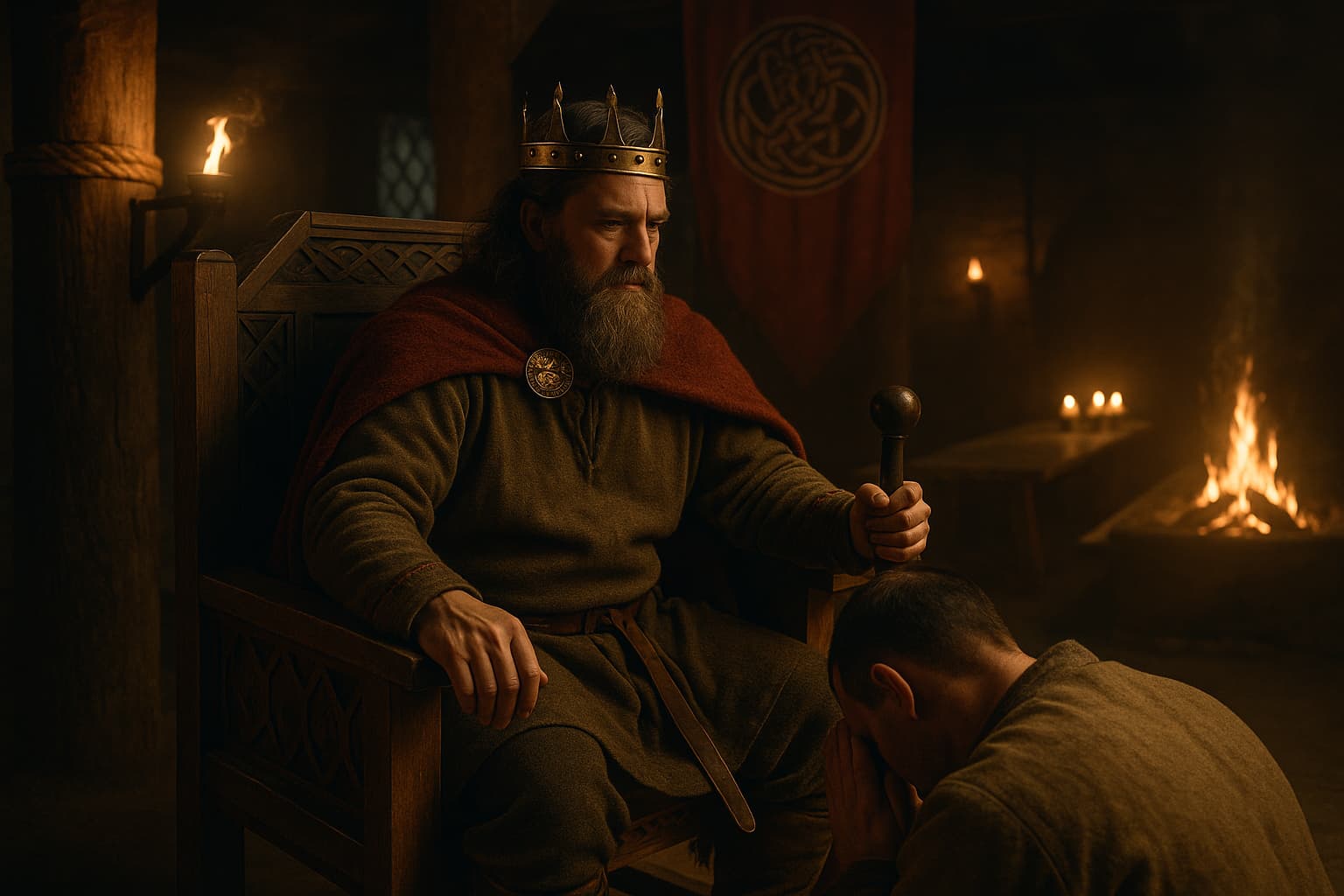
Before Christianity, before the Normans, and even before the first major kingdoms took shape, Ireland’s social landscape was defined by networks of kinship, alliance, and tradition. Known collectively today as the ancient Irish society, this structure was both decentralised and highly ordered—built on tribal groupings known as túatha, governed by customary law, and shaped by a linguistic heritage still visible in Irish today. It was organised from the smallest kin group (fine) to the larger tribal unit (túath), upward toward regional kingship (rí ruirech) and, eventually, the Ard Rí or High King.
But it was not merely a hierarchy of rulers. The system reflected a complex understanding of status, duty, and community, deeply embedded in the legal framework of Brehon law and the Irish language itself. By examining the terminology—túath, fine, derbfine, aire, nemed—we can trace the shape and purpose of these institutions. Social roles were so integrated with legal function that one’s identity was tied to their group, their obligations, and their position.
The Túath: Ireland’s Foundational Social Unit
In early Irish society, the túath (plural: túatha) was the basic political and social unit—often translated as “tribe” or “people”, but meaning far more than either term suggests. It was not a territorial state in the modern sense, but a community of people bound by kinship, law, and mutual obligation, usually occupying a defined area of land. Each túath had its own legal system, king (rí), and assembly (óenach), and could range in size but typically over 6,000.
The túath was largely self-governing, yet often existed in a network of alliances and overlordship with neighbouring túatha. In total, early medieval Ireland may have had over 150 such túatha at any one time (potentially much more), each functionally autonomous but interconnected through marriage, warfare, tribute, and ceremony.
What made the túath so unique was its fusion of law, language, and lineage. Brehon law placed the túath at the heart of political legitimacy. A king did not rule a geographical region in the abstract; he ruled a people—his túath. The túath’s assembly could depose a king who failed in his obligations, revealing a remarkably early form of collective governance.
Key Features of the Túath in Ancient Irish Society
| Feature | Description |
|---|---|
| Meaning | From Old Irish túath, meaning “people” or “tribe”; originally related to Teutā in Celtic and Germanic languages. |
| Size | Typically over 6,000 people; encompassing extended families and clients. |
| Structure | Governed by a rí túaithe (king), advised by nobles and legal experts (brehons). |
| Law | Operated under Brehon law; túath could make local legal decisions via assembly (óenach). |
| Role | Core unit of identity, legal responsibility, and land ownership. |
| Assembly | The óenach functioned as a forum for dispute resolution, lawmaking, and ritual gatherings. |
| Language Insight | Cognate with Gaulish touta and Gothic þiuda, showing pan-Celtic concept of tribal identity. |
The túath was not static. Some túatha combined into larger units under a regional king (rí ruirech), while others broke apart due to feuds or succession disputes. But the principle of the túath remained foundational: social identity was rooted in kinship and shared legal tradition, not territorial borders.
Next we’ll explore the smaller, inner layers of this social structure: the fine (kin group) and derbfine, which governed family ties, inheritance, and status.

Clan and Kinship: The Fine and Derbfine
Beneath the broader framework of the túath lay the fine—the extended family group that was the fundamental unit of identity and legal responsibility in ancient Irish society. The term fine (pronounced fin-eh) refers to a group of kin who shared a common ancestor and were tied together through obligations of support, protection, and inheritance. A person’s rights, status, and responsibilities were determined largely by their position within their fine.
One of the most important subdivisions of the fine was the derbfine. This comprised a person’s relatives within four generations: usually including their father, grandfather, great-grandfather, and all male descendants from those ancestors, along with collateral male kin (brothers, uncles, cousins). It was this group that had legal standing for key functions like inheritance, land ownership, fostering, and even the election of kings.
While the modern notion of “clan” is sometimes used loosely, it’s important to distinguish that clans in medieval Irish history were not fixed tribal units, but networks of extended kinship, constantly evolving and branching as generations passed.
Table: Kinship Groups in Ancient Irish Society
| Term | Description | Role in Society |
|---|---|---|
| Fine | Extended kin group descended from a common ancestor | Legal and social unit; responsible for paying fines, supporting members, arranging marriages |
| Derbfine | Subset of the fine within four generations | Primary legal unit for inheritance, succession, and landholding |
| Cenél | Larger kin group or kindred (often forming the basis of a ruling dynasty) | Political and dynastic term used to define broader family alliances (e.g. Cenél nEógain) |
| Clann | Literally “children”, used later to describe large kin groups | Came into use in later medieval sources as surnames and lineages solidified |
| Fosterage (altram) | Common practice of raising children in another fine | Built alliances between families and túatha; children gained status and protection |
These kinship units were not just social—they were legal entities. If a member of the fine committed an offence, the group was collectively responsible for compensation. If someone died without heirs, their property reverted to the fine. A person without a fine—such as an outsider or freed slave—had limited legal standing under Brehon law, showing just how central kinship was to social survival.
Next, we’ll move up the ladder again and examine the layers of kingship in ancient Irish society—from the local rí túaithe to the Ard Rí of legend and history.
Kingship and Hierarchy: From Rí Túaithe to Ard Rí
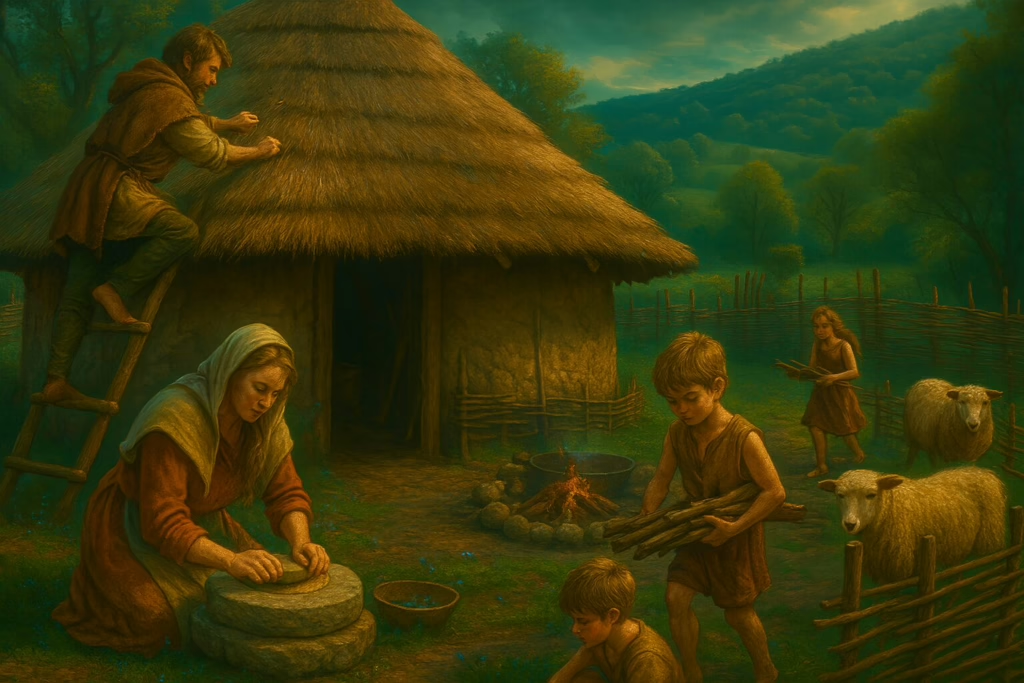
Ancient Irish society was hierarchical but decentralised. At its apex stood kings (rí)—but unlike in many medieval European states, kingship in Ireland was layered, conditional, and deeply tied to kinship and ritual legitimacy.
The basic king (rí túaithe) ruled a single túath. His power was not absolute: he was expected to uphold justice, maintain peace, and preside over ceremonies and assemblies. He ruled with the consent of his people, and could be deposed for failure in duty. Above him were regional and provincial kings, and, at the very top, the Ard Rí—the so-called High King of Ireland (rí Érenn), based at sites like Tara.
This hierarchy was not a strict pyramid, but a web of personal relationships, mutual obligations, and political alliances. Overkings (rí ruirech or rí cóicid) were often chosen from among subordinate kings. Crucially, kingship was not inherited by primogeniture, but rather through tanistry—a system in which the successor (tánaiste) was elected during the king’s lifetime, usually from the derbfine.
Kingship carried both political and sacred significance. A king was bound to ritual obligations, including marriage to the sovereignty goddess in mythic terms, and to the fír flathemon—the “truth of the ruler”—by which the land prospered only under just leadership.
Table: Irish Kingship Levels and Roles
| Title | Translation / Role | Scope |
|---|---|---|
| Rí Túaithe | King of a single túath | Local authority; elected from within ruling derbfine |
| Rí Ruirech | Overking or provincial king | Ruled over several túatha; recognised overlordship |
| Rí Cóicid | King of one of the five provinces (cóiceda) | Rare; examples include kings of Munster, Ulster, etc. |
| Ard Rí | High King of Ireland | Ceremonial overlord of all Ireland, based at Tara; mostly symbolic power before 9th century |
| Tánaiste | Designated heir or deputy | Chosen from eligible kin during the king’s reign |
| Fír Flathemon | “Truth of the ruler” | Ideological basis of kingship—justice, truth, and rightful order ensured prosperity |
Irish kingship was, therefore, neither absolute nor permanent. Kings could be deposed, killed in battle, or even ritually rejected if misfortune was seen as a sign of divine disfavour. This blend of law, myth, and politics makes Irish kingship distinct from feudal monarchies elsewhere in Europe.
Next, we’ll explore the legal backbone of this social system: the Brehon laws, which defined everything from kingship to cattle raids.
The Role of Brehon Law in Social Order
At the heart of ancient Irish society lay Brehon law (fénechas)—a sophisticated and decentralised system of customary law that governed every aspect of social interaction. It was not imposed by a central authority, but administered by professional jurists known as brehons (brithem), who interpreted and recited law based on memorised precedents and case law.
Unlike Roman or English law, Brehon law was restorative rather than punitive. Its focus was not on punishment or incarceration, but on restoring balance through compensation, honour-price, and arbitration. It regulated status, marriage, land, contracts, insult, injury, and even satire. The law was deeply embedded in social rank, with obligations and penalties calculated according to a person’s status group (aicme).
Importantly, Brehon law preserved an early Irish worldview in which community, reputation, and reciprocity were central. Every person was embedded in their fine, and legal responsibility extended across kinship networks. Even kings were not above the law—on the contrary, they were its primary enforcers and subjects.
Key Features of Brehon Law
| Feature | Description |
|---|---|
| Legal Authority | Administered by brehons; not state-imposed or centrally codified |
| Focus | Restorative justice—compensation (eric), honour-price (lóg n-enech), restitution |
| Basis | Oral tradition, precedents, and judgments passed down and memorised |
| Social Role | Reflected and reinforced the existing social structure and status hierarchy |
| Women’s Rights | Complex; women could hold property and initiate divorce, but were still legally dependent in many respects |
| Kin Liability | Fines and compensation paid by the fine; collective responsibility underpinned social cohesion |
| Flexibility | Adaptable across regions and túatha; allowed for variation within a shared cultural-legal framework |
Brehon law was deeply entwined with status and speech. Poets could injure with words, contracts could be sealed by oaths, and even satire (áer) could legally damage a person’s honour-price. Language didn’t just reflect law—it was the law, binding society through spoken tradition and reputation.
Language as a Window: What Irish Terms Reveal About Society
The structure of ancient Irish society was not only upheld by law—it was encoded in the language itself. The Irish lexicon of the early medieval period offers profound insight into how people conceptualised identity, authority, duty, and status. Terms were not just descriptive—they were prescriptive, defining a person’s role and obligations within the social order.
For example, the word túath didn’t mean territory—it meant people. This indicates that Irish political identity was communal, not geographic. Similarly, the term fine implies both kin and legal responsibility. These terms highlight a society where social ties outweighed spatial boundaries, and law emerged from relationship, not state power.
Moreover, the legal and poetic registers of Old Irish contained a wealth of nuanced vocabulary to describe status, honour, and law. Words like nemed, aire, and fír flathemon reveal a world where speech, truth, and justice were deeply interwoven.
Table: Key Terms and What They Reveal
| Term | Literal Meaning | Social Insight |
|---|---|---|
| Túath | People, tribe | Political identity was communal and kin-based |
| Fine | Kin group | Legal personhood was tied to extended family |
| Derbfine | “True kin” (four generations) | Legal succession and inheritance group |
| Aire | Noble, freeman | Refers to multiple ranks of nobles; title tied to land, duty, and honour-price |
| Nemed | Sacred, privileged | Designated a legally protected or elite class (often poets, scholars, or ecclesiastics) |
| Fír Flathemon | Truth of the ruler | Myth-legal concept where just kingship leads to prosperity |
| Lóg n-enech | Honour-price (“price of the face”) | Status quantified in legal terms; insults or injuries required restitution |
| Brehon (brithem) | Judge | Rooted in speech, not enforcement; justice as interpretation, not command |
| Altram | Fosterage | Familial ties extended through cultural and political exchange |
Therefore, language in ancient Irish society was not ornamental. It was the medium of law, identity, and memory. Oral tradition, poetry, and legal judgment all depended on precision of expression. The Irish worldview was spoken into being—and it is through these words that we can still read the shape of that world today.
Order Without State – The Flexibility of Iron Age Society
Ancient Irish society – as revealed through its language, laws, and structures – was a remarkably cohesive yet decentralised system. It lacked a centralised state or standing army. There were no cities, no bureaucracy, and little sense of unified political control over the entire island. Yet despite this, early Ireland was not anarchic. It was instead carefully ordered through kinship, custom, and speech.
The túath provided the framework for political identity, while the fine and derbfine defined a person’s legal and social belonging. Kingship operated as a layered and ritualised institution, bound by tradition and legal obligation rather than absolute authority. And underpinning it all was Brehon law—a system of justice that was inherently personal, community-based, and reliant on the spoken word.
This was a world where legal rights were inherited, not granted. Where a man’s honour had a measurable value, and where truth and justice were inseparable from prosperity. Power did not lie in coercion, but in consensus, relationship, and reputation.
The Irish language preserves these ideas with exceptional clarity. Words like aire, nemed, fír, and túath are not relics—they are keys to understanding a worldview where society was not imposed from above, but negotiated from within.
Frequently Asked Questions: Ancient Irish Society
Ancient Irish society was structured around kinship-based units. The smallest group was the fine (extended family), followed by the túath (tribal community), and larger groupings ruled by regional or provincial kings. Society was decentralised but highly ordered through custom and Brehon law.
A túath was the fundamental political and legal unit in ancient Ireland. It referred to a community of people, not a territory, usually numbering several thousand. Each túath had its own king, legal system, and assembly, and functioned as a semi-autonomous society.
The fine was an extended family group responsible for its members’ welfare, legal obligations, and inheritance. A subset called the derbfine included relatives within four generations and played a key role in succession and landholding.
Irish kingship was layered and elective. A rí túaithe ruled a túath, while overkings and provincial kings oversaw multiple túatha. Kings were chosen from within the royal kin-group (derbfine) by tanistry, not by primogeniture. A High King (Ard Rí) was more symbolic than centralised.
YOU MAY ALSO LIKE
 Who was St Columba? Missionary, Monk, and Legend of Iona
 Iron Age Trade in Ireland: Networks, Imports, and Economic Life
 Irish Festival Names Explained: The Etymology of Samhain, Imbolc, Bealtaine and Lughnasadh
 Etymology of Irish Animal Names: Myth & Language Revealed
 Ancient Irish Proverbs and their Origins: Wisdom in a few Words
 Iron Age Clothing in Ireland: What People Really Wore
 Roots of Language: Irish Tree Mythology, Ogham & Sacred Law
 Ogham Tree Alphabet: Irish Script, Meaning & Origins