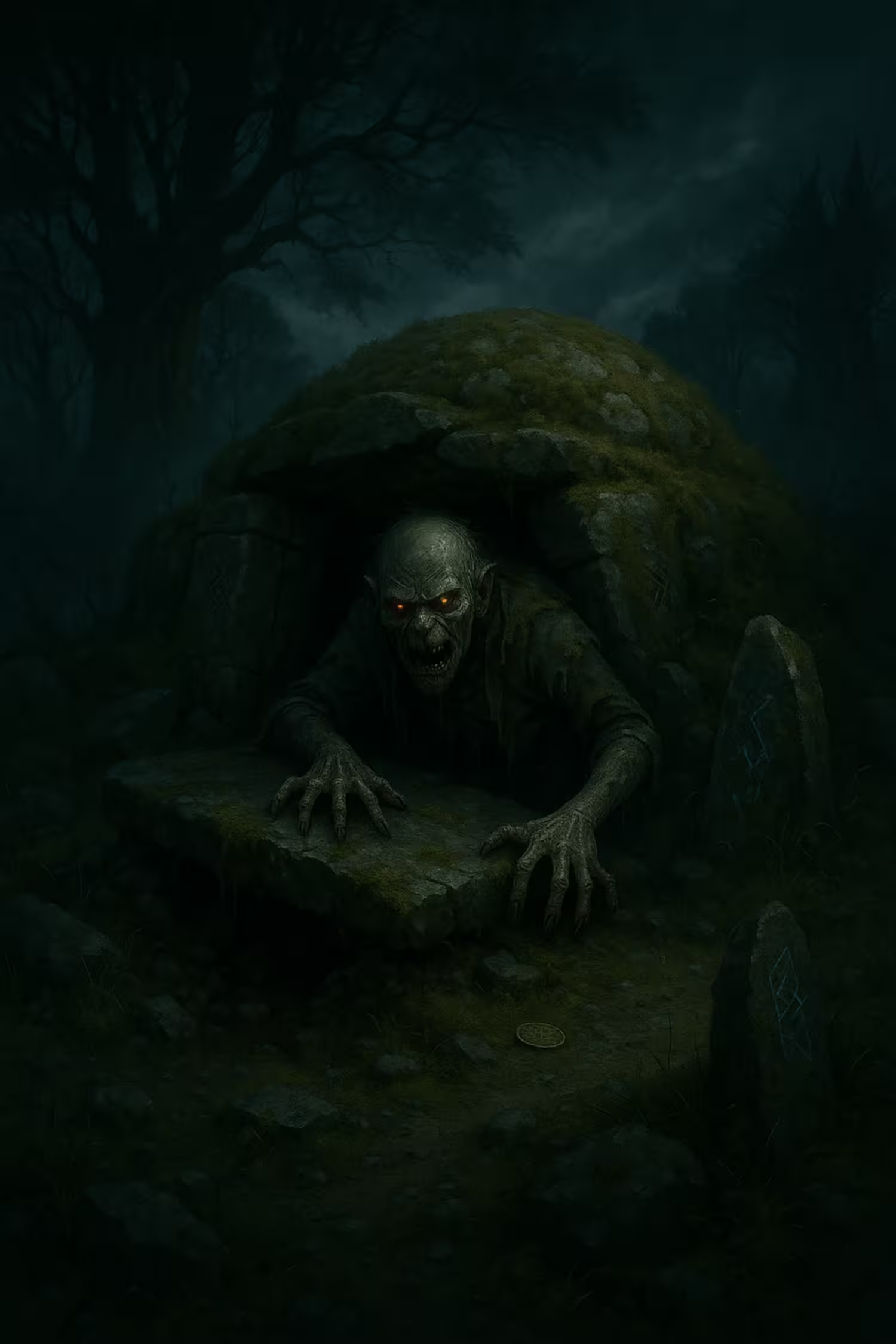
Among the many creatures of Irish mythology, few are as chilling as Abhartach [pronounced AH-wur-takh]. Said to be a cruel dwarf chieftain from County Derry, his story begins in life as a tyrant but continues after death in an even darker form. According to local tradition, Abhartach rose from his grave demanding blood from the living, binding his people in fear long after his burial.
The legend survives most vividly around Slaghtaverty, where a great stone-covered grave known as the “Giant’s Grave” is still pointed out as his resting place. Folklorists have described Abhartach as one of the earliest vampire-like figures in European tradition, and some have even suggested he may have influenced Bram Stoker’s Dracula. Whether seen as an Irish revenant or a precursor to vampire traditions, Abhartach remains one of the most unsettling figures in Ireland’s mythic past.
This post explores the origins and etymology of the creature, tracing its roots back into ancient Irish mythology, before considering the Abhartach’s folklore and legacy.
Abhartach Etymology and Origins
The name Abhartach (sometimes written Abhartagh or Avartagh) comes from Irish. It is generally understood to mean “dwarf” or “distorted one.” It enters Irish tradition relatively late, with the likely earliest surviving account recorded by the historian P.W. Joyce in his 1870 work The Origin and History of Irish Names of Places.
Joyce presents Abhartach as a sinister chieftain of medieval Ireland, described as a dwarf whose tyranny was so feared that, after his death, the local people rejoiced—only to find that he returned from the grave demanding blood from the living. This detail, the draining of blood, is what has led some to regard Abhartach as Ireland’s own “vampire,” predating the literary creations of Bram Stoker.
Yet, the fact that the story surfaces only in the 19th century cautions against projecting it back into medieval tradition. It is best understood as part of Ireland’s rich nineteenth-century folklore, though it draws upon older narrative themes of restless dead and supernatural punishment. Indeed, these earlier themes – dwarfs and blood-drinking – date back to some of the earliest recorded Irish myths.
Ancient Roots: Dwarves and Blood-Drinking
While Abhartach’s story is late, elements within it resonate with much older Irish tradition. The very term abhartach likely derives from Old Irish abacc, meaning “dwarf.” This word is attested as early as the 9th–10th century in Sanas Cormaic (Cormac’s Glossary). Other early traditions, such as those concerning the luchorpán (small, water-dwelling beings), reinforce the association of short figures with supernatural traits, long before Abhartach appears in record.
The second striking feature of the tale is blood-drinking. While Abhartach himself is a late entry, revenants who consume blood appear in much older Irish material. In the Echtra Nerai (Adventure of Nera), preserved in the 12th-century Lebor na hUidre, a corpse rises and demands a drink, refusing milk and insisting on blood. The episode suggests that beliefs about the hungry dead, and their connection to blood, were already established in the early medieval imagination.
Other examples exist in the wider mythological cycle. The Irish war goddess the Morrígan is described in the Táin Bó Cúailnge as reveling in the gore of battle, sometimes drinking blood from the slain. Similarly, the Fomorians, while not blood-drinkers, were remembered as extracting severe tributes from the Tuatha Dé Danann, draining their resources in a way later interpreted metaphorically as vampiric.
These traditions do not amount to “vampirism” in the modern sense, but they establish a native background of dwarfish figures with supernatural powers, and restless corpses or deities associated with blood. Against this backdrop, Abhartach’s legend reads less as a unique invention of the 19th century and more as a late crystallisation of much older Irish beliefs and myths—the dwarf as uncanny, and the dead as restless and hungry.

The Tyrant of Slaghtaverty
So who was the Abhartach and why does he matter? Well the narrative as preserved by Joyce is simple yet powerful. The story of Abhartach begins with his life as a cruel ruler in the district around Slaghtaverty in County Derry. Local accounts describe him as a dwarf or small, twisted man, but despite his stature he wielded great authority. He was feared more than respected, ruling through oppression and violence.
When he died — whether naturally or at the hands of an enemy varies across versions — the community might have expected relief. Instead, his death was only the beginning of their terror.
According to tradition, Abhartach could not rest in the grave. Soon after his burial, he returned from the earth, pale and twisted, demanding that his people supply him with bowls of blood. This gruesome tribute established him not only as a tyrant in life but a predator in death. Unlike the banshee, who warns of death, or the dullahan, who carries it out, Abhartach was himself undead — a revenant who crossed the line between worlds.
The people buried him again, but each time he rose back from the earth. His thirst for blood, and his refusal to remain in the grave, made him something more than a ghost. He was a walking corpse, a figure we might today describe as vampiric, long before the word “vampire” entered the Irish language.
The Defeat of Abhartach
In many accounts, the people turned to a local hero or warrior to put an end to Abhartach’s terror. This figure is sometimes called Cathán or given no name at all, but he fought and killed Abhartach not once, but several times. Each time Abhartach was buried, he clawed his way back, hungering for more blood.
The cycle only ended when a druid or Christian saint — the stories differ depending on whether the tale is framed in a pagan or Christian context — advised that Abhartach must be buried in a very particular way. He was to be pinned into the earth with a sword of yew or iron, placed upside down in his grave, and covered with heavy stones.
In some accounts, thorn bushes were planted above the grave, adding another layer of protection. These ritual acts were designed to bind him, stopping his return from the underworld.
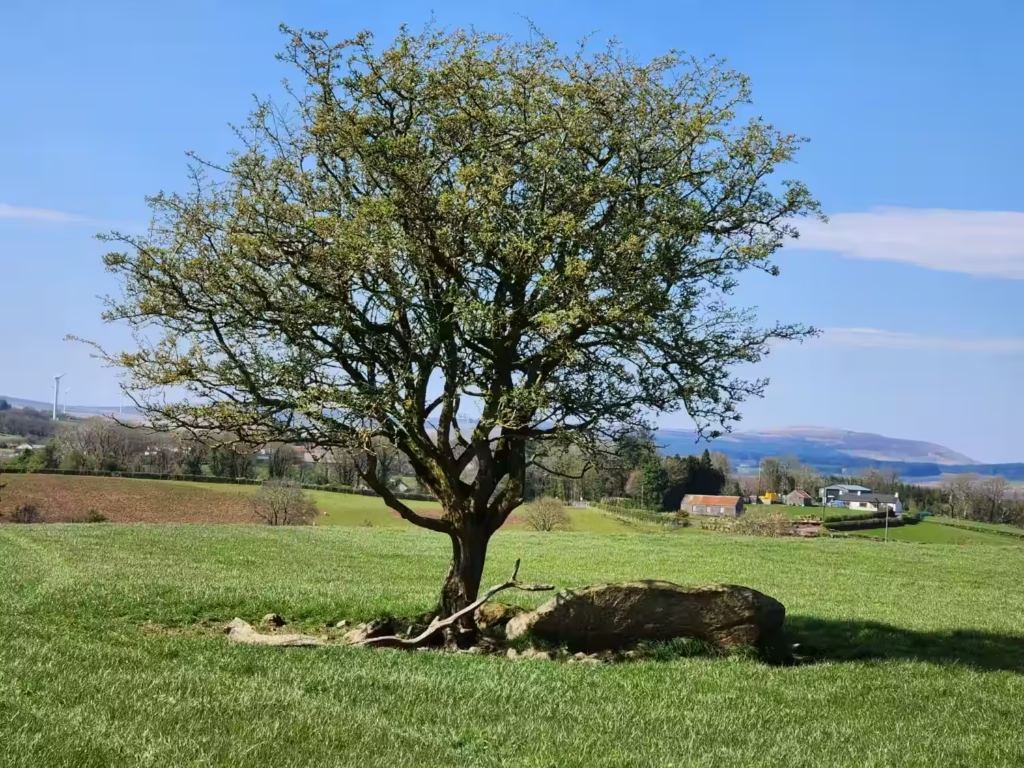
The Giant’s Grave at Slaghtaverty
The site of Abhartach’s supposed resting place is still pointed out today. There’s a large stone-covered mound beneath a hawthorn tree in Slaghtaverty, often called the “Giant’s Grave.” Though archaeologists identify it as a prehistoric tomb, local folklore insists that it holds the remains of the undead chieftain.
The association of Abhartach with the mound and hawthorn tree at Slaghtaverty ties him to Ireland’s wider sacred landscape. Much like fairy forts and ringforts, his grave is a sacred space — a place where the boundaries between the living and the dead are fragile. The warnings not to disturb the site echo the taboos surrounding fairy mounds, reinforcing a culture of respect (and fear) for the old places in the land.
Stories persist that bad luck follows anyone who disturbs the site. Farmers who tried to move stones, or meddle with the thorn tree, were said to have suffered accidents soon after.
A Proto-Vampire in Irish Folklore
What makes Abhartach unique in Irish mythology is his strong resemblance to the vampire archetype. He does not merely haunt, he consumes. He does not simply appear as a ghost, he rises in physical form. The detail of demanding blood from his people places him alongside European revenants, Slavic vampires, and even Norse draugr.
Because of these traits, scholars and folklorists have often described Abhartach as “Ireland’s vampire.” His legend predates Bram Stoker’s Dracula by centuries, and some have suggested that Stoker — born in Dublin and deeply interested in folklore — may have known of Abhartach’s tale.
While there is no proof, the parallels are tempting: a blood-drinking tyrant, buried in Ireland, who rises again and again despite attempts to restrain him.
Comparison between Abhartach and other Vampiric mythological creatures
| Creature | Culture | Main Traits |
|---|---|---|
| Abhartach | Irish (folklore, 19th c.) | Dwarf-like chieftain, repeatedly rises from the grave, demands blood, subdued only by ritual burial. |
| Revenant (general) | Widespread medieval Europe | Restless dead returning from the grave, often to harm the living or drain vitality. |
| Dearg Due | Irish folklore | Female spirit/vampire, said to rise from the grave to lure and drain men. |
| Vrykolakas | Greek folklore | Undead being feeding on the living, suppressed by ritual practices. |
| Draugr | Norse mythology | Reanimated corpse, often guarding treasure, capable of harming the living. |
| Slavic Vampire | Slavic folklore | Dead returning to drink blood, spreading plague, subdued by staking or burning. |
Legacy and Importance Today
Abhartach remains one of the darkest and most compelling figures in Irish mythology. As an undead dwarf chieftain who rose from his grave to drink the blood of the living, he embodies the fears of tyranny, restless death, and the consequences of upsetting the natural and supernatural order.
His legend is firmly tied to Slaghtaverty in County Derry, where the “Giant’s Grave” and its hawthorn tree mark a sacred space between the living and the dead. Across centuries, the story of Abhartach has evolved, blending pagan and Christian elements, yet its core remains: the terror of a figure who refuses to rest, and the human ingenuity required to contain him.
Beyond local folklore, Abhartach resonates in broader cultural memory as a proto-vampire, linking Irish myth to global vampire lore and inspiring fascination in literature and popular culture. He reminds us that some fears — the fear of death, of tyranny, and of the dead who return — are timeless.
Frequently Asked Questions: Abhartach
Abhartach was a legendary undead figure in Irish folklore, often described as a dwarf chieftain who rose from his grave to drink the blood of his people.
According to tradition, Abhartach’s grave lies in Slaghtaverty, County Londonderry, under a hawthorn tree known locally as the “Giant’s Grave.”
Many scholars and folklorists believe Abhartach is one of the earliest vampire-like figures in European folklore, possibly influencing later vampire legends.
Some researchers speculate that Abhartach may have influenced Bram Stoker’s creation of Dracula, though direct evidence is lacking.
The name is thought to come from Irish, meaning “dwarf” or “distorted one,” reflecting his unusual size or appearance.
YOU MAY ALSO LIKE
 Iron Age Clothing in Ireland: What People Really Wore
 Irish Festival Names Explained: The Etymology of Samhain, Imbolc, Bealtaine and Lughnasadh
 Iron Age Trade in Ireland: Networks, Imports, and Economic Life
 Etymology of Irish Animal Names: Myth & Language Revealed
 Nuada of the Silver Hand: King of the Tuatha Dé Danann in Irish Mythology
 Fomorians in Irish Mythology: Giants of Chaos and the Sea
 Ancient Irish Society: Language, Law & the Structures of Kinship
 Balor of the Evil Eye: King of the Fomorians