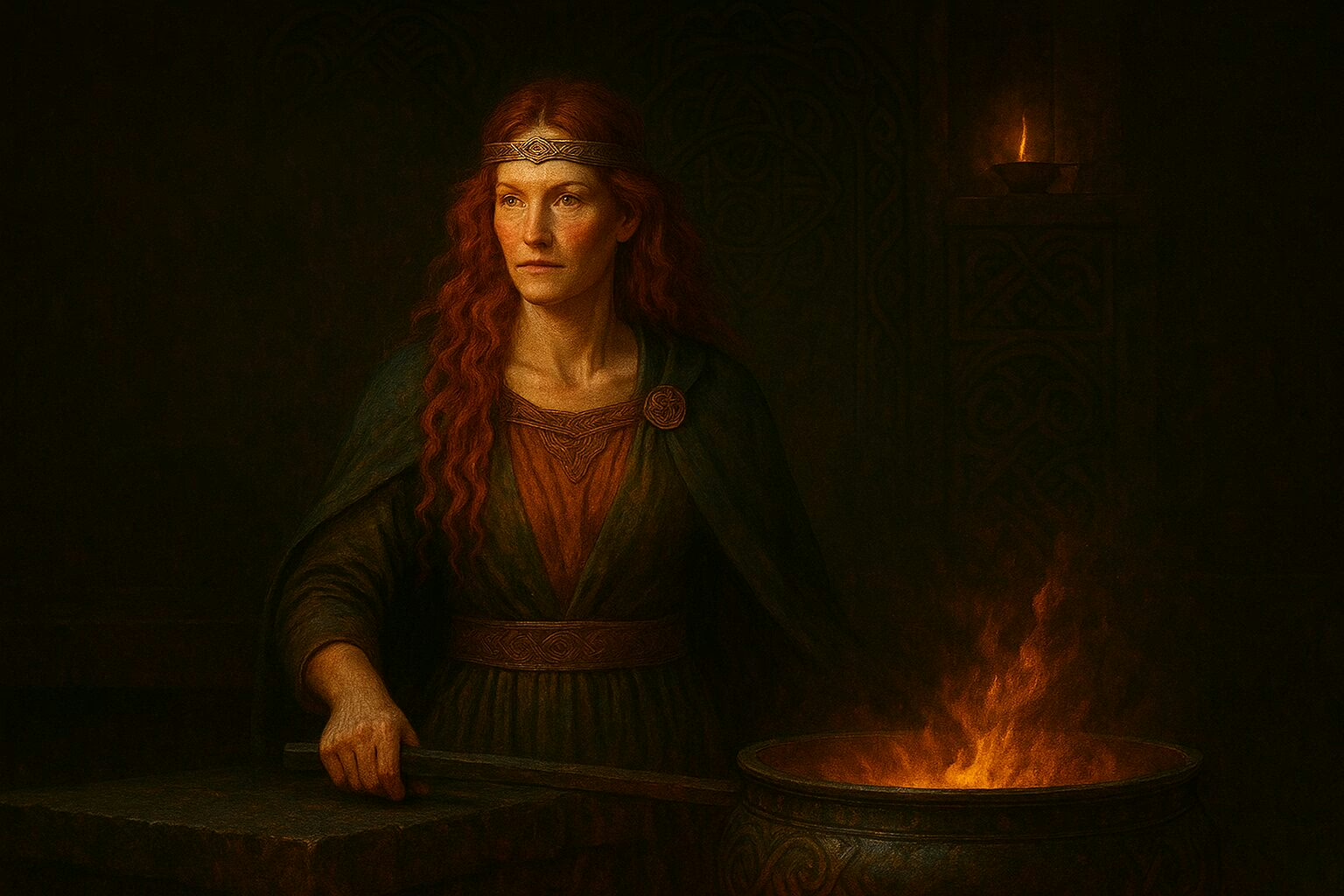
We have all felt the ceaseless strain of life which can feel relentless and overwhelming. We move from month to month with little opportunity to pause and reflect. Moments of quiet and peace in our modern Christian calendar has largely been eroded by inexhaustible noise of commercial narratives and events – Santa, bunnies, or chocolate. But even before the Christian calendar came into being, the ancient Irish followed a different natural calendar, one marked by nature’s seasons and cycles. And one which had a clear focal point for renewal – marked by Brigid, the Irish goddess of fire and fertility.
In the earliest Irish sources, Brigid is presented as a daughter of the Dagda, the powerful chieftain of the Tuatha Dé Danann. But unlike some of her divine kin who are known chiefly through epic exploits or battles, Brigid’s power lies in the quieter forces that shape life: creativity, healing, and the domestic hearth. She was honoured by poets and smiths alike, linked to the rhythms of nature, and remembered in wells, fires, and seasonal rites long after the old gods faded from official memory. Today she reminds us of the importance of pausing, of rest, and renewal. A lesson worth stopping to enjoy.
For this post explores Brigid as she appears in Irish mythology, distinct from the Christian saint who later bore her name. Drawing on early texts, ritual tradition, and cultural memory, we will uncover her origins, roles, and the sacred landscapes still connected to her today — from Imbolc festivals to the fires of Kildare. In doing so, we trace the story of a goddess whose influence survived the fall of her world, transforming but never extinguished.
Brigid’s Origins and Etymology
The name Brigid (Old Irish: Brigit) is thought to derive from the Proto-Celtic Brigantī, meaning “the exalted one” or “high one.” It shares roots with the name of the British goddess Brigantia, worshipped in Roman Britain, and with the Old Irish word brígh, meaning “power” or “strength.” This etymology reflects a status of reverence and authority, perhaps hinting at Brigid’s early role as a sovereignty figure or tribal tutelary goddess.
She appears in Lebor Gabála Érenn (The Book of the Taking of Ireland), where she is listed among the principal members of the Tuatha Dé Danann. It lists Brigid as the daughter of the Dagda, one of the chieftains of the Tuatha Dé Danann. She is described there as a goddess of poetry and wisdom, and is sometimes called a poetess (banfhile), which underscores her association with inspiration and the sacred word.
The Lebor Gabála also notes that she had two oxen, the Fea and the Femen, and a king of the boars called Torc Triath, as well as a sacred ram. These animals are said to cry out in warning when plagues or invasions are near. This motif places Brigid in the role of a guardian of Ireland’s wellbeing, closely tied to the land and its creatures — a role echoed centuries later in folk traditions about protecting livestock and warding off illness.
Some medieval sources claim that there were three Brigids, all daughters of the Dagda: one a poet, one a healer, and one a smith. Whether this reflects an ancient triadic form or a medieval attempt to synthesise diverse traditions remains debated. What’s clear is that Brigid was seen not just as a figure of power, but as a goddess of integration — bringing together multiple aspects of civilisation under one name.
Brigid in the Mythological Texts
Unlike many prominent figures in Irish mythology, Brigid does not appear at the centre of extended narrative cycles. She is not the protagonist of a great battle, nor is she the orchestrator of epic deeds. Yet her presence in the mythological record is nonetheless powerful — subtle, but significant. Rather than through detailed stories, Brigid is known through genealogical mentions, ritual references, and cultural memory.
One of the only myths in which Brigid plays a more direct role involves the death of her son, Ruadán. In some versions of the Cath Maige Tuired (The Second Battle of Mag Tuired), Ruadán, son of Brigid and the Fomorian smith Bres, dies in battle after turning against the Tuatha Dé Danann. Brigid mourns his death with such grief that it is said she invented keening (caoineadh), the ritual wail for the dead. Though a brief account, this tale gives Brigid one of her most human and affecting roles: that of the grieving mother who transforms personal loss into a cultural ritual. It positions her not just as a divine figure, but as the originator of emotional expression — a goddess whose sorrow becomes a communal language.
Outside these fleeting mentions, Brigid’s presence in the medieval manuscripts is largely inferential. The absence of a central myth has puzzled some modern readers, but it may point instead to her origin in pre-literate, pre-narrative ritual contexts. Unlike Morrigan or Lugh, whose reputations rest on heroic action, Brigid’s divinity may have been anchored in lived practice — through oral tradition, craft, and ceremony rather than formal tale.
Imbolc and Ritual Worship
Brigid’s enduring presence in Irish tradition is perhaps felt most powerfully through the ancient festival of Imbolc, held around the 1st of February. Marking the start of spring in the Irish calendar, Imbolc signals the return of light and fertility after the long winter. It is a time associated with lambing, fresh milk, and the stirring of seeds beneath the soil — natural processes that echo Brigid’s mythological roles as nurturer and life-giver.
Though the festival was later Christianised as the Feast of Saint Brigid, its pre-Christian roots lie firmly in the domain of the goddess. In early Irish society, Imbolc was likely a time of household and communal rituals focused on purification, protection, and renewal. Fires were lit to honour the lengthening days, and Brigid’s role as goddess of the hearth made her the natural focus of these celebrations.
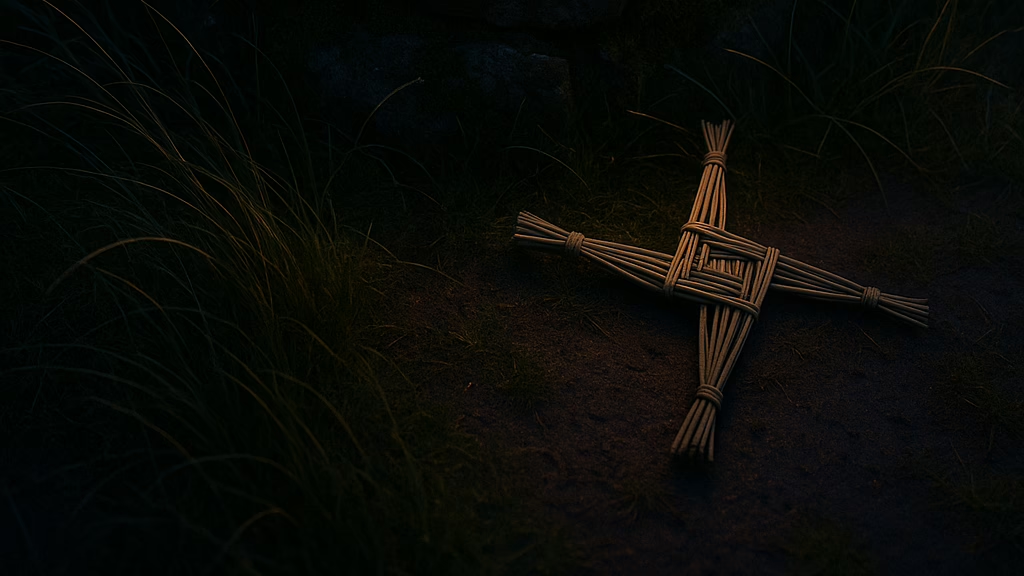
One of the most iconic traditions associated with Imbolc is the Brigid’s Cross — a woven symbol traditionally made from rushes or straw. The exact origin of the cross is unclear, and while often linked with Christian iconography, its use during Imbolc suggests older, folkloric roots. These crosses were hung above doorways or fireplaces to invoke Brigid’s protection over the home and livestock.
Other customs include Brídeóg — a small effigy or doll representing Brigid, often made of cloth and carried from house to house by young girls or left in special resting places overnight; and Brat Bríde (Brigid’s mantle) — laying of cloths or ribbons on hedges or windowsills on Imbolc Eve, in the hope that the goddess would bless them overnight.
Sacred Landscapes and Archaeology
Brigid was tied to specific natural features, ritual spaces, and place names, like Ériu who represented the land itself. This physical dimension of her worship is a vital clue to her role in pre-Christian belief.
Foremost among these is Kildare (Cill Dara, meaning “church of the oak”), which would later become the centre of Saint Brigid’s worship. However, long before the Christian monastery was founded there, the area is believed to have been a site of sacred fire and oak groves, both strongly associated with Indo-European goddess worship. Medieval sources tell us of an eternal flame tended by a group of women, a tradition absorbed into the Christian period by nuns dedicated to Saint Brigid — but almost certainly a survival of earlier pagan devotion.
The presence of sacred wells linked to Brigid across Ireland further reflects her association with healing, fertility, and liminality — all common themes in pre-Christian water cults. Brigid’s wells are often located at thresholds: the edges of settlements, boundaries between fields, or near burial mounds. These locations reinforce her identity as a goddess of transition and blessing.
The geographical spread of Brigid place names is also noteworthy. Dozens of sites across Ireland bear her name, often in rural areas linked to pastoral life — hills, fields, holy stones, and groves. These are not sites of grand temple complexes but landscapes of everyday reverence, where myth met material reality. Even today, pilgrimage sites such as Brigid’s Well in Liscannor (County Clare) or Kildare’s flame ceremony remain active points of spiritual and cultural meaning.
Table: Irish Placenames with links to the Irish goddess Brigit
| Placename (Irish / English) | County | Meaning / Brigid link |
|---|---|---|
| Cill Dara / Kildare | Kildare | “Church of the Oak”; monastic & cult centre founded under Brigid and long associated with her sacred flame |
| Na Coillte Bríde / Kilbride (35+ townlands) | Multiple (e.g., Mayo, Meath, Wicklow) | “Church (cill) of Brigid”; the most widespread Brigid toponym |
| Tobar Bríde / Tubberbride | Sligo | “Brigid’s Well”; a healing well and adjoining townland dedicated to her |
| Brideswell / Tobar Bríde | Roscommon | Village named for a celebrated holy well of Brigid (“Bride’s well”) |
| Knockbride / Cnoc Bhríde | Cavan | “Brigid’s Hill”; hill‑townland echoing the cnoc sites tied to seasonal rites |
| Knockbridge / Cnoc Bhríde | Louth | Another “Brigid’s Hill”, linked in folklore to Imbolc celebrations |
| Teampall Bhríde / Templebreedy | Cork | “Church of Brigid”; parish overlooking Cork Harbour with medieval dedication to her |
| Tobar Bhríde Lios Ceannúir / St Brigid’s Well, Liscannor | Clare | Pilgrimage well famed for cures and Brigid’s Day rituals |
| Kilbree (Cill Bhrí) | Cork | “Brigid’s Church”; townland with well (St Bríde/Brioneach) honouring her |
| Rathbride (Ráth Bhríde) | Kildare | “Brigid’s Ringfort”; early medieval earthwork linked to her cult in the Curragh area |
Brigid and the Tuatha Dé Danann
As a daughter of the Dagda, Brigid belongs to the divine race of the Tuatha Dé Danann — the mythological ancestors of Ireland’s gods, artisans, and rulers. Her parentage alone suggests deep importance. The Dagda is a figure of abundance, fertility, and druidic wisdom. As his daughter, Brigid inherits a position at the core of divine society, and possibly shares in his function as a bringer of order and blessing to the world. Some sources list her siblings as Aengus (god of youth and love) and Cermait, though the exact family tree varies between traditions.
Brigid also bridges two significant divine domains: the domestic and the magical. In Irish mythology, smithing and poetry were not mere crafts, but sacred practices, linked to transformation, prophecy, and cultural preservation. Her dominion over these arts places her alongside other gods of knowledge and skill, such as Ogma, the inventor of Ogham script, and Goibniu, the divine smith. Yet Brigid’s character remains distinct. While others specialise in a single craft, she spans multiple forms of inspired, creative life — not just tools or words, but the fire that animates both.
There is also a subtle thematic pairing between Brigid and Morrígan, another daughter of the Dagda. Where the Morrígan presides over fate, war, and death, Brigid governs birth, healing, and continuity. Together, they may represent a divine polarity — destruction and renewal, chaos and order — each necessary, each complementary. Though they rarely appear together in myth, their contrasting roles help define the breadth of the Tuatha Dé Danann as guardians of every sphere of life.
Brigid in Comparative Mythology
Though Brigid is firmly rooted in the Irish landscape and imagination, the qualities she embodies — inspiration, healing, fertility, and fire — are echoed in goddess figures across the ancient world.
One of the most striking comparisons is with the Roman goddess Minerva, and her Greek counterpart Athena. Both are goddesses of wisdom and craft — domains that overlap with Brigid’s role as patroness of poetry and smithing. Another clear parallel can be drawn with the Greek Hestia (Roman: Vesta), the goddess of the hearth and sacred flame. Both goddesses are linked with eternal fires, household blessing, and the idea of sanctity within the everyday.
In Norse mythology, Brigid’s closest counterpart may be Frigg, the wife of Odin and goddess of household management, foresight, and motherhood. Like Brigid, Frigg is a complex figure whose influence is often indirect but deeply felt. While Norse mythology places more emphasis on conflict and fate, Frigg represents the stabilising power of order and fertility, a role that resonates with Brigid’s guardianship of livestock, craft, and family life.
Outside of the major pantheons, Brigid also bears resemblance to Brigantia, a goddess of the Celtic tribes of Britain. Though little is known about her mythology, inscriptions and iconography associate Brigantia with rivers, sovereignty, and protection, hinting at a pan-Celtic archetype of the exalted female figure. Linguistically, Brigid and Brigantia likely share the same Proto-Celtic root (brigantī), meaning “high” or “noble.”
While we should be cautious about drawing direct equivalences between culturally distinct goddesses, these comparisons illustrate a common thread: in many ancient societies, female deities were revered not just for fertility, but for their power to inspire, preserve, and sanctify.
Table: Comparison between Brigid and the gods from other ancient religions
| Deity & Tradition | Shared themes with Brigid | Distinctive features |
|---|---|---|
| Athena (Greek) | Craft; wisdom; patronage of arts | Strategic war goddess; born fully armed; city‑state protector |
| Hestia / Vesta (Greek / Roman) | Hearth fire; domestic guardianship; ritual centrality | Lacks creative domains; rarely personified in narrative |
| Saraswati (Hindu) | Poetry; learning; inspiration; sacred rivers | No forge or healing aspect; iconography with veena & swan |
| Frigg (Norse) | Household sovereignty; motherhood; foresight | Linked to spinning/fate; queen of the Æsir, not a craft patron |
| Hathor (Egyptian) | Fertility; music; maternal care | Solar eye goddess; cow imagery; presides over afterlife rebirth |
A refreshing legacy
Brigid stands apart in the landscape of Irish mythology — not because of great battles or epic quests, but because of the quiet, enduring power she represents. As a goddess of inspiration, healing, and fire, she embodies the rhythms of everyday life and the forces that sustain it. Her presence in early Irish texts is sparse but significant, and her legacy has survived not through grand narratives, but through ritual, place, and practice.
From Imbolc fires to sacred wells, Brigid’s essence has shaped Irish culture across centuries, adapting to new forms while retaining deep roots in the land and imagination. In her, we see a figure who connects poetry to prophecy, craft to magic, and the spiritual to the practical. She is both uniquely Irish and recognisably part of a wider tradition of life-giving goddesses found throughout the ancient world.
For me, she represents the importance of pausing to reflect. Her festival was a chance for renewal as we emerge from the long winter (whether physical or metaphorical), letting the fire clear away the past as we set off into the spring. I can see why her symbolism has endured as long as it has.
YOU MAY ALSO LIKE
 Iron Age Clothing in Ireland: What People Really Wore
 The Brehon Laws: How Ireland’s Ancient Legal System Really Worked
 Irish Placenames: Ancient History and Mythology
 Irish Festival Names Explained: The Etymology of Samhain, Imbolc, Bealtaine and Lughnasadh
 Etymology of Irish Animal Names: Myth & Language Revealed
 Nuada of the Silver Hand: King of the Tuatha Dé Danann in Irish Mythology
 Irish Megaliths: Henges, Portal & Passage Tombs & Stone Circles
 Ancient Irish Society: Language, Law & the Structures of Kinship