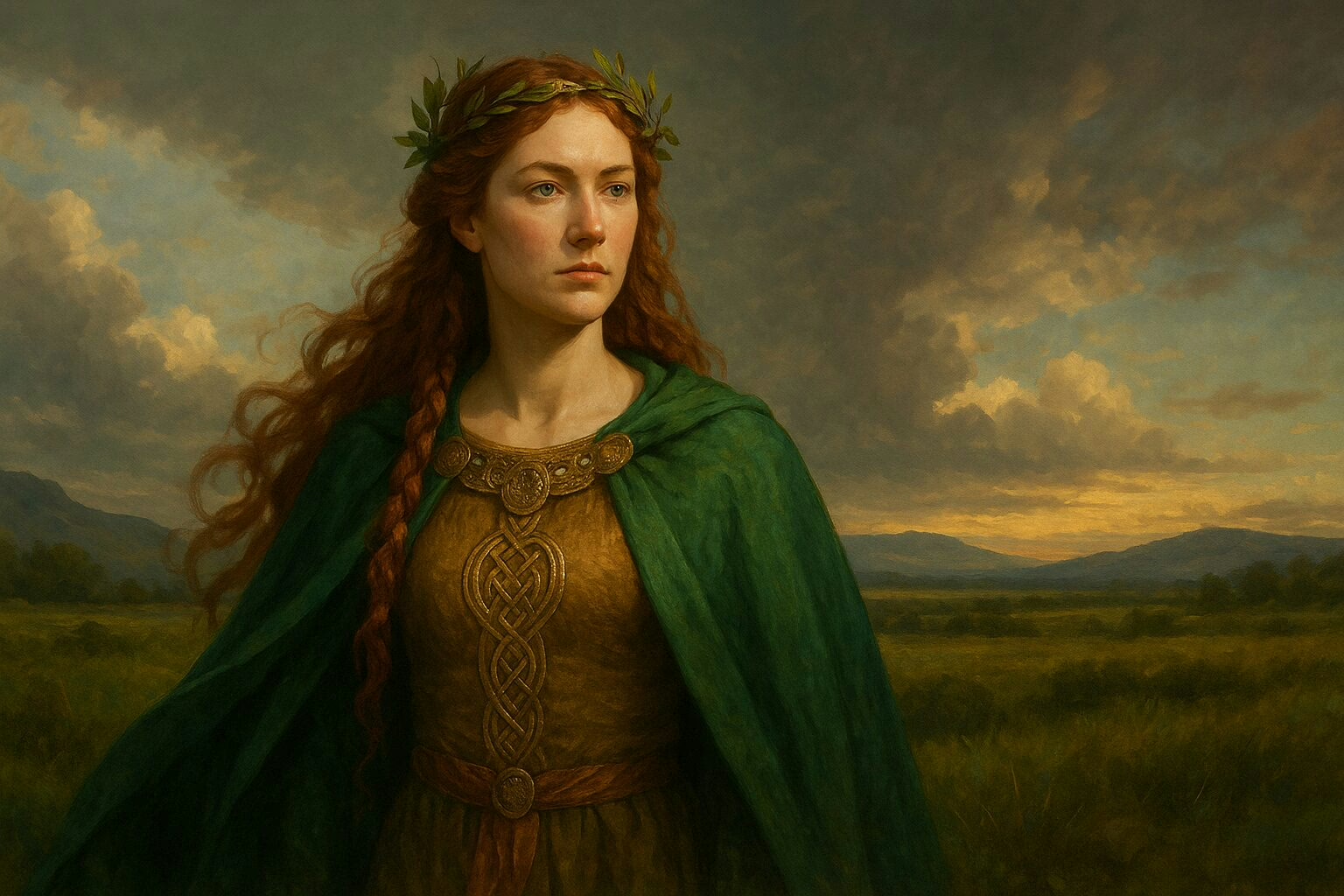
I always knew names mattered, but it was only when I had to choose the names of my children that I began to truly appreciate their significance. And if that’s true for you and I, how much more so is it for the naming of a country. For behind Ireland’s name Éire lies a figure both ancient and enduring: Ériu, the Irish goddess of sovereignty and land. Though her appearances in myth are brief, her presence has never faded. She is one of the few deities in Irish tradition whose name has been carried directly into the modern world — not in legend, but in language, stamped on coins, laws, and maps as the very name of the country itself.
Pronounced AIR-ree-uh, Ériu is best known as one of three sisters — along with Banba and Fódla — who appear to the Milesians in the Lebor Gabála Érenn, the medieval Book of Invasions. Each asks to have the land named after her, but it is Ériu’s name that endures. Through this act of naming, she becomes more than a character in myth. Ériu is inseparable from the land itself, appearing not only as a goddess but as a personification of sovereignty and place.
This post explores Ériu’s origins, her symbolic role in Irish mythology, and her lasting influence — not only as a mythological figure, but as a cultural presence woven into the very fabric of the nation. In doing so, I uncover how a goddess with few stories can leave behind a legacy that surrounds us every day.
The Name Ériu: Language, Land and Meaning
Ériu’s importance in Irish mythology is anchored not in a wealth of stories, but in the power of her name. From Ériu comes Éire — the modern Irish word for Ireland — and from Éire comes Ireland itself, through anglicisation.
Etymologically, the name Ériu is ancient, possibly deriving from a Proto-Celtic root Īweriū or Īwerjon- meaning “fat land” or “land of abundance.” This root is also found in Latin references to Ireland (Hibernia) and in early Greek (Ierne or Iouernia), all of which may echo the same ancient linguistic substrate. Some scholars trace these to the Proto-Indo-European root piHwer- (“fat, fertile”), reinforcing Ériu’s role as a goddess of the rich and life-giving land.1
Together this indicates rich symbolism for the goddess, personifying the very abundance and prosperity of the land of Ireland itself. In this sense, myths portraying her as the source for the island’s naming, are portraying Ireland’s fertility. In the ancient world, such fertility was inextricably linked with the survival and prosperity of the inhabitants. But to truly appreciate the context, let’s turn to the naming myth itself.
Ériu in Irish Myth and Tradition
Ériu’s central appearance in Irish myth occurs during a pivotal moment in the Mythological Cycle — the arrival of the Milesians, the final wave of supernatural settlers whose victory marks the end of the divine Tuatha Dé Danann’s rule and the beginning of mortal sovereignty in Ireland.
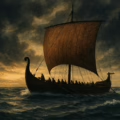
The source for this episode is the Lebor Gabála Érenn (The Book of the Taking of Ireland), a medieval synthesis of Irish origin myths and pseudo-history. In this account, the Milesians arrive in Ireland led by the poet-warrior Amhairghin. As they journey across land, they encounter three divine sisters: Banba, Fódla, and Ériu. Each goddess is described as beautiful, noble, and powerful, and each one asks the Milesians to name the island in her honour.
Amhairghin promises to do so — and indeed, all three names become associated with Ireland — but it is Ériu whose name takes precedence. The land is henceforth called Éire, and in English, Ireland. In this moment, Ériu becomes not just a goddess of the land, but the land personified, the divine essence with which the newcomers must negotiate in order to claim kingship.
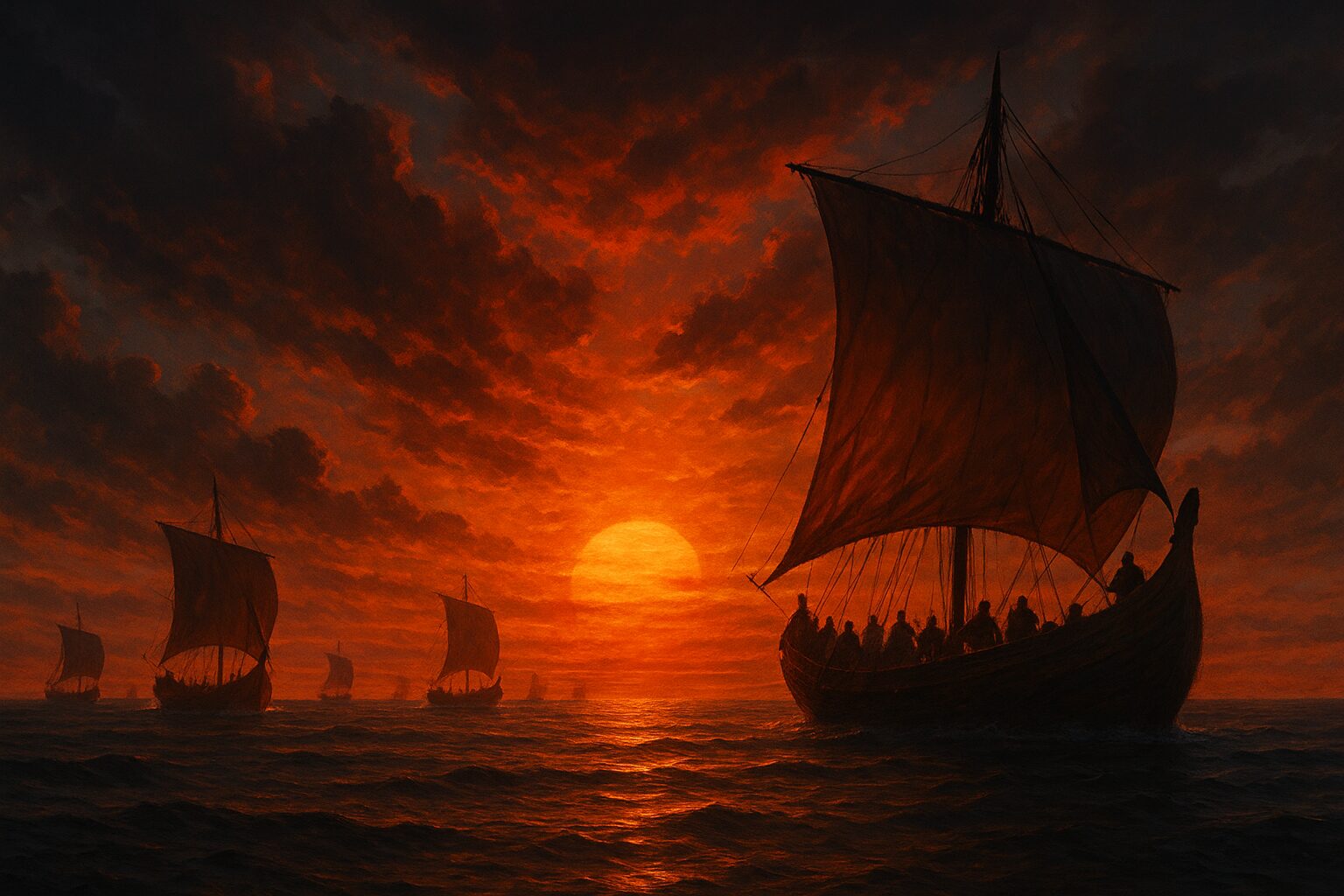
Milesians and Eriu
This story is often interpreted not as a literal conquest, but as a mythic marriage between the Milesians and the land itself. The naming is a symbolic act of sovereignty and union. In early Irish legal and poetic traditions, kingship was not simply a matter of rule — it was a contract between king and goddess, with the land granting authority to the one deemed worthy. Ériu, in this context, plays the role of the sovereignty goddess, whose favour legitimises political power.
What’s notable is Ériu’s composure and dignity in the tale. Unlike many other deities, she does not demand worship or tribute. She asks only for memory — for her name to endure. That simple request becomes one of the most enduring acts in Irish mythology: a goddess remembered not through temples or tales, but through the name of a nation.
Though Ériu does not appear again in mythological narratives, her legacy is established. In giving her name to the land, she becomes a silent witness to everything that follows — from ancient battles to modern revolutions. In many ways, she stands at the threshold of myth and history, the last voice of the divine world before the age of mortals begins.
Ériu, Banba and Fódla: Naming the Land
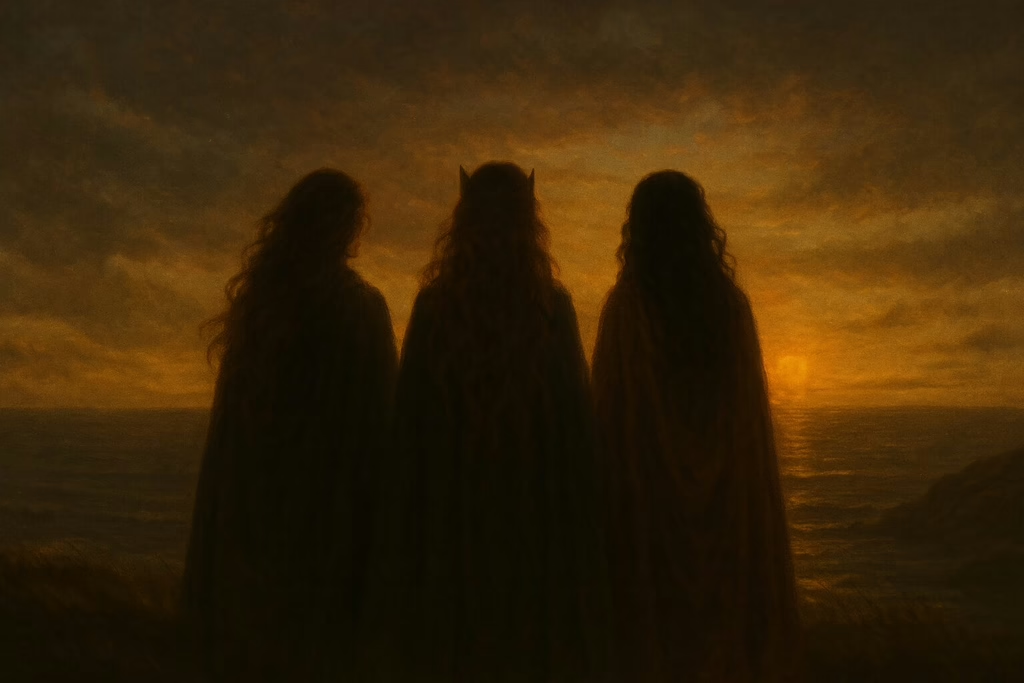
In the Lebor Gabála Érenn, Ériu appears alongside her sisters Banba and Fódla, forming a divine triad associated with the land of Ireland. Their continued presence in Irish literature and political rhetoric suggests that they were not simply narrative devices, but part of a mythic system of triple representation.
Triads are common in Irish tradition — three brothers, three goddesses, three geasa — and often signal wholeness, balance, or the threefold division of land. Banba, Fódla, and Ériu may reflect the three provinces of ancient Ireland2, or embody different aspects of the land’s character — though the texts do not define them in detail.
Poets and bards continued to invoke Banba and Fódla as alternate names for Ireland well into the early modern period. These epithets appear in political speeches, laments, and nationalistic verse, where Ireland is referred to as “Banba’s green isle” or “Fódla of the sorrows.” Each name carries its own emotional or symbolic weight, often chosen to suit the tone of a particular poem or cause.
Still, it is Ériu’s name that becomes central, both linguistically and politically. Why this happened is uncertain. It may reflect her encounter with Amhairghin being the final one, or perhaps a deliberate editorial choice by medieval scribes aiming to unify the island’s identity under a single name.
Yet taken together, the three represent more than historical naming. They form a tripartite embodiment of Ireland, reminding us that the land is complex, plural, and layered with meaning. Where Ériu stands for identity and sovereignty, Banba may evoke endurance, and Fódla loss or longing — interpretations that reflect how these names were used in later political contexts.
Parallels in Other Mythologies
Ériu’s role as a goddess of sovereignty and land is far from unique in the ancient world.
In Greek mythology, the closest analogue is Gaia, the primordial earth mother. Gaia is not just the ground, but a generative force from which gods and mortals alike emerge. Like Ériu, she is ever-present rather than narratively dominant — more foundation than character. Where Gaia symbolises cosmic creation, Ériu represents territorial identity, but both reflect a reverence for the land that transcends myth.
In Roman tradition, Terra Mater (Mother Earth) performs a similar role, while Tellus is invoked in rituals connected to fertility, agriculture, and state protection. These goddesses were not central to mythic drama, but were central to life — much like Ériu, whose presence is ritualistic, symbolic, and enduring.
The Norse figure Jord (Earth), mother of Thor, is another example of a goddess whose mythological importance lies in what she represents rather than what she does. She is seldom mentioned in myths, yet her name (meaning “earth”) ties her to the same deep sense of geographic divinity that defines Ériu.
What sets Ériu apart is the explicit naming of a modern nation after her — an enduring linguistic and political legacy that is rare among ancient deities. While figures like Gaia or Terra were worshipped and invoked, their names did not become the name of the country itself. Ériu’s identity merged with the land so completely that even after belief in her faded, her name survived — carried on in maps, currency, and everyday speech.
Comparing Eriu and other goddesses
| Goddess (Culture) | Domain / Role | Key Differences |
|---|---|---|
| Ériu (Irish) | Sovereignty, personification of Ireland | No standalone myths; survives through naming and symbolic acts |
| Gaia (Greek) | Earth, creation, motherhood | Primordial creator and progenitor of gods; cosmic rather than territorial |
| Terra / Tellus (Roman) | Earth, fertility, agriculture | Stronger emphasis on agriculture and formal Roman rites |
| Jörð (Norse) | Earth, mother of Thor | Mythological presence is minimal; not connected to kingship or sovereignty |
| Prithvi (Vedic) | Earth, cosmic stability | Functions in a cosmic duality (Earth–Sky); revered through philosophical hymns |
| Danu (Irish) | Ancestral mother of the Tuatha Dé Danann | More abstract; not personified as Ireland or tied to sovereignty rituals |
| Inanna / Ishtar (Sumerian) | Fertility, war, sovereignty, love | Far broader domain: sexuality, war, and cosmic descent myths |
| Brigid (Irish) | Fertility, healing, inspiration | Functional and widely worshipped; merged with Christian saint cult |
The Legacy of Ériu in Irish Tradition
Ériu is one of the few deities of the Tuatha Dé Danann whose name never passed out of use. While other gods were forgotten or transformed in folk tradition, Ériu remained embedded in the very name of the country, quietly present in every reference to Éire, Ireland, or Irishness. Her survival owes not to temples or ritual practice, but to language, identity, and the politics of place.
During the cultural revival of the 19th and early 20th centuries, Ériu became a powerful symbol of national spirit. Irish poets and political writers reimagined her as a personification of Ireland — often idealised, sometimes sorrowful, and always sacred. In the early 20th century, Irish nationalists adopted her as a personification of the nation, much like Britannia in Britain or Marianne in France. She appeared in romantic and nationalist literature as the land betrayed or the motherland awaiting freedom, often under poetic names like Banba or Fódla. The choice to retain Éire as the Irish-language name of the state following independence in 1922 reflects this deep connection.
In this way, Ériu continues to shape Irish identity — not as a figure of the past, but as a perpetual presence in the present, whose name and meaning are still unfolding in the life of the land she once embodied.
Ériu reminds us that not all myths are loud. Some are quiet, embedded in everyday words and landscapes. Her story is a whisper beneath the soil — a call to remember that sovereignty begins not with conquest, but with recognition. In that way, she remains present still — not only in maps and monuments, but in the soul of the country she gave her name.
Frequently Asked Questions: Eriu, the Irish goddess
Ériu was one of the three goddess sisters — alongside Banba and Fódla — who personified the island of Ireland in early Irish mythology. She is best known from Lebor Gabála Érenn (The Book of the Taking of Ireland), where she meets the invading Milesians and gives her name to the land — Éire, still the Irish name for Ireland today.
The name Éire comes from the goddess Ériu and is linguistically linked to the Proto-Celtic *Īweriū, which likely derives from the Proto-Indo-European root *piHwer‑, meaning “fat” or “fertile.” This same root appears in Latin Hibernia and Greek Iernē — early foreign names for Ireland.
All three are personifications of Ireland, appearing as sisters in Irish myth. While Ériu gave her name to the modern nation, Banba and Fódla are preserved in poetry and myth as alternative, often symbolic names for the island. Each represents different aspects of the land’s spirit and sovereignty.
- Koch, J.T., 1991. Ériu, Alba, and Letha. Emania, 9, pp.17-27. ↩︎
- In the earliest ancient traditions it appears that Ulster and Meath were omitted as provinces of Ireland, possibly due to being subsumed under the others – Connacht, Munster and Leinster. Byrne, Francis John. Irish Kings and High-Kings. Dublin: Four Courts Press, 2001 (2nd ed.). ↩︎
YOU MAY ALSO LIKE
 Irish war chariots: Celtic war machines and symbols of power
 Iron Age Clothing in Ireland: What People Really Wore
 What Is a Selkie? Irish Selkie Meaning & Folklore Explained
 Irish Festival Names Explained: The Etymology of Samhain, Imbolc, Bealtaine and Lughnasadh
 Ancient Irish Society: Language, Law & the Structures of Kinship
 Etymology of Irish Animal Names: Myth & Language Revealed
 Iron Age Trade in Ireland: Networks, Imports, and Economic Life
 Nuada of the Silver Hand: King of the Tuatha Dé Danann in Irish Mythology