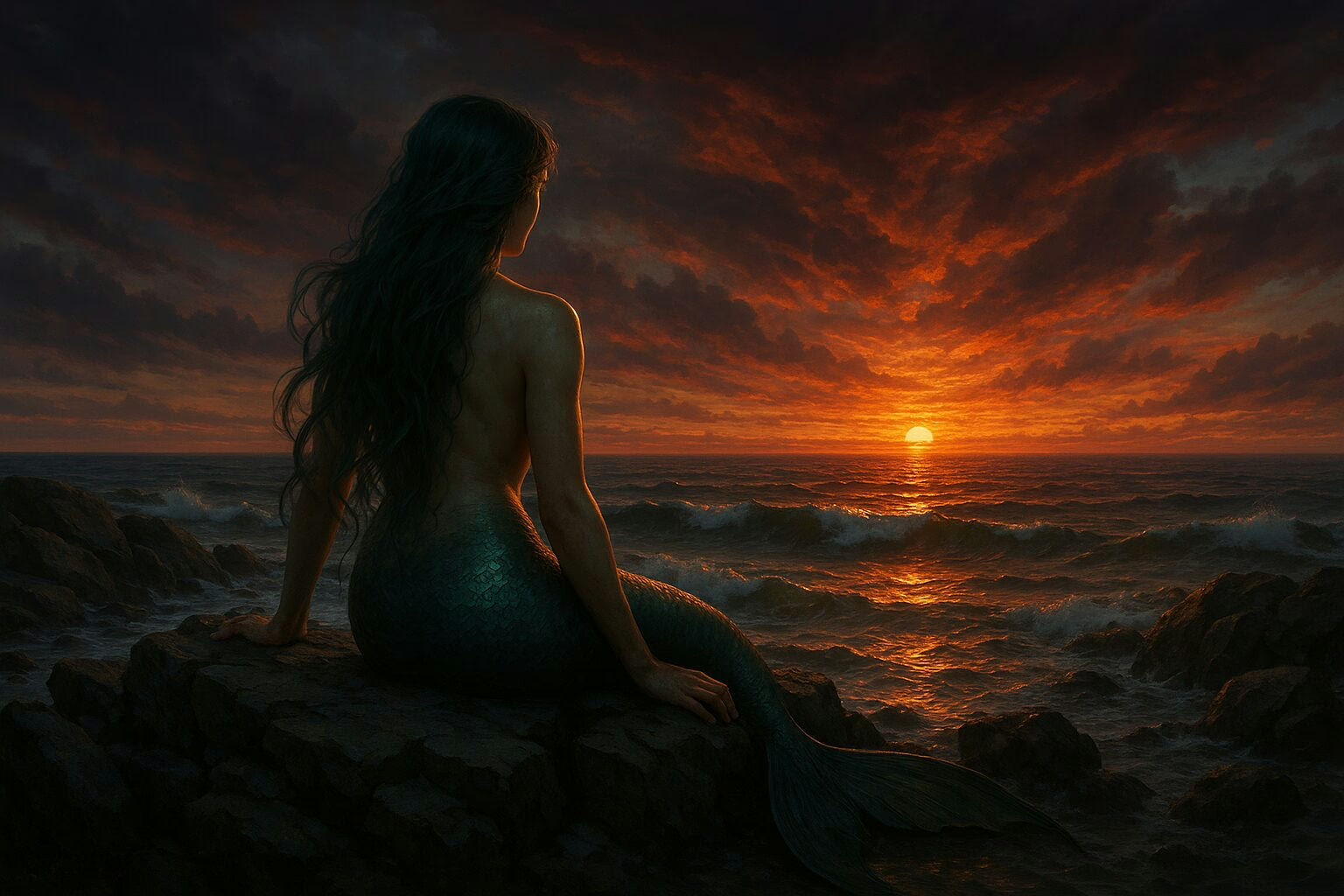
Growing up beside the Atlantic Ocean fuelled my imagination and sense of wonder, and I clearly am not alone. For its vastness, dangers, and intriguing beauty, have long been immortalised into Irish folklore. Among the most evocative figures to emerge from this maritime world is the Merrow (from Irish muiríoch or murúch), a sea-being both wondrous and tragic. Described as web-fingered, green-haired, and wearing a red magical cap, the Merrow straddles the boundary between human and otherworldly. Like the selkie, but rooted more firmly within the Irish Gaelic tradition1, the Merrow reveals how deeply the ocean influenced Irish mythical creatures. However, unlike later romanticised sea-maids, the Merrow belonged to a harsher coastal world shaped by storms, fishing, and loss.
This post explores the Merrow’s place in Irish mythology and coastal folklore. Drawing on oral tradition, historical sources, archaeology, and modern scholarship, I examine how tales of the Merrow reflect Ireland’s relationship with the sea—its bounty, its mystery, and its ever-present peril. This links to other Irish mythical creatures I’ve covered including the Selkies and the Cailleach.
Who are the Merrow?
The Merrow is Ireland’s answer to the mermaid. Descriptions vary by region and time period, but most 19th-century folklore collectors—including Thomas Crofton Croker and William Wilde2—describe female Merrows as green-haired, web-fingered, and clad in garments that shimmer like fish scales. A distinctive red cap or cloak, known as the cochaillín rúin (little magical hood), grants her the ability to return beneath the waves. Without it, she is stranded on land.
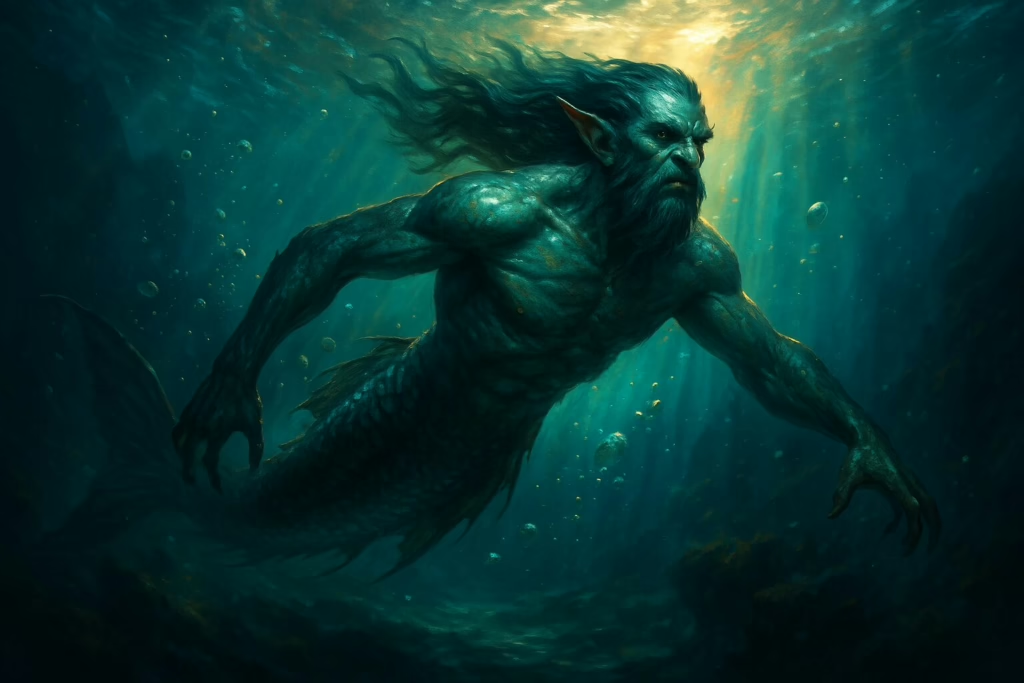
Male Merrows are depicted as grotesquely scaled or fishlike, with pig-like snouts and tusks. Unlike their female counterparts, they are rarely the object of romantic narratives and are instead associated with shipwrecks, storms, or drowned souls. In some traditions, male Merrows are called fir ghorma na fairrige—“blue men of the sea”—and are portrayed quite differently from their female counterparts.
Where the Merrow Came From: Language, Sailors, and Older Sea Beliefs
The Merrow’s roots lie deep within Ireland’s maritime imagination. Linguistically, the word muiríoch (or modern murúch) is formed from muir, the Irish word for “sea,” combined with the agentive suffix -ach, giving a literal meaning of “sea-dweller” or “one of the sea.” This term was used historically to refer to both female and male beings of the deep.
While classical Irish mythology—such as the Mythological Cycle—contains no direct references to Merrows, older texts do include hints of aquatic beings. One of the earliest literary mentions appears in the Vision of Mac Conglinne (c. 1100), which describes fish-tailed sea-folk known as muirígh or muiríghe. This was a satirical Middle Irish prose tale, suggesting a blending of pre-Christian mythic elements with ecclesiastical parody, reflecting how such sea-beings were already woven into cultural consciousness by the 11th century. However, the fully developed image of the Merrow as we know it today only emerges much later, preserved in the oral tradition and first recorded in writing by 19th-century folklorists.
Early Modern Folklore Traditions
Scholars suggest that the Merrow legend crystallised during the early modern period, especially in the 17th and 18th centuries, as Ireland’s coastal communities became increasingly tied to Atlantic fishing. As maritime travel became both more common and more dangerous, supernatural figures like the Merrow helped explain the suddenness of storms, disappearances at sea, and the ambiguous fortunes of fishing expeditions.
Cultural historian Patricia Lysaght has argued that Merrow beliefs were shaped not just by narrative imagination, but by lived experience. As coastal economies expanded, people began embedding their fears and hopes into the landscape through story. The Merrow, half-human and half-sea, emerged as a figure through which fishermen and their families could express anxieties about livelihood, loss, and the lure of the unknown.
In short, the Merrow as a figure is not simply mythic or literary: she is the product of centuries of interaction between sea, story, and survival. Her origins reflect a uniquely Irish blending of older mythic tropes, coastal ecology, and community memory.
Soul Cages, Red Caps, and the Stories Told About Merrow
The Merrow appears most vividly in Irish oral storytelling, where her role often shifts between benevolent, romantic, and ominous. Three major narrative cycles dominate Merrow folklore: the marriage tale, the treasure guardian, and the storm harbinger. Each offers insight into how Irish communities viewed the sea—not only as a source of livelihood, but as a realm of mystery and moral complexity.
Merrow’s three narrative cycles
| Narrative Cycle | Summary | Themes & Cultural Function |
|---|---|---|
| The Marriage Cycle | A fisherman steals a Merrow’s red cap, marries her, and they raise children. She later finds the cap and returns to the sea, leaving the family. | Loss, hybrid identity, tensions between land and sea, female autonomy and the impermanence of possession. |
| The Treasure Keeper | Merrows are said to guard sunken hoards or store drowned sailors’ souls in traps, such as lobster pots. | Folk memory of wrecks, supernatural custodianship of the sea, spiritual echoes of maritime death and treasure. |
| The Storm Herald | Merrows sing or cry before storms, their laments serving as omens to fishermen to avoid going to sea. | Traditional ecological knowledge, sea personification, protective warnings rooted in coastal oral traditions. |
The Marriage Cycle
Perhaps the most enduring Merrow narrative is the supernatural spouse motif, typically involving a fisherman or farmer who captures a Merrow’s magical red cap (cochaillín rúin), preventing her return to the sea. Stranded on land, she marries the man and bears children. Years later, she rediscovers her hidden cap and returns to the ocean, leaving her family behind.
This story appears in numerous regional variants, most famously in Thomas Crofton Croker’s 1825 tale “The Lady of Gollerus.” In it, a Kerry man named Dick Fitzgerald marries a Merrow, and their children are described as having “webs between their fingers.” After finding her cap in a locked chest, the Merrow bids a sorrowful farewell and disappears into the sea.
Scholars interpret these tales as metaphors for cultural hybridity and emotional dislocation. The children—part human, part sea-creature—embody liminality, neither fully belonging to land nor ocean. The Merrow’s eventual return suggests that the pull of origin and identity is ultimately irrepressible.
The motif has close parallels in selkie stories and appears elsewhere across Celtic and Scandinavian folklore. However, the Irish Merrow tale is distinct in its emphasis on emotional depth and the tragic inevitability of separation. The tale does not cast the Merrow as monstrous, but as a sympathetic figure torn between two worlds.
The Treasure Guardian and Sunken Riches
The second strand of Merrow folklore casts them not as lovers or mourners, but as custodians of the sea’s hidden wealth. These stories often revolve around hoards of gold, silver, or other valuables kept beneath the waves—spoils of shipwrecks, plundered relics, or supernatural treasures guarded by the Merrow.
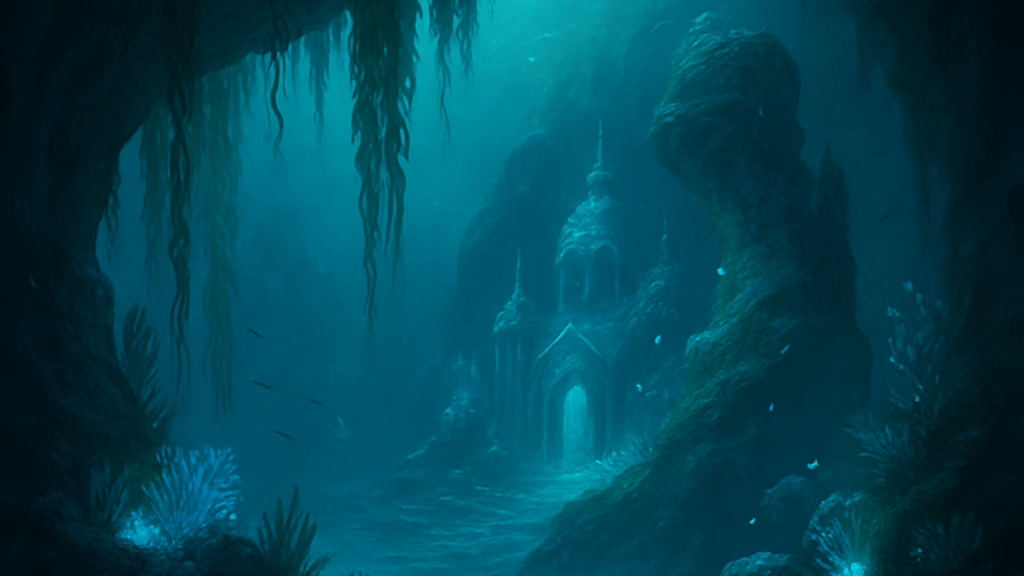
In the Cork variant The Soul Cages, popularised by Thomas Keightley in the early 19th century, a fisherman named Jack Dogherty befriends a male Merrow named Coomara. Coomara lives in an underwater palace and stores the souls of drowned sailors in lobster pots.3 Jack eventually outwits him, freeing the trapped spirits and returning them to the sea.
Other legends attribute vast sunken hoards to the Merrow, including Spanish silver from the 1588 wreck of the La Girona and Norse treasure lost in storms. These tales often centre on human attempts to retrieve the gold—only to be foiled by waves, guilt, or the Merrow’s eerie interventions.
Archaeological finds lend a degree of support to this layer of the legend. Hoards of coins from the La Girona were indeed recovered by divers in the 1960s off County Antrim, while earlier anecdotal accounts speak of local “gold divers” operating unofficially. The idea of Merrows as treasure-guardians may have arisen to explain both the danger of these pursuits and the allure of forbidden riches.
At heart, these stories reveal an ambivalence towards wealth acquired from the sea. It is desirable, but also cursed or morally ambiguous—guarded by beings who demand respect and sacrifice. The Merrow here is not merely a sea-spirit, but a gatekeeper between mortal ambition and the mysterious depths.
The Storm Harbinger and Mourning Voice
Among the most evocative Merrow traditions is their role as storm-bringers or weather omens. In parts of western and northern Ireland—especially coastal regions of Donegal and Mayo—fishermen once believed that hearing a Merrow’s song carried urgent warnings. If the mournful keening came from the sea, it signalled incoming storms, and boats were to remain ashore. If it came from land, it foretold a death in the village.
For instance, the tradition is noted in the Irish Folklore Commission’s Donegal field‑notes (collected by Seán Ó hEochaidh, c. 1937), where a participant from Kilcar recalled fishermen delaying launches upon hearing caoin na mban mara—‘the wail of the sea-women’—a warning believed to precede storms.
This motif aligns the Merrow with other supernatural warning figures in Irish folklore, such as the banshee. However, unlike the banshee, whose cries are bound to death and family lineage, the Merrow’s voice is directed outward to the community—protective rather than punitive. This suggests a different emotional and cultural register: the Merrow as a guardian of seafaring lives, not merely a herald of doom.
In this role, the Merrow becomes a liminal figure: neither fully divine nor demonic, neither wholly feared nor trusted. She watches the boundary between land and sea, calling across it in moments of risk. Whether interpreted as psychological projection, weather lore, or metaphysical belief, the motif reflects a maritime culture attuned to both nature’s rhythms and the need for meaning in uncertainty.
Material Culture and Archaeological Context
Although the Merrow is a figure of legend, aspects of the folklore surrounding her intersect with tangible elements of coastal material culture in Ireland. These physical traces—whether ritual objects, pigments, or carved motifs—offer insight into the belief systems and symbolic practices that sustained Merrow traditions over time.
Historical evidence for Merrow mythology and folklore in Ireland
| Site / Artefact | Location | Dating | Findings | Interpretation |
|---|---|---|---|---|
| Dooneen Cave Deposits | Dooneen, Co. Kerry | 17th century | Clay pipes, coins placed in sea-flooded chambers | Possible votive offerings to sea spirits like Merrows (O’Sullivan 2011) |
| Red Ochre Lumps in Fisher Huts | Aran Islands | 18th century | Red pigment found near boat storage huts | Used in boat painting and protective charms; parallels Merrow’s red cap as apotropaic symbol |
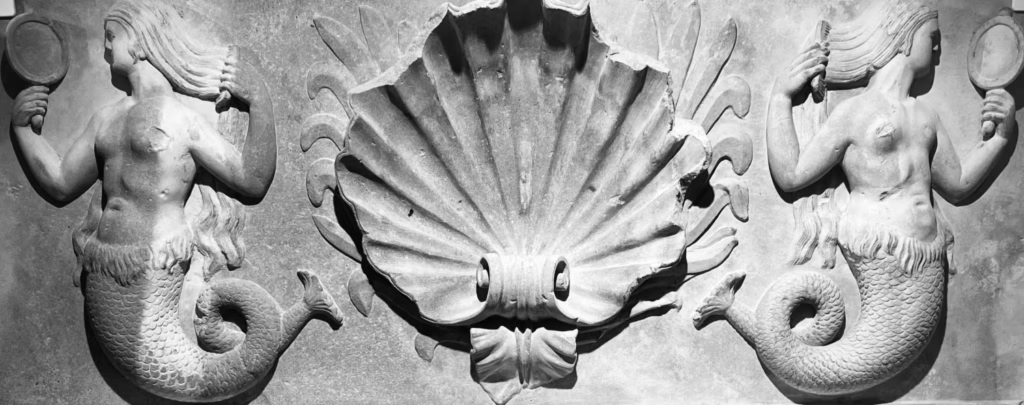
| Carved Lintel Depicting Mermaid Figure | Kilrush, Co. Clare | c. 1500 CE | Stone carving of fish-tailed woman holding a comb | Identified locally as a “murúch”; indicates Church tolerance of vernacular sea-creature beliefs |
| Grave Slabs with Hybrid Motifs | Coastal graveyards | Various (medieval) | Cross-slabs and graffiti with hybrid aquatic motifs | May represent Merrow-like beings or Christianised sea spirits |
| Pattern Day Pilgrimage Artifacts | Mount Brandon, Co. Kerry | Late medieval – modern | Pilgrimage tokens, inscribed stones | Associated with St Brendan but also linked to local sea lore; landscape sacred to maritime mythology |
Coastal Offerings and Sea Rituals
Excavations along Ireland’s western seaboard have uncovered evidence of votive practices that may connect to Merrow beliefs. At Dooneen Cave in County Kerry, archaeologist Aidan O’Sullivan reported the discovery of 17th- and 18th-century clay pipes, coins, and ceramics deliberately placed in tidal recesses. These deposits, interpreted as offerings to appease marine spirits, suggest a local tradition of honouring or bargaining with sea-beings—potentially including the Merrow.
In the absence of formal maritime shrines, caves and natural coastal features likely served as ritual spaces for fishermen and smugglers alike.
Red Pigment and Protective Magic
In Irish folklore, the Merrow’s distinctive cochaillín rúin (red cap) is central to her identity. Intriguingly, red pigment also appears in the archaeological record as a protective substance. On the Aran Islands, lumps of red ochre have been found in abandoned boathouses and bothies. Ethnographic accounts link this pigment to apotropaic rituals: painting keels, charms, or talismans to ward off misfortune at sea.
Some historians and scholars propose that this tradition symbolically echoes the Merrow’s red cap—a visual signifier of otherworldly protection or sea-based power.
Iconography in Art
While no physical remains of Merrows exist, their mythological counterparts are echoed in Irish ecclesiastical art. One of the best-known examples is found at Clontuskert Abbey in County Galway, where a 15th-century carving above the west doorway shows a mermaid-like figure holding a mirror—a common symbol in European and Irish mermaid iconography. Such figures were not uncommon in medieval church art, where they were often interpreted as allegories for vanity or sin. However, in coastal Irish contexts, these carvings may also have resonated with local traditions of sea-spirits like the murúch (Merrow).
Other examples of female sea figures appear in late medieval churches across western Ireland, sometimes incorporated into liminal spaces such as doorway lintels or funerary markers. While typically labelled as decorative or moralistic in academic catalogues, oral tradition in some regions identified these figures not with biblical allegory, but with supernatural beings from folklore. This blending of Christian symbolism and local myth reflects the syncretic religious culture of late medieval Ireland—particularly in remote coastal parishes where sea-lore remained vital to community identity.
Comparative Mythology
The Merrow belongs to a wider family of sea-beings found across both Celtic and global traditions. Within the Celtic world, parallels emerge in the ben-varrey of Manx folklore, who, like the Merrow, is said to sing from beneath the waves and warn fishermen of approaching storms. In Brittany, the morgan or mari-morgan appears as a beautiful but dangerous sea-maiden who hoards treasure and occasionally lures sailors to their doom—echoing Merrow tales, though with a more malevolent bent.
Scottish selkie legends, especially prominent in Orkney and Shetland, share the motif of a human stealing the supernatural being’s garment—in this case, a seal skin—thereby preventing her return to the sea. While selkies transform fully between seal and human, the Merrow remains distinct in her hybrid form, half-human and half-fish, with webbed fingers and the essential red cap.
Beyond the Celtic sphere, global analogues deepen the comparative picture. Slavic rusalki are the spirits of drowned women who haunt lakes and rivers, often portrayed as tragic and dangerous figures. Greek Nereids, in contrast, are helpful sea-nymphs who guide sailors and embody the ocean’s gentler aspects. In Japan, the ningyo—a fish-human creature—carries spiritual danger; its flesh is said to confer immortality or disaster, depending on the context.
What unites these figures is their symbolic function: each reflects a human attempt to grapple with the sea’s mysteries, to explain its bounty and its peril.
Comparison between Sea Creature Mythologies
| Culture | Name | Appearance | Role in Myth |
|---|---|---|---|
| Irish | Merrow (Muiríoch) | Green hair, webbed fingers, red cap (cochaillín rúin) | Warnings to sailors; abducted or abducting spouses; symbol of ocean’s dual nature |
| Scottish | Selkie | Seal-human shapeshifter | Marriage with humans; tales of return to the sea |
| Manx | Ben-varrey | Sea-woman, often beautiful, fish-tailed | Omens and protectors; romantic encounters |
| Breton | Morgan/Mari-Morgan | Mermaid-like with gold treasures | Guardians of hidden treasure; love stories with tragic ends |
| Greek | Nereids | Beautiful maidens of the sea | Assisting sailors like Odysseus; divine sea maidens |
| Slavic | Rusalka | Water spirit, often ghostly female | Dangerous or tragic figures luring men; seasonal fertility links |
| Japanese | Ningyo | Fish-like creature, often carp-bodied | Captured as omens or blessings from the sea |
Echoes of the Deep Today
The Merrow occupies a unique place in Irish mythology—an amphibious figure that merges the mystery of the ocean with the intimacy of domestic life, the folklore of coastal communities with the broader symbolic language of transformation, loss, and return. Though often grouped with global mermaid traditions, the Merrow is distinct in its recurring themes of kinship, the tension between sea and shore, and the red cap as a cipher of identity and agency.
More than a fantastical creature, the Merrow embodies enduring human questions—about belonging, change, and our relationship with the boundaries between death and life. Whether mournful guardian or trickster of the tide, she reminds us that the sea is more than a physical place, it’s a boundary and opportunity. Like the mythology of Manannan mac Lir, or the selkies, the Merrow teaches us to respect the power of the natural environment – to respect its force and heed their warnings. Perhaps these are lessons worth remembering even today.
Frequently Asked Questions: The Merrow in Irish Mythology
A Merrow (Irish: muiríoch or murúch) is a supernatural sea-being from Irish folklore, often likened to a mermaid or merman. Female Merrows are typically described as beautiful, green-haired creatures with webbed fingers and a red cap (cochaillín rúin) that allows them to travel beneath the sea. Male Merrows are portrayed as more grotesque and rarely appear in romantic tales.
While they share similarities, Merrows are distinct from Selkies and Sirens. Selkies originate in Scottish and Northern Irish folklore and are seal-people who shed their skins. Sirens come from Classical mythology and lure sailors with their song. Merrows, on the other hand, are uniquely Irish and are often associated with both love and loss, storm-omens, and sea guardianship.
There is no direct archaeological evidence of Merrows, as they are mythological beings. However, folklore has been found carved into church iconography, such as the mermaid at Clontuskert Abbey, and in votive offerings at sea caves. These suggest that belief in sea spirits was once widespread in coastal communities and integrated into everyday ritual life.
The red cap (cochaillín rúin) is essential to a Merrow’s ability to return to the sea. In many stories, if a human hides this cap, the Merrow becomes stranded on land. The motif is closely related to the “external soul” folklore type, symbolising vulnerability and the tension between freedom and captivity.
- For more on the Selkies, see my post: https://www.danielkirkpatrick.co.uk/irish-mythology/irish-selkie-folklore-mythology/ ↩︎
- Croker, T. C. (1825). Fairy Legends and Traditions of the South of Ireland (Vol. 1). London: John Murray.
— See the tale “The Lady of Gollerus,” where Croker describes the Merrow’s green hair, webbed fingers, and shimmering garments. ↩︎ - Keightley, Thomas. The Soul Cages. In Fairy Mythology: Illustrative of the Romance and Superstition of Various Countries, vol. 2, London: H.G. Bohn, 1850, pp. 207–212. ↩︎
YOU MAY ALSO LIKE
 Iron Age Clothing in Ireland: What People Really Wore
 What Is a Selkie? Irish Selkie Meaning & Folklore Explained
 Abhartach in Irish Mythology: The Blood-Drinking Undead Dwarf
 Aos Sí in Irish Mythology: Origins, Folklore & Legacy
 Irish Festival Names Explained: The Etymology of Samhain, Imbolc, Bealtaine and Lughnasadh
 Iron Age Trade in Ireland: Networks, Imports, and Economic Life
 Etymology of Irish Animal Names: Myth & Language Revealed
 Ancient Irish Society: Language, Law & the Structures of Kinship