Why Words Grow on Trees
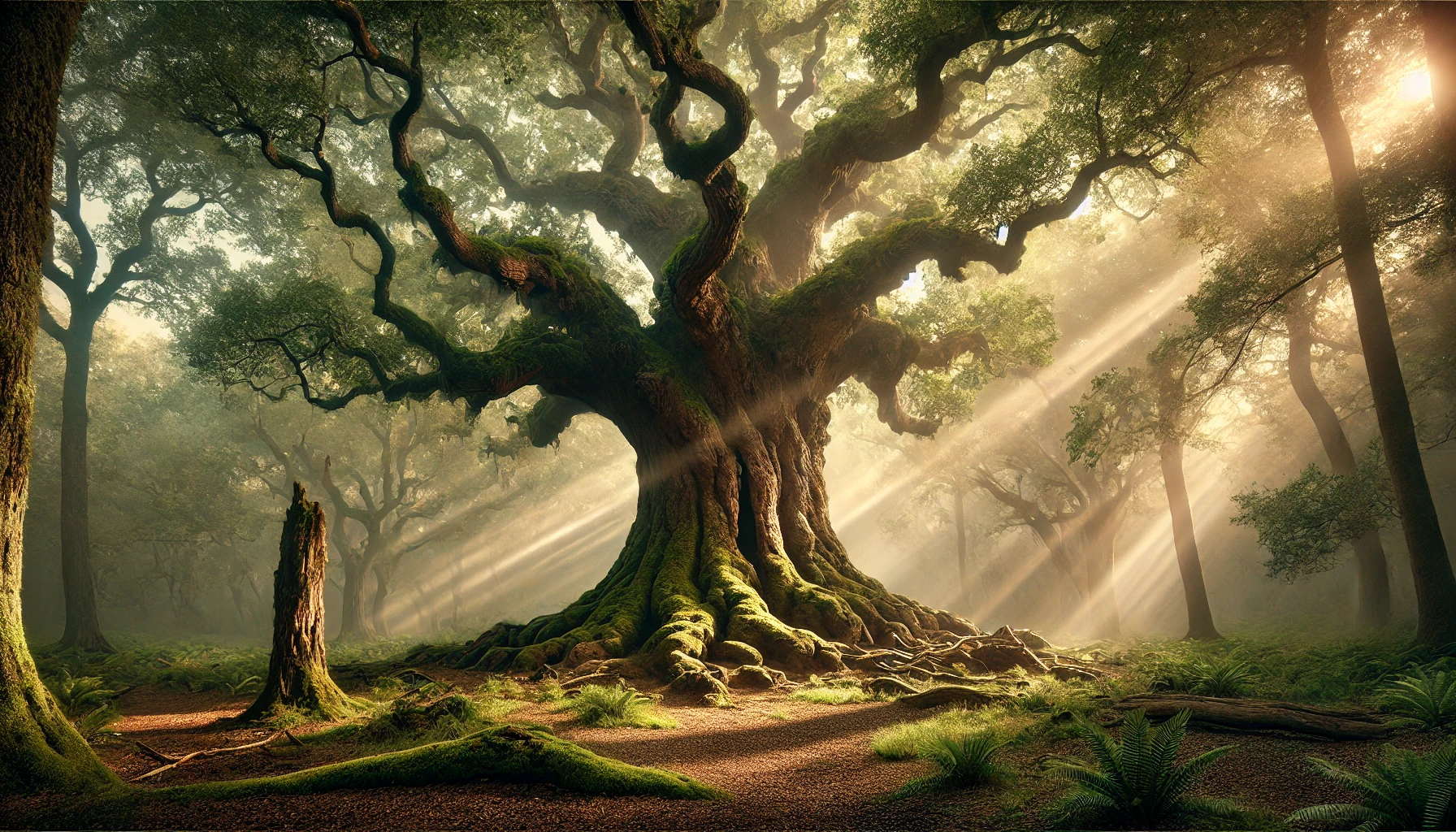
Irish never names a tree in isolation. Each Irish tree name carries rings of story. Whether it’s the law codes that fined a man two milch cows and a three-year-old heifer for felling an oak, the inauguration rites held beneath a clan’s sacred bíle, or the poems that call hazel the tree of wisdom. In this post I follow these linguistic roots to understand the mythology and ancient history of Irish trees.
I begin with everyday Gaelic nouns for Ireland’s seven pre-eminent trees, then trace how those same species anchor Brehon Law, ogham inscriptions, and the legends of the Tuatha Dé Danann. If you enjoy my writing on early Irish festivals or druidic rituals, consider this the language key that unlocks them.
Talking About Trees – Core Vocabulary & Cultural Notes
Early jurists ranked twenty-eight native species, but seven “lords of the wood” (airig fedo) stood above the rest—oak, hazel, holly, yew, ash, Scots pine and wild apple. Damaging one could empty a purse or start a feud. Their Irish names are still in daily use:
Table of the 7 most significant trees in Irish history and language
| Irish | Pronunciation | English | Cultural tag |
|---|---|---|---|
| dair | “darr” | oak | strength; Dagda’s club |
| coll | “kull” | hazel | wisdom; Salmon of Knowledge |
| cuileann | “KWIL-en” | holly | winter protector |
| iúr | “yoor” | yew | death & rebirth symbolism |
| fuinseog | “FIN-shug” | ash | spear-shafts; world-tree axis |
| péine Albanach | “PAY-nə AL-bah-nokh” | Scots pine | ship-timber; rare Irish remnant |
| fia-úll | “FEE-ə ool” | wild (crab) apple | fertility, otherworld food |
Because each tree word anchors a myth or legal status, sprinkling them through place-names (Doire “oak-grove”, Collins “of the hazel”) instantly connects your Irish to stories you may have read on Brehon Law fines or the Salmon of Knowledge.
Sacred Bíle Trees & Kingship
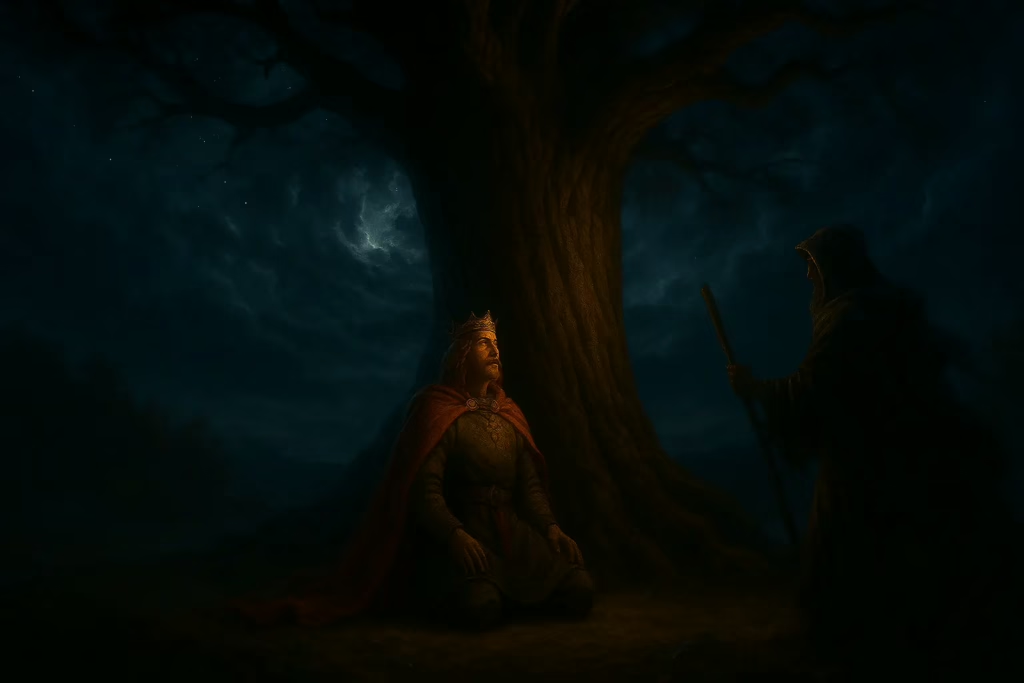
A bíle (pronounced “BEE-leh”) was more than an impressive specimen; it was the living standard of a túath. Old glossaries call it “the habitation of gods or elemental spirits,” and it widely noted that tribal chieftains or kings were frequently inaugurated under its branches.1
Under a bíle the new rí (king) swore to uphold fír flathemon—the justice of good rulership—while witnesses tied his lineage to the land with a branch cut from that very tree. Destroying a rival’s bíle was therefore an act of open war, a deed the annals compare to toppling a royal fortress.
The Five Great Trees
Medieval Dindsenchas lore magnifies the tradition, naming five primordial bíle that protected the whole island:
1. Eo Mugna – an oak whose vast branches shaded cattle at Clonmore.
2. Bile Dáithí – an ash sacred to the kings of Connacht.
3. Bile Tortan – ash of the Northern Uí Néill.
4. Craeb Uisneg – ash on the Hill of Uisnech, Ireland’s mythical centre.
5. Eo Rossa – a yew felled, legend says, in the 7th century and distributed as relics to saints.
Scholars caution that these lists come from 12th-century manuscripts and may polish older oral memory rather than present hard fact. Still, the echoes are consistent: each tree marks sovereignty, boundaries and spiritual power.
However, the word bíle itself surfaces in place-names—Ballyboley (< Baile bíle “town of the sacred tree”), An Bile Thoir “the eastern bíle”—a linguistic breadcrumb trail. So when you encounter bile inside a modern Irish phrase, you are hearing the root of ancient kingship.
Tree Status in Bretha Comaithchesa – Irish tree mythology in law
The eighth-century legal tract Bretha Comaithchesa treats trees as protected property—not scenery.2 Twenty-eight native species are sorted into four value bands that decide the dire (penalty-fine) owed for cutting or damaging your neighbour’s trees. The classes reflect economic worth (timber, fodder, fruit), but they also mirror prestige in myth and ceremony.
Table showing ancient legal status of trees
| Legal class (Old Irish) | Literal meaning | Sample species listed in the text | Base penalty for unlawful felling* |
|---|---|---|---|
| Airig fedo | “lords of the wood” | oak, hazel, holly, yew, ash, Scots pine, wild apple | two milch cows + one three-year-old heifer |
| Aithig fedo | “commoners of the wood” | alder, willow, hawthorn, rowan, birch, elm, wild cherry | one milch cow (plus the same again if cut at the base) |
| Fodla fedo | “lower divisions” | blackthorn, elder, spindle, whitebeam, strawberry-tree, aspen, juniper | yearling heifer |
| Losa fedo | “bushes of the wood” | bracken, gorse, bramble, heather, broom, bog-myrtle, wild rose/ivy | one sheep for branch damage; yearling heifer for uprooting |
* The law then scales additional compensation according to how the harm was done—branch-cutting, fork-cutting, base-cutting or total extirpation.
Significance of the legal status of trees
Beside the obvious legal fines and shame associated with this, these laws have much wider significance. First is the mythological links, as the same seven “lords” appear in inauguration tales and in sacred-tree lists like Eo Mugna or Bile Tortan. Secondly, they reflect the economic realities of the time with hazel nuts, oak acorns and apple bark all carry specific cash-equivalent values in the commentary, underscoring how woodland products underpinned cattle wealth and winter stores.
Lastly, the society itself is reflected in these trees, with the felling an airig fedo being on a par with killing a chieftain. The fine was public theatre—a reminder that trees bolstered status as much as timber sheds did. It’s hard for us to relate today but it shows just how embedded nature was with the sacred and identity of ancient Irish societies. A good example of this is seen in the link to the ancient Irish script of Ogham.
Ogham – From Boundary Stone to “Tree Alphabet”
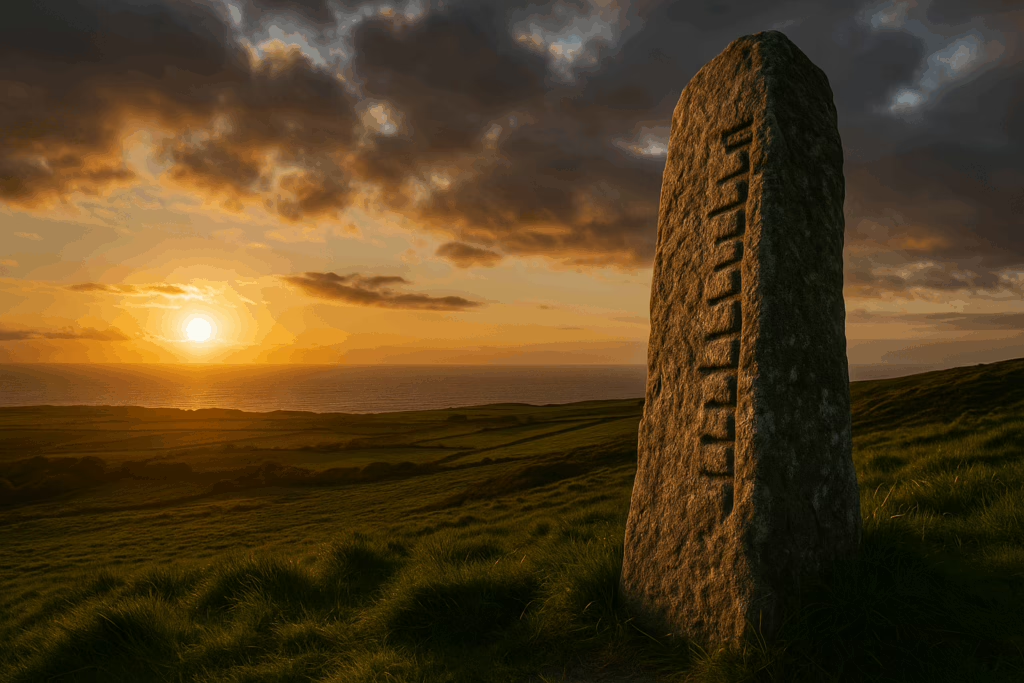
Ogham is Ireland’s earliest native script, carved on some hundreds of surviving stone pillars dating mainly to the 5th- and 6th-centuries AD. Most inscriptions are prosaic—“X son of Y”—yet the medium itself is linguistically radical: scores cut along a stone edge, read bottom-to-top.
Early glossators label each character a fid (tree) and the set collectively as feda (“woods”). Even the technical jargon—druim “ridge”, flesc “twig”—is arboreal, hinting that scribes conceptualised writing through the anatomy of a tree.
How botanical is the alphabet?
Modern scholarship is cautious. For instance, only eight of the twenty primary letter-names are unequivocally tree words; others were retro-fitted by medieval scholars who assumed that because the letters were called feda they had to be trees. In other words, the “Celtic Tree Alphabet” is a 10th-century intellectual flourish layered over a 5th-century practical script.
However, several Ogham letters reuse the very tree names already ranked in Bretha Comaithchesa—dair for “D”, coll for “C”, sail for “S”. For example, the same word that cost a trespasser two cows – if chopped – also etched itself into stone as a personal signature. That overlap shows how legal, mythic and epigraphic strands intersect.
Mythic Case-Studies – Hazel, Salmon & Oak
Hazel of Wisdom & the Salmon of Knowledge
The hazel (coll) sits at the edge of every Irish forest myth—but nowhere more clearly than in Macgnímartha Finn (“The Boyhood Deeds of Fionn”). Nine hazel trees overhang the Well of Wisdom; when their nuts fall, a single salmon eats them and absorbs all knowledge. The poet Finn Éces finally catches the fish, yet young Fionn mac Cumhaill gains its power after burning his thumb on the cooking fat and tasting it. From then on, he unlocks wisdom by biting that thumb.
This matters because the same word that names a “lord of the wood” in Bretha Comaithchesa—coll—also carries Ireland’s most famous wisdom tale. Therefore, when you drop coll into conversation (“Fiafraím de do choll físe” – “I ask your hazel of vision”), you echo both legal status and legend.
Oak in Cath Maige Tuired
In the Second Battle of Mag Tuired, the Dagda vows:
“I will be a giant oak in every ford and every pass you cross; the mark of my axe will remain in every oak forever.”
The quote turns the oak (dair) into the Dagda’s emblem of unbreakable strength—precisely the quality that made dair the first name on the “lords of the wood” list. Even his great harp is called Daur da Bláo (“Oak of Two Blossoms”).
Therefore, hazel and oak show how the legal, literary, and mythic layers reinforce each other: a tree in the law-texts is the same tree that carries the hero or god’s defining episode. This is can be seen clearly when we consider place-names themselves.
Dindsenchas & Place-Name Lore
Early poets preserved landscape memory in the dindsenchas (“lore of places”)—176 poems and stories explaining why hills, wells or groves bear the names they do.3 The dindsenchas material long circulated orally as a mnemonic map for elites and warrior-bands. By the 12th century scribes copied two written “recensions,” the best-known in the Book of Leinster. But scholars agree the material is rooted in oral tradition and therefore preserves ideas far older than the manuscript date.
Bardic handbooks list dindsenchas alongside genealogy and law as knowledge every fili (court-poet) had to master; reciting a site’s origin story proved both learning and loyalty. Sacred oaks and ash groves appear repeatedly: in origin tales for Uisneach (Ireland’s mythical centre), in the saga of Boann and the Boyne, and in stories of rival clans felling an enemy’s bíle to break their power. The tree vocabulary you met earlier—dair, coll, iúr—is therefore etched directly onto the map.
Table showing trees in significant Irish place-names
| Modern place | Old/Middle Irish form | Literal meaning |
|---|---|---|
| Doire (Derry) | Doire | “oak-grove” |
| Collinstown (Co. Westmeath) | Baile na gCoill | “town of the woods” |
| Bile Uisnech (Hill of Uisneach) | bile Uisnig | “sacred tree of Uisneach” |
| Cró Inis (Mythic) | Inis na hIúr | “island of the yews” |
Ireland’s Trees Today
From sacred bíle and legal fines to ogham strokes and place-name poems, Irish words for trees give us a window into the lives of the ancient Irish. The connections between legal and sacred, economic and social, are all bound up in these simple words. Trees represented stability and strength alongside their life-giving, fruit-bearing, fuel and material providing functions. This has certainly made me pause when I consider the trees around us today. Having one of the lowest tree densities in Europe today, Ireland has sadly lost sight of this great heritage. Lost – but it can be regained. Time will tell.
If you have enjoyed this post, please explore the related posts listed below—or subscribe to the monthly newsletter so you never miss any further posts on ancient Ireland’s history and mythology.
Frequently Asked Questions: Trees and Nature in Irish
A bíle (Old Irish) is a sacred tribal tree. Chiefs were often inaugurated under their bíle, linking the tree’s health to the clan’s well-being.
Early Irish law and legend name oak (dair), hazel, holly, yew, and ash among the most sacred trees. These appear in myth (e.g. the Dagda’s sacred oak) and were protected by heavy fines if cut.
Ogham is often called the “Celtic Tree Alphabet.” Many Ogham letters are named for trees (e.g. Dair = oak) and medieval sources describe the letters as feda (‘trees’).
Yes. For instance, coill (forest), abhainn (river), and sliabh (mountain) are common Gaelic terms rooted in Celtic geography. These words, often with Old Irish origins, reflect Ireland’s landscape and were used poetically in literature.
In Brehon law (Bretha Comaithchesa), the “lords of the wood” (airig fedo) – oak, hazel, holly, yew, ash, Scots pine, and wild apple – were legally protected. Heavy fines were imposed for harming these valued trees, underscoring their economic and spiritual importance.
- D. A. Binchy, Corpus Iuris Hibernici (1978). ↩︎
- Kelly, Fergus. “Trees in Early Ireland.” Irish Forestry 56 (1999): 31-47 – Augustine Henry Memorial Lecture.
PDF available via Forestry Focus: https://www.forestryfocus.ie/wp-content/uploads/2013/02/Trees-in-Early-Ireland.pdf ↩︎ - Gwynn, Metrical Dindshenchas I (1903) Introduction. ↩︎
YOU MAY ALSO LIKE
 What was Dun Aengus? Ireland’s Ancient West Maritime Hub
  Etymology of Irish Festivals
  What is the Ogham Tree Alphabet?
  Who is the Irish mother goddess Dana?
  Ancient Irish Proverbs and their Origins: Wisdom in a few Words
  Ancient Roads of Ireland – 5 Slíghe (Highways) Radiating from Tara
  Etymology of Irish Animal Names: Myth & Language Revealed