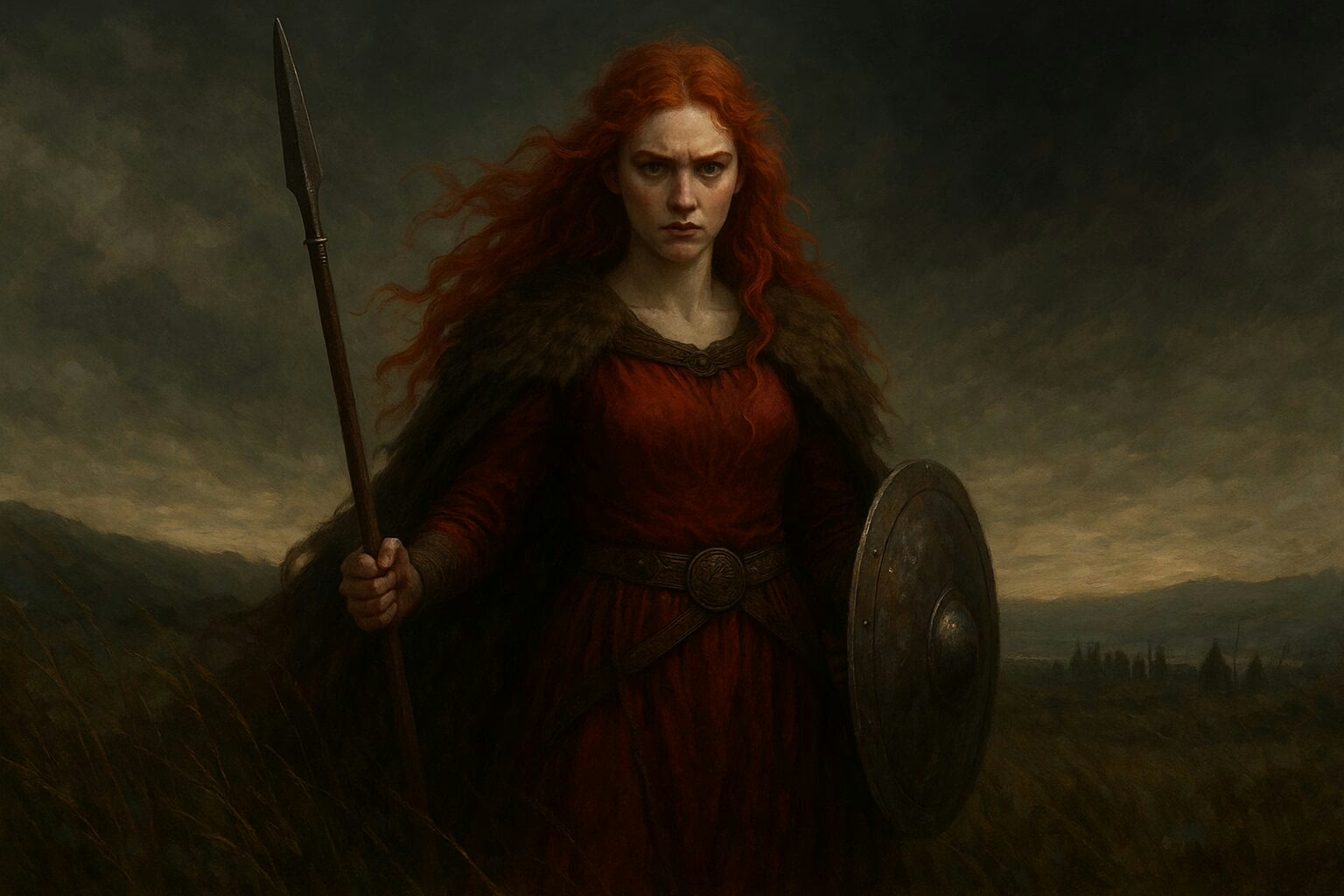
We all know the power and pain of suffering – how it refines our character and can often be our ‘making or breaking’. It’s as much a force of nature as the rain or wind, for while we may do all we can to avoid it, life has a way of granting us our share. And if this is true for us today, how much more so for the ancient Irish? So it’ll be no surprise that these themes were embedded in their mythology, in the very person of Macha – an Irish goddess of war, retribution, and suffering. Her story is as painful and tragic as it is powerful and compelling – symbolising how power lies not merely in glory or conquest, but in pain endured and justice enforced.
From the mythical mother who curses Ulster’s king, to the war goddess who collected trophies of the heads of men. Macha embodies both fertility and ferocity of life, a common theme in Irish mythology – where life and death and seen in a cyclical (not linear) way.
Therefore, this post explores the layered identity of Macha, Irish goddess of suffering and retribution. I will trace her appearances in the Ulster Cycle, examine her link to Ireland’s landscape, and consider her symbolic role in myth and modern meaning. So first we must consider who was Macha.
Who was Macha? Etymology and Origins
The name Macha is among the oldest in Irish myth, and one of the most enduring. While its exact etymology remains uncertain, scholars have proposed links to the Proto-Celtic root magos- meaning “plain” or “field,” suggesting a connection to the land. While, like Ériu, she embodied aspects of sovereignty, others have associated the name with horses, drawing on her later symbolism and her close link to Emain Macha, a site long associated with royal horse rituals and kingship.1
Reducing Macha to a single figure in Irish mythology is also challenging. She is sometimes used interchangeably with the goddess Morrigan. Other times she’s described as one of three sisters – Morrigan, Babd, and Macha – all goddesses of war. And then again we see her appear in various distinct narratives:
1. Macha, wife of Nemed, who is said to have died clearing the plains that bear her name.
2. Macha Mong Ruad (“Red Mane”), remembered as the only woman listed among Ireland’s High Kings in medieval annals.
3. Macha of the Ulster Cycle, the best-known figure, who appears in the tale of the curse of the Ulstermen.
While the first two are notable, it’s the third narrative which is the most significant, and certainly has the greatest legacy.
Macha and the Pangs of Ulster
One of the most striking episodes in Irish mythology is the tale of Macha’s curse, preserved in the Ulster Cycle, particularly in the text Noínden Ulad (“The Debility of the Ulstermen”).2 This Macha — unnamed beyond her title — arrives mysteriously at the home of a wealthy farmer. She becomes his wife, and through her presence, his fortune increases. But her divine nature is only revealed when the king of Ulster demands her humiliation.
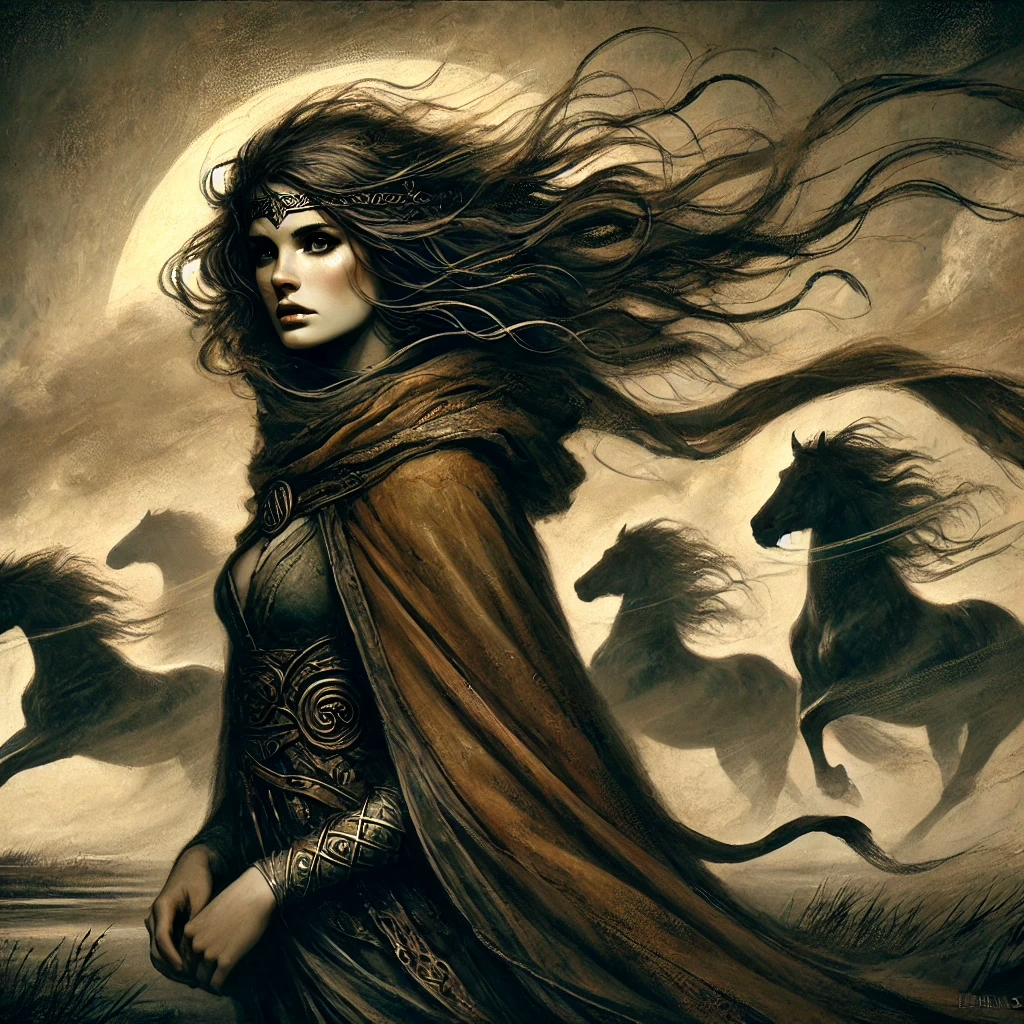
At a royal gathering, the farmer boasts that his wife can outrun the king’s horses. Macha is summoned to prove it — despite being heavily pregnant. She pleads for mercy, asking to wait until after giving birth, but the King of Ulster refuses. Forced to race, she wins — only to collapse on the finish line in labour pains, where she gives birth to twins on the field.
In the moment of agony, Macha curses the men of Ulster: whenever their province is in greatest need, they will be struck with the pain of childbirth for five days and four nights.
Macha’s Curse
This curse becomes a central theme in the Ulster Cycle, explaining why the warriors are incapacitated during the events of Táin Bó Cúailnge, leaving Cú Chulainn to defend the province alone. The story goes that when Queen Medb of Connacht launches her massive raid into Ulster, aiming to steal the prized bull Donn Cuailnge, the curse takes hold. The seasoned warriors of Ulster, usually a formidable force, lie incapacitated in agony — their strength useless, their cries echoing through the halls of Emain Macha.
Only one remains unaffected: the young hero Cú Chulainn, who, due to his divine origins and youth, is immune to the curse. He alone must stand against the armies of Connacht, facing impossible odds in a series of solo battles. The curse of Macha thus sets the stage for Cú Chulainn’s rise and frames his exploits as not just heroic, but necessary. Another tragic story unfolds, with slaughter and destruction on all sides. But underpinning it all is Macha’s curse which places the fate of Ulster in the hands of a single warrior.
In this sense, Macha’s curse is more than divine punishment — it is a reckoning for public humiliation, a response to the violence of spectacle, and a challenge to the unchecked power of kings. The land herself cries out through her, and the rebalancing of justice is enacted through pain — not her own, but imposed in return upon those who dishonoured her.
So – unlike many goddesses in mythology – Macha does not grant victory or wealth. She grants consequences. Her curse is enduring, her pain public, and her agency fierce. In a mythology full of warriors and heroes, Macha’s story is one of resistance through suffering — a divine protest against power without compassion.
Emain Macha and the Sacred Landscape
Standing just outside modern Armagh lies one of the most important ritual sites in early Irish history: Emain Macha. Known in English as Navan Fort, this circular earthwork was once the royal seat of the kings of Ulster — and its very name roots it in myth. Emain Macha is usually translated as “Macha’s Twins,” a reference to the children she bore in agony after being forced to race in the Ulster Cycle. But it also carries the deeper weight of ritual naming, where landscape and story are bound together.
Emain Macha was not just a backdrop to myth — it was a centre of royal inauguration, tribal identity, and religious significance. Archaeological excavations reveal it as a site of ceremonial importance dating back to at least the Iron Age, with evidence of large wooden structures, animal sacrifice, and the kind of public display typical of sacred kingship rites. That it was associated with Macha suggests more than simple naming — it points to a sacred claim of legitimacy, one where rule over Ulster was symbolically tethered to her story.
This idea of a divine or supernatural woman tied to the land and its sovereignty appears again and again in Irish tradition. But in Macha’s case, it is more visceral: her labour becomes a founding act. The site of suffering becomes the seat of power, binding the kings of Ulster not just to martial authority but to memory — a memory of pain endured and judgement issued.
The enduring name of Armagh (Ard Mhacha, “Macha’s Height”) preserves this legacy. It reminds us that the land remembers — and that divine agency in Irish myth is often not expressed in the heavens, but in the naming of hills, fields, and fortresses.
Comparing Macha with other ancient goddesses
When viewed alongside the divine figures of other ancient cultures, Macha emerges as a uniquely layered goddess — one who blends traits of sovereignty, land, war, and retribution.
In Greek mythology, the closest comparison is perhaps Athena, the warrior goddess of strategy, wisdom, and civic power. Like Macha, Athena is a fierce protector of territory and associated with military prowess. However, Athena’s warlike aspect is often restrained and intellectual, whereas Macha’s is visceral — tied to blood, birth, and bodily consequence. Where Athena emerges from the head of Zeus, Macha births her curse from the womb, grounding her power in suffering as well as strength.
In Roman tradition, Bellona stands out — a lesser-known goddess of war often depicted alongside Mars. Bellona represents the chaos and fury of battle, similar to Macha’s association with violence and punishment. Yet Macha’s mythology adds an intimate political edge: her curse directly critiques male authority and complicit power structures.
Norse mythology offers Freyja, who combines fertility, war, and death. Like Macha, she rides into battle and receives the slain. But Freyja’s emphasis is often on love and magic, while Macha’s narrative centres more on land, childbirth, and divine justice.
Thus, while parallels can be drawn, Macha’s identity remains deeply Irish: a goddess of sovereignty who defends her dignity with devastating consequence, and whose mythology speaks to land, gender, and leadership in a uniquely powerful way.
Table: Comparison between Macha and other ancient goddesses
| Goddess | Culture | Domains | Shared Traits with Macha | Key Differences |
|---|---|---|---|---|
| Macha | Irish | War, sovereignty, land, fertility, childbirth, curse | Embodiment of sovereignty; war goddess; associated with territory and suffering; linked to Emain Macha | Unique for cursing men with childbirth pains as divine retribution; deeply tied to Ulster myth |
| Athena | Greek | War (strategy), wisdom, civic life | Warrior goddess; protects heroes and cities; associated with sovereignty and martial defence | Intellectual and strategic in battle, not linked to childbirth or vengeance through suffering |
| Bellona | Roman | War (chaos, aggression) | Goddess of battle fury and martial chaos; associated with war cries and destruction | Lacks the land/sovereignty aspect; more one-dimensional than Macha |
| Freyja | Norse | Love, war, death, fertility, magic | Warrior aspect; receives half the slain warriors; sensual and sovereign | Combines sexuality and war; not punitive or associated with maternal suffering |
| Anat | Canaanite | War, hunting, fertility | Bloodthirsty in battle; strong, independent warrior goddess | Not tied to land or childbirth; far more aggressive and violent |
| Sekhmet | Egyptian | War, plague, vengeance | Bringer of divine retribution; protector of Ma’at (cosmic order); punishes injustice | Associated with disease and fire; vengeance on cosmic scale rather than societal injustice |
Symbolism and Legacy
Macha’s voice in Irish mythology is brief, but clear. She is not a goddess of conquest or prophecy, but of consequence — a figure whose power lies in what happens when dignity is denied and justice withheld. Whether as a woman forced to race while pregnant, a sovereign tied to sacred land, or a shadow of the Morrígan’s warlike triad, Macha emerges again and again as a guardian of endurance and reckoning.
Her curse on Ulster’s warriors is more than a mythic origin story. It is a warning — that leadership without respect leads to collapse, that the body and the land remember injustice, and that divine retribution may take unexpected forms. Through suffering, Macha gains power. Through silence, she speaks volumes.
Even now, her presence lingers — not in temples or worship, but in place-names, poems, and echoes across the Ulster landscape. In remembering her, we remember that mythology is not only about gods and glory — but also about the truths that shape a people’s relationship to power, land, and justice.
Frequently Asked Questions: Macha, Irish goddess of War and Retribution
Macha is a prominent goddess in Irish mythology, associated with war, sovereignty, fertility, and the land. She appears in several forms across different tales, most notably in connection with Emain Macha (Navan Fort), the ancient capital of Ulster. Her story often reflects themes of power, suffering, and retribution.
Yes. In some medieval texts, Macha is considered one aspect of the Morrígna, the triad of war goddesses that also includes Badb and Nemain. These figures often appear together on the battlefield, foretelling doom and manipulating fate. However, Macha also appears independently in other tales.
Emain Macha (modern Navan Fort in County Armagh) is named after the goddess Macha. The name is often interpreted as “the twins of Macha”, referencing the story where she gave birth to twins after the chariot race. It was the ceremonial and political centre of Ulster.
- Tatár, M.M., 2007. The myth of Macha in eastern Europe. JOURNAL OF INDOEUROPEAN STUDIES, 35(3/4), p.323. ↩︎
- Carney, J., 2008. The pangs of the Ulstermen: An exchangist perspective. The Journal of Indo-European Studies, 36(1), pp.1-14. ↩︎
YOU MAY ALSO LIKE
 Iron Age Clothing in Ireland: What People Really Wore
  How old is Newgrange and who built it?
  Who was the Irish god Nuada of the Silver Hand?
  Who was the Irish god Lugh of the Long Arm?
  Who is the Cailleach? Ireland’s Winter Goddess
  Irish Celtic Druids: Healers, Judges & Ancient Irish Wisdom
  Who were the Merrow in Irish Mythology?
  What are Irish Megaliths? Henges, Cists, Tombs & Circles