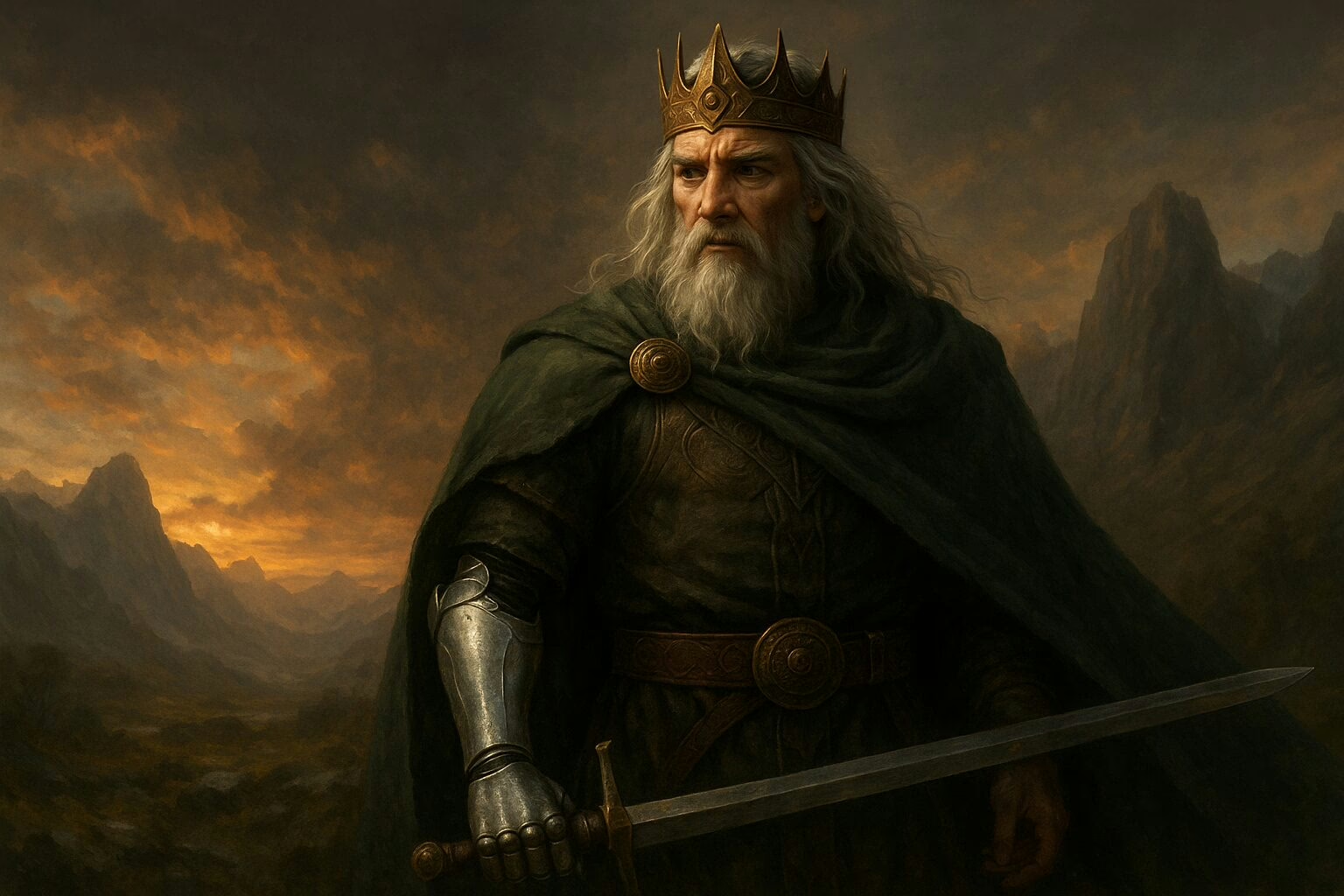
All great stories have sacrifice at their heart – often at a key turning point – whereby one of the characters puts others ahead of themselves for the wider good. And in Irish mythology, Nuada Airgetlám is that story — Nuada of the Silver Hand. A king, a warrior, and a figure of loss and restoration, Nuada stands at the heart of the Mythological Cycle, embodying themes of justice, kingship, and resilience. His tale is one of both greatness and tragedy: a ruler forced to abdicate after injury, restored through divine craftsmanship, and ultimately slain in the final defence of his people – apologies there will be many spoilers.
What I love about Nuada’s mythology is enduring questions that it raises, which continue to have deep resonance. What does it mean to be a just ruler? Can leadership exist without wholeness? And what is the cost of sovereignty when the king himself must be sacrificed?
Though less widely known today than gods like Lugh or Brigid, Nuada’s role in early Irish myth is foundational. He is the first king of the Tuatha Dé Danann, a symbol of lawful authority and rightful rule. His silver arm is not just a marvel of healing — it is a statement about identity, continuity, and the repair of what has been broken. And so, in this post, I’ll explore Nuada’s origins, battles, symbolism, and legacy — and uncover why, in the story of Ireland’s gods, he remains both a forgotten hero and an uniquely relatable figure of enduring power.
Name, Etymology, and Early Origins
The name Nuada is among the oldest in Irish mythology. Most commonly rendered in Old Irish as Nuadu or Nuada, his epithet Airgetlám — meaning “Silver Hand” or “Silver Arm” — is the feature by which he is most widely recognised. The word airget (silver) and lám (hand) are straightforward in meaning, but deeply symbolic in function, pointing to one of the earliest examples in Irish literature of technological restoration and divine craft.
Scholars have long noted similarities between Nuada and the British god Nodens, a figure worshipped in Roman Britain at Lydney Park, Gloucestershire. Nodens was associated with healing, hunting, and the sea, and inscriptions link him to restorative powers and magical craftsmanship — suggestive of a shared Celtic origin. Both names likely derive from a Proto-Celtic root noudent- or snowdo- meaning “to acquire” or “to catch,” possibly linked to wealth, power, or providence. This connection strengthens the view that Nuada’s role — though developed uniquely in Irish myth — draws from an older pan-Celtic archetype of a healing or providential deity.
In fact, there appear to have been many so-called Nuada’s throughout Irish mythology. But these likely reflect the evolving narrative in oral mythology, rather than distinct characters. A leading scholarly study summarised this clearly and is worth quoting at length:
“There was Nuada son of Tadg (Teague), supreme druid of Cathair the Great, king of Ireland in the second Irish epic cycle, and ancestor of the Ossianic line of heroes. This cycle purports to refer to events of the second century A.n., when Nodens was already, presumably, worshipped in Britain; but the cycles are not reliable history. There was also Nuada Derg (son of Loegaire, king of Ireland) the assailant of St. Patrick. The Coir Anmann….mentions seven Nuadas: N. Deglam (‘fair-hand’), N. Find Fail, N. Find Feimin, N. Full6n, N. Necht, and N. Salfota (‘long-heel’), in addition to Nuada Airgetlam. Many of these may be due to disconnected memories of different things concerning a single figure.”1
Nuada was therefore clearly an enduring figure within Irish mythology. His significance cuts across ancient Britain with close links to Nodens and the Welsh Nudd. But Nuada’s Irish roots are evident as we turn to the very foundational narratives of Irish mythology – the Battles of Mag Tuired.
Nuada in the Mythological Cycle
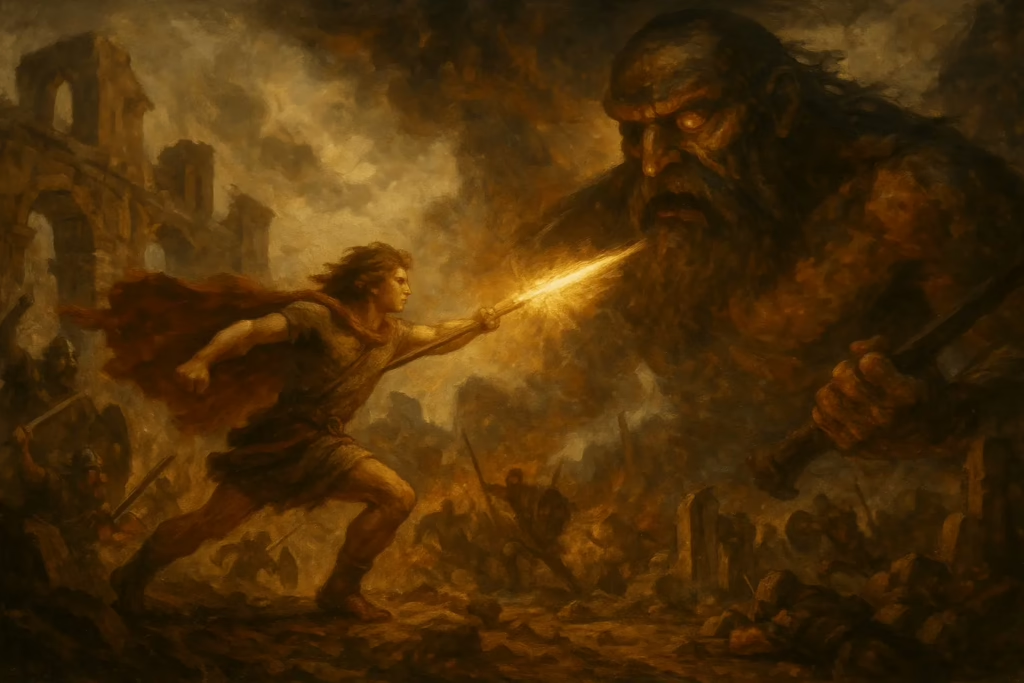
Nuada features prominently in two of the most important stories of the Mythological Cycle: the First and Second Battles of Mag Tuired (Cath Maige Tuired), which depict the Tuatha Dé Danann’s arrival in Ireland and their struggle to reclaim the land from rival powers.
When the Tuatha Dé Danann first come to Ireland, Nuada is their high king, chosen for his leadership and fairness. In the First Battle of Mag Tuired, the Tuatha face the native Fir Bolg. Though victorious, Nuada loses his right arm in combat — a seemingly minor injury with profound consequences. For according to early Irish law, a king must be physically whole to reign, and therefore Nuada was forced to step down. His place is taken by Bres, whose reign proves disastrous: though strong, Bres is unjust, disrespectful to poets, and fails to uphold the prosperity of the land.
During Bres’s rule, the Tuatha suffer greatly contrasting acutely to wise rule of Nuada. The contrast between Nuada and Bres is clearly deliberate. Bres, though strong and whole, is unworthy — unjust, greedy, and disconnected from the land’s prosperity. Nuada, though once wounded, rules with dignity and fairness. His story challenges superficial measures of fitness to rule, emphasising the deeper qualities of character and justice.
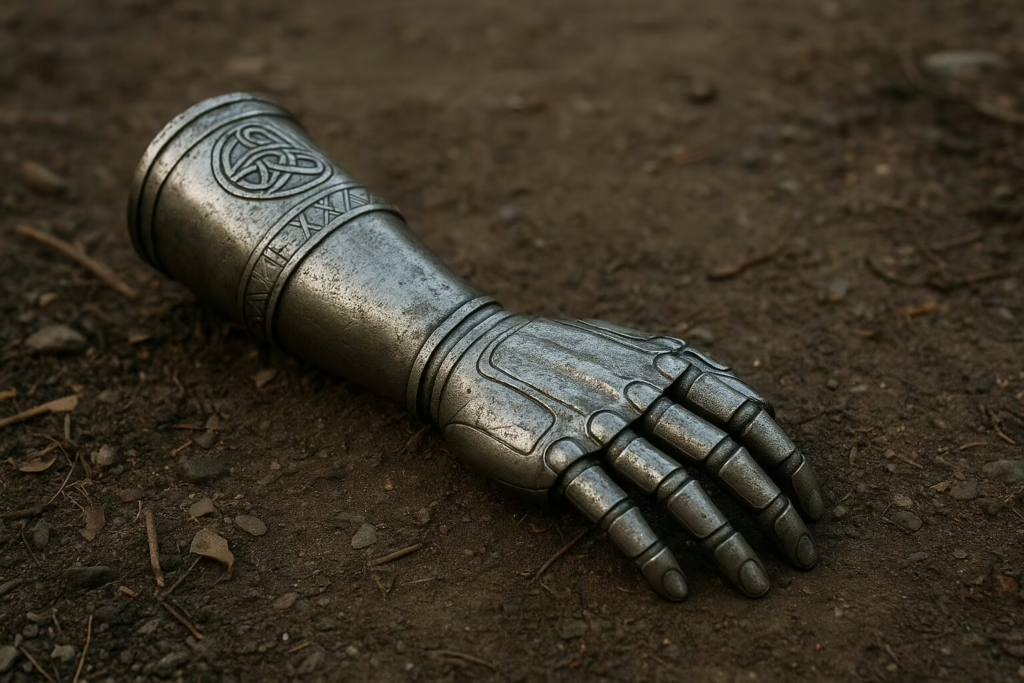
Unsurprisingly efforts are made to restore Nuada. The divine healer Dian Cécht fashions him a silver arm, earning him the name Airgetlám. Though strong and functional, it still marks him as imperfect. It is only later, when Dian Cécht’s son Miach and daughter Airmed craft a living flesh-and-blood replacement, that Nuada becomes fully healed — and therefore, restored to kingship.
Return of the king
Nuada’s return to the throne marks a shift: power is not merely about might, but about justice, healing, and renewal. He leads the Tuatha into the Second Battle of Mag Tuired, this time against the Fomorians — chaotic, oppressive beings who threaten to dominate Ireland. However, prophecy has already foretold that it is Lugh, a younger and more complete figure, who will ultimately lead the gods to victory. Nuada graciously steps aside, recognising that his role has passed to a new generation.
However, in the final battle, Nuada fights bravely but is slain by Balor of the Evil Eye, the monstrous Fomorian king. Nuada’s transformation from wounded king to silver-handed warrior, and then to fully restored leader, reflects the cycles of destruction and repair that lie at the heart of myth. His death at Balor’s hands is not a defeat, but a necessary passing, clearing the way for the young and complete Lugh to rise. Like many sacrificial kings in world mythology, Nuada’s fall enables the renewal of the people and the land.
In the end, Nuada represents a different kind of hero — one not glorified for conquest or charisma, but honoured for his integrity, humility, and enduring symbolic power. He is the wounded sovereign, the one who holds the kingdom together not through force, but through rightful leadership and a willingness to let go when his time has passed.
Nuada and the Tuatha Dé Danann
As the first king of the Tuatha Dé Danann, Nuada occupies a foundational place in the mythic structure of Irish divinity. His leadership sets the precedent for what it means to govern the gods not through tyranny, but through justice, order, and sacrificial restraint. His relationships with other members of the Tuatha offer further insight into his role and character.
Nuada’s kingship pre-dates the arrival of Lugh, the multi-skilled warrior who would later rise to prominence. While Lugh embodies youthful brilliance, versatility, and heroic energy, Nuada represents mature authority and a more measured form of power. Their relationship is not antagonistic but generational. Nuada recognises Lugh’s potential and willingly yields the throne before the decisive battle with the Fomorians. This act is unusual in myth — a reigning god stepping aside for the greater good — and affirms Nuada’s commitment to the wellbeing of his people over personal rule.
His interactions with other Tuatha figures are equally revealing. Nuada is closely linked to Dian Cécht, the divine physician who creates the silver arm, and to Miach and Airmed, whose healing surpasses Dian Cécht’s but leads to jealousy and tragedy. These associations place Nuada at the centre of themes concerning restoration, generational tension, and the limits of divine pride.
Though later eclipsed by more dynamic or dramatic gods, Nuada’s place among the Tuatha is quietly pivotal. He defines the moral centre of their society, the one by whom others — kings, warriors, healers — are measured. In stepping down and stepping aside, he reveals that true authority often lies not in holding power, but in knowing when to let it go.
Parallels in Comparative Mythology
Though rooted firmly in Irish tradition, Nuada’s story shares deep thematic patterns with other deities from Indo-European and neighbouring religious systems.
As already mentioned, in Britain, the clearest analogue is the Celtic god Nodens, worshipped at the Roman-era temple complex at Lydney Park. Inscriptions link Nodens to healing, hunting, and dreams, and while his mythology is largely lost, the etymological similarity between Nuada and Nodens strongly suggests a shared ancestral deity. Nodens was also associated with water and restorative magic — qualities that align with Nuada’s healing and redemptive symbolism. The silver hand may even hint at an earlier mythological connection between metalwork and regeneration.
In Norse mythology, Nuada shares traits with Týr, the one-handed god of law and justice. Týr loses his hand when he binds the wolf Fenrir, sacrificing his limb for the good of the cosmos. Like Nuada, Týr remains noble despite physical loss — a symbol that justice often requires personal cost. Both are defined not by violence, but by integrity and principle, and both are somewhat eclipsed in later myths by more charismatic figures (Lugh in Ireland, Odin and Thor in Scandinavia).
Another point of comparison is Hephaestus in Greek mythology — the god of fire, craftsmanship, and metallurgy. Hephaestus is also physically impaired (lame from birth or injury, depending on the version) yet indispensable to the gods because of his skill. While his personality differs significantly from Nuada’s, both deities speak to an ancient respect for creative restoration: the idea that brokenness can give rise to power when channelled through skill and knowledge.
Table: Comparison between the Irish god Nuada and other ancient deities
| Deity (Tradition) | Key likenesses to Nuada | Key contrasts / unique traits |
|---|---|---|
| Týr (Norse) | Both lose a right limb and embody law  honour; sacrifice ensures cosmic order | Týr never regains the hand and is not a king; Nuada’s silver arm restores his rule |
| Nodens (British‑Roman) | Shared name root; links to healing, metal and possibly a silver limb | Nodens is a hunter‑healer at Lydney, not a warrior‑king and lacks the physical‑wholeness kingship motif |
| Hephaestus (Greek) | Physical impairment offset by craft; divine smith provides lifesaving tech (parallels the forged silver arm) | Hephaestus is permanently lame and a master artisan, not a ruler or sovereignty symbol |
| Osiris (Egyptian) | Dismemberment‑and‑restoration theme; legitimacy tied to body’s integrity | Osiris is resurrected ruler of the dead; Nuada’s tale centres on earthly kingship and battle |
| Cronus (Greek Titan) | Supplanted patriarch whose fall marks a new divine order, echoing Nuada’s yielding to Lugh | Cronus is overthrown for tyranny, not disability; Nuada steps aside voluntarily after healing |
Nuada’s Legacy and Modern Reinterpretation
Nuada may not be as widely known today as Brigid or Lugh, but his legacy has quietly endured — not through living folk tradition, but through literature, scholarship, and symbolic reinterpretation. His story, once confined to early Irish manuscripts, has found new life in the imagination of modern writers, artists, and spiritual practitioners seeking to reclaim Ireland’s mythic past.
In early modern Ireland, Nuada’s name faded from popular devotion, unlike Brigid, whose attributes merged easily into Christian sainthood. The absence of a seasonal festival or a strong association with a specific location may have contributed to this. Yet his myth survived in manuscript tradition, and by the 19th and 20th centuries, Celtic revivalists and romantic poets began to rediscover him as a figure of nobility and sacrifice. Writers such as W. B. Yeats and Lady Gregory, while focusing more on figures like Lugh and Cú Chulainn, laid the groundwork for renewed interest in Ireland’s mythic kings.
In contemporary culture, Nuada has reappeared in fantasy literature, role-playing games, and comic books, often adapted loosely as a warrior or fallen monarch. The most notable example is in Guillermo del Toro’s Hellboy II: The Golden Army, where a character named Prince Nuada is cast as a tragic elven antagonist. Though heavily fictionalised, the name alone gestures to the enduring symbolic weight of Nuada’s story — a leader exiled, misunderstood, and connected to the old ways of the land.
Remembering his sacrifice
Nuada Airgetlám may not stride through Irish myth with the flash of Lugh or the ferocity of the Morrígan, but his presence is no less powerful. As the first king of the Tuatha Dé Danann, Nuada’s story is one of dignity in defeat and strength in sacrifice. He loses the throne not through weakness, but through adherence to tradition. He regains it not through conquest, but through healing. And when his time has passed, he steps aside so that another may lead. In doing so, he becomes more than a king — he becomes a standard by which kings are judged.
Though his legacy has often been overshadowed, Nuada remains a deeply compelling figure. In the silver and the silence, in the act of stepping down as much as rising up, he offers a vision of leadership rooted not in dominance, but in integrity, humility, and the quiet courage to serve.
Frequently Asked Questions: Nuada, first king of the Tuatha de Danann
He was the first king of the Tuatha Dé Danann and lost his throne after losing his arm in battle.
They are likely related but from different Celtic cultures — Irish and British.
He was killed by Balor during the Second Battle of Moytura.
Because early Irish law required the king to be physically fit.
- Wheeler, R. E. Mortimer. Report on the Excavation of the Pre‑Roman and Roman Site in Lydney Park, Gloucestershire (Society of Antiquaries of London Research Report 9). London: Society of Antiquaries, 1932. Open‑access PDF available via OAPEN: https://library.oapen.org/bitstream/handle/20.500.12657/50813/9780854312191.pdf ↩︎
YOU MAY ALSO LIKE
 Iron Age Clothing in Ireland: What People Really Wore
  Who is the Irish ‘good god’ the Dagda?
  Who was the Irish goddess Macha?
  What were the Irish war chariots?
  How did the Romans influence Ireland?
  Who was the Irish war goddess The Morrigan?
  Who was St Patrick? Life, Miracles & Lasting Legacy
  Who is the Cailleach? Ireland’s Winter Goddess