Republic of Ireland Heritage Tool
Explore the heritage of every barony in the Republic of Ireland. Search by name or county, click a barony on the map, or browse the four historical provinces below. Each barony page draws together archaeological records from the National Monuments Service, listed buildings from the National Inventory of Architectural Heritage, placename heritage from Logainm, terrain from EURODEM, and bedrock geology from Geological Survey Ireland into a single analytical profile.
Loading…
Explore the interactive map
Browse all 280 baronies of the Republic of Ireland visually. Click any region to view its heritage profile.
Click anywhere to open the map →Browse by historical province
Each province profile aggregates the per-barony data into a single analytical view with cross-province comparisons.
Explore further
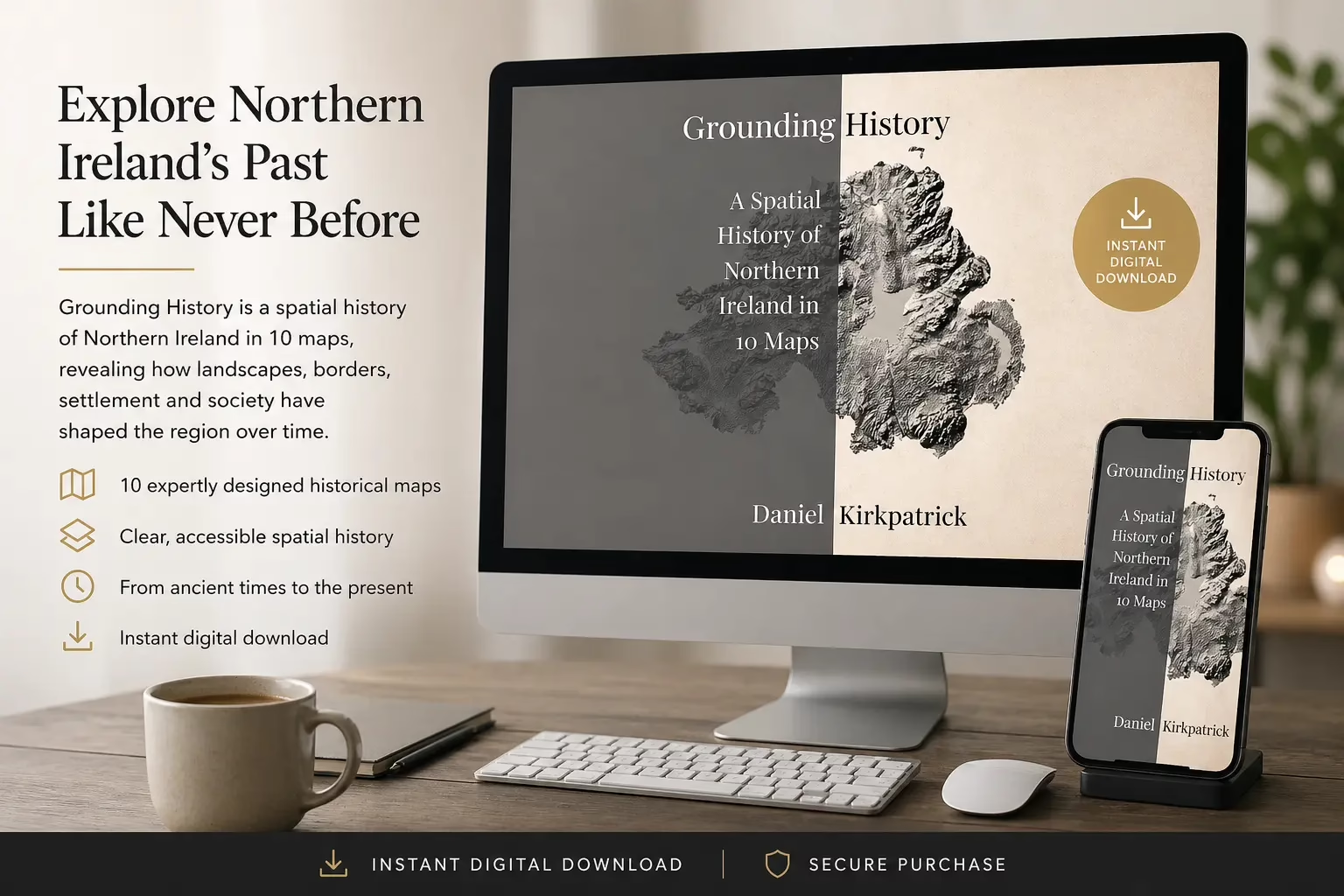
Grounding History: 10 Maps of Northern Ireland's Past
If you're interested in Irish heritage more widely, the companion report for Northern Ireland brings together the analysis of all 462 NI wards into one place through 10 high-quality maps — covering monument density, archaeological periods, placename heritage, terrain, wetland, and the historic landscape at first survey. Take a look.
About this tool
Click any section below to expand.
What is the Republic of Ireland Heritage Tool?
The Republic of Ireland Heritage Tool is an interactive research resource designed to help explore the historic landscape of the Republic through its 280 historical baronies. Rather than focusing on individual monuments in isolation, the tool allows users to examine how archaeology, settlement history, landscape, geology, and placenames combine within a defined local area. Each barony profile draws together evidence from three statutory state registers and brings spatial context from terrain, land cover, and bedrock geology layers into one analytical view. The tool is intended for local residents researching the history of their area, genealogists placing family history in a spatial context, students and researchers using the data as a starting point for landscape analysis, and anyone with an interest in Ireland's historical geography.
How to use this tool
Using the Republic of Ireland Heritage Tool is straightforward and requires no specialist knowledge.
Begin by entering at least two characters into the search box above. The search function will suggest barony names — Tulla Lower, Iveragh, Burren, Carbery — as you type. Because some barony names appear in multiple counties (Carbery East, Decies Within Drum), the dropdown shows the county in brackets after each suggestion so you can pick the right one. Once you select a barony, you'll be taken straight to its full heritage profile page.
You can also click Show Map to see all 280 baronies plotted on an interactive map. Click any polygon to open a popup with the barony's name, basic stats, and a link to its full profile. If you'd rather browse by region, the Browse by historical province section above lists Ulster, Leinster, Munster, and Connacht with their barony counts and a link to each province's aggregated heritage profile.
Each barony profile presents an overview of recorded archaeological and architectural heritage, the dominant monument types and chronological periods, terrain and bedrock geology, and placename heritage. Because the tool operates at barony level, it encourages exploration of everyday historic landscapes as well as the famous monuments.
Methodology behind the tool
This tool was built out of a desire to better understand Ireland's heritage spatially. The sheer volume of recorded sites and the span of history involved can be overwhelming. The barony framework helps structure this data into manageable, historically coherent units.
The tool presents heritage data for all 280 baronies of the Republic of Ireland, drawn from a bespoke spatial pipeline. Each barony's record was built by spatially joining four statutory registers — the National Monuments Service Sites and Monuments Record, the National Inventory of Architectural Heritage, the Logainm placenames database, and the Geological Survey Ireland bedrock map — to barony boundary polygons using point-in-polygon and area-weighted assignment respectively. Heritage density figures (sites per km²) exclude listed buildings and are calculated against the full barony area derived from the Ordnance Survey Ireland statutory boundary dataset.
Period classification for archaeological sites follows a multi-pass lexicon applied to the NMS site-type vocabulary, consolidated into a canonical nine-period framework (Mesolithic, Neolithic, Early Bronze Age, Middle Late Bronze Age, Iron Age, Early Medieval, Medieval, Post Medieval, Modern). Pre-Mesolithic and Roman-period labels in the source data are folded into their chronologically-closest canonical bucket because Ireland had no Palaeolithic occupation and lay outside the Roman Empire. Placename heritage classifications apply a conservative pattern matcher to the Logainm townland names, flagging diagnostic Gaelic roots that signal defensive sites (ráth-, lios-, dún-), ecclesiastical foundations (cill-, teampall-, domhnach-), prehistoric burial-ritual features (tuaim-, carn-), and Norse-contact settlement (gall-). Terrain data is derived from the EURODEM digital elevation model and the ESA WorldCover 2021 land-cover product, aggregated to barony level by area-weighted mean. Bedrock geology is read from the Geological Survey Ireland 1:100,000 bedrock map and summarised by geological system, rocktype, and formation shares. Where a data field shows a dash or is absent, the underlying record did not contain sufficient information to compute the metric reliably.
What is a barony?
Baronies are a sub-county administrative unit dating to the Norman period. They were the standard unit of local government and land assessment in Ireland for several centuries before being superseded by Local Government areas in the late 19th and 20th centuries. The 280 baronies of the Republic of Ireland are still recognised as a statutory boundary by Ordnance Survey Ireland, and they remain a useful unit for historical and archaeological analysis because they aggregate the townland-level evidence into coherent regional groupings.
Data coverage
This tool covers the 280 baronies of the Republic of Ireland. The six counties of Northern Ireland (Antrim, Armagh, Derry, Down, Fermanagh, Tyrone) are covered by the sibling Northern Ireland ward heritage tool on this same site. The two tools use different statutory data sources on different boundary units, which makes direct head-to-head counts of sites or listed buildings unsafe to compare without caveats. Terrain and bedrock geology, however, are directly comparable across the two tools.
What counts as a site?
This tool combines three distinct heritage registers, each with its own definition of what constitutes a recordable site:
- Archaeological sites (NMS). The National Monuments Service Sites and Monuments Record catalogues every known archaeological monument in the Republic — from prehistoric burial mounds and ringforts to medieval churches and post-medieval defensive works. A subset lies within a recorded protection zone, giving those sites statutory protection under the National Monuments Acts.
- Listed buildings (NIAH). The National Inventory of Architectural Heritage records buildings of architectural, historical, archaeological, artistic, cultural, scientific, social, or technical interest, appraised on a five-tier scale from International through National, Regional, Local, and Record-Only.
- Heritage placenames (Logainm). A heritage-diagnostic classifier flags Irish-language townland names carrying roots that signal defensive sites, ecclesiastical foundations, prehistoric burial-ritual features, or Norse-contact settlement.
Editorial principles
The narrative sections on each barony and province profile follow several explicit principles:
- Evidential. Every claim about a barony's heritage character is anchored in the underlying register data.
- Comparative. Counts are reported alongside their rank among ROI baronies or provinces so the reader can see whether a figure is unusual.
- Transparent on limits. Coverage gaps and survey biases are flagged where they meaningfully affect the figures rather than hidden.
- No interpretation beyond what the data supports. The narrative does not speculate about historical events or social dynamics beyond what the recorded heritage and placename evidence directly attests.
Data caveats and limits
- NMS Sites and Monuments Record is the product of survey campaigns at different intensities across counties and decades. Some baronies have been surveyed more thoroughly than others, and absolute counts should be read in that light. Sites destroyed by development before survey are typically not represented; sites in heavily forested or upland terrain are sometimes under-recorded.
- NIAH coverage is broadly complete for the Republic but was conducted on a rolling county-by-county basis. Recently built or recently demolished structures may not be reflected.
- Logainm classification applies a deliberately conservative pattern-matching approach to flag diagnostic Gaelic roots. A townland may carry a heritage signal the classifier doesn't recognise, particularly where the modern anglicised name has lost the original Irish form.
- Period attribution. The chronological distribution reflects only NMS sites with a recognised period attribution in the source data; sites listed as "Unknown" are surfaced as a data-coverage signal but excluded from canonical period totals.
- Bedrock geology is mapped at 1:100,000 scale, which means local variation within a barony — small pockets of different rock type, mineral veins, alluvium overlying bedrock — is generalised. The dominant-system and rocktype figures are area-weighted.
- Boundary changes. Some baronies have undergone minor boundary adjustments since their 19th-century definition; the OSi 2019 generalised boundaries used here are the current statutory definition and may differ slightly from historical maps in border areas.
Data sources
- National Monuments Service — Sites and Monuments Record (SMR) data.gov.ie
- National Inventory of Architectural Heritage (NIAH) data.gov.ie
- Logainm — Placenames Database of Ireland logainm.ie
- Ordnance Survey Ireland — National Statutory Barony Boundaries 2019 data-osi.opendata.arcgis.com
- EURODEM — European Digital Elevation Model mapsforeurope.org
- ESA WorldCover esa-worldcover.org
- Geological Survey Ireland — 1:100,000 Bedrock Geology gsi.ie
Copyright and use
The narrative content, analytical commentary, and visual design of this tool are © Daniel Kirkpatrick and may not be reproduced without permission. The underlying source data (NMS, NIAH, Logainm, OSi boundaries, EURODEM, ESA WorldCover, GSI bedrock geology) is open data, redistributed here under the respective open licences listed above. Maps and visualisations generated from that source data are made available for personal, educational, and research use. For commercial use or large-scale republication, please get in touch.
Spotted an error or have a suggestion? Email contact@danielkirkpatrick.co.uk — corrections and improvements are very welcome.
How to cite this tool
If you reference any data, figures, or narrative from this tool in academic, journalistic, or genealogical writing, the suggested citation is:
Kirkpatrick, D. (2026). Barony Heritage Profile: Republic of Ireland Barony Heritage Project. www.danielkirkpatrick.co.uk/republic-of-ireland-heritage-tool
For per-barony or per-province citations, append the specific profile name and URL — for example:
Kirkpatrick, D. (2026). Tulla Lower Barony Heritage Profile. www.danielkirkpatrick.co.uk/baronies/tulla-lower-clare-heritage-profile
The underlying source datasets (NMS, NIAH, Logainm, OSi, EURODEM, ESA WorldCover, GSI bedrock geology) should be cited separately where their figures are quoted directly — links and licence terms for each are listed under Data sources above.