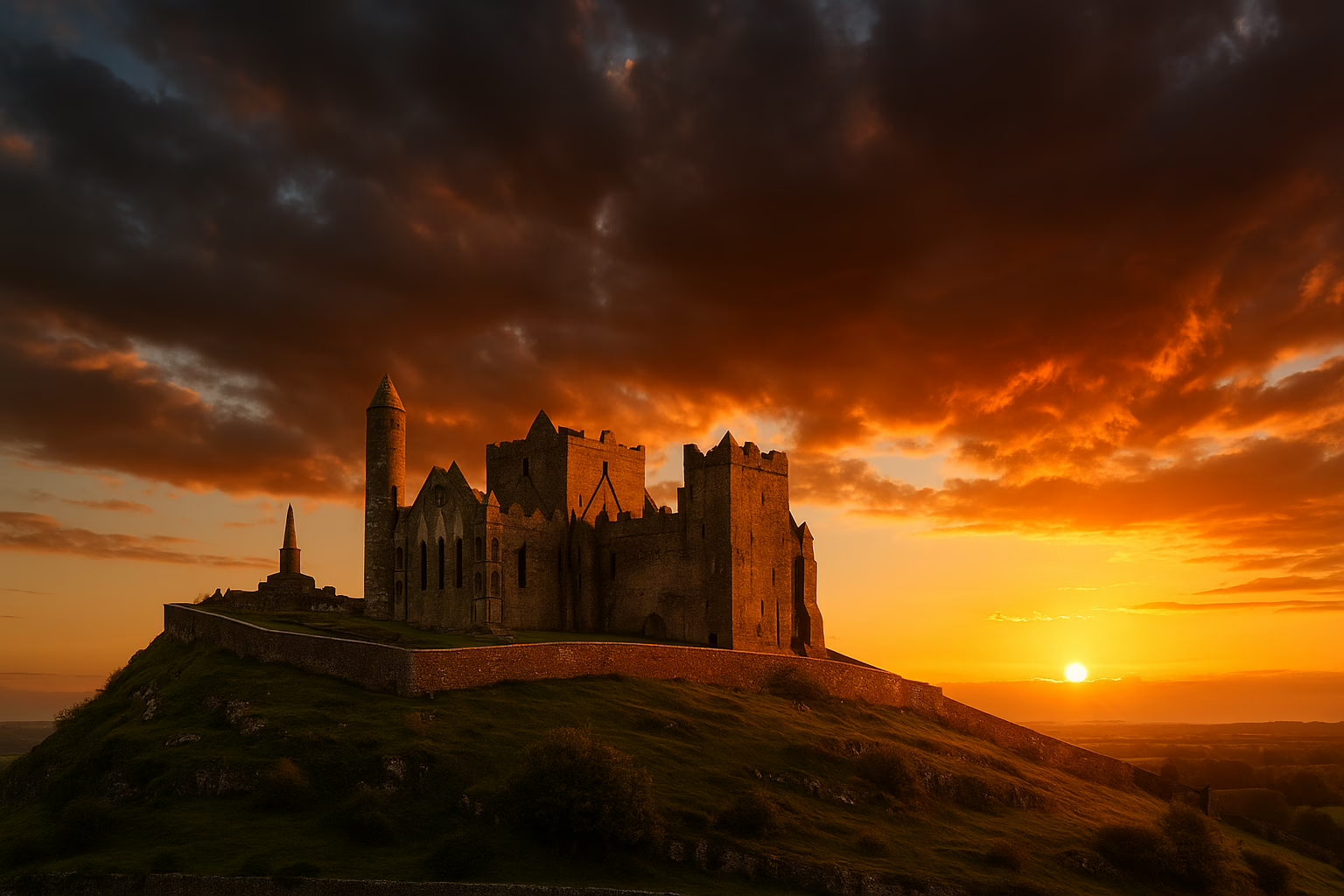
Each year, as we approach Christmas, many of us will don the charade of Santa Claus for our children, portraying a wonderful joy-wrapped lie. We put out our shortbread and milk, hang up the stockings, possibly even ring a few bells to pretend the reindeers are nearby. The wonder and excitement of our children fuels this seasonal untruth and continued to do so for decades. So while some lies are damaging – the vast majority – others, such as Santa Claus, can have a genuine purpose. So too with history. Particularly so with the Rock of Cashel in Ireland.
The Rock of Cashel in County Tipperary is one of Ireland’s most significant historical sites, a dramatic fortress rising above the plains. But behind the myths of Munster’s kings lies a story shaped as much by propaganda as by stone. This post explores its ancient origins dating back into the Iron Age, and how it evolved into the iconic medieval Christian sites in Ireland.
Iron Age Origins of The Rock of Cashel
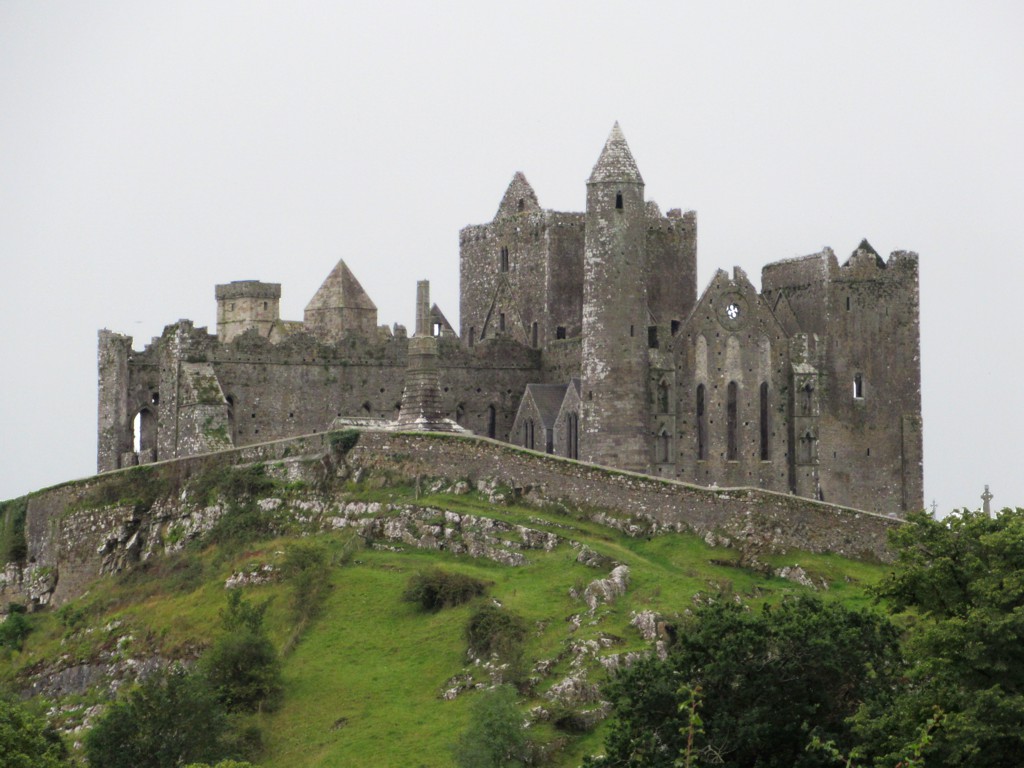
The Rock of Cashel is one of the most iconic ecclesiastical monuments in Ireland, possibly even Europe. Situated atop a rocky crag, a series of imposing spires and towers looms over the vast, grassy plains beneath. Its medieval history has been well documented and fascinating to explore, but its ancient past is much more challenging and, for that reason, all the more compelling.
For it is widely portrayed as the ancient capital of the Kingdom of Munster, the inauguration seat of its King, dating back into prehistory. Contemporary with the Hill of Tara, Dun Ailinne, Rathcroghan, and Emain Macha, Cashel was believed to have been the political epicenter for Iron Age Munster.1 That is, until recently.
Timeline of the Rock of Cashel
| Date / period | Event |
|---|---|
| c. 4–5 c AD | Alleged hill-fort seat of the Eóganacht kings of Munster |
| 978 | Brian Boru crowned High King at Cashel |
| 1101 | King Muirchertach Ua Briain grants the Rock to the Church |
| 1127–1134 | Cormac’s Chapel built; Romanesque frescoes painted |
| 1235-1270 | Gothic cathedral constructed against north wall of chapel |
| 15 Sep 1647 | Sack/Massacre of Cashel by Inchiquin’s Parliamentarian army |
| 1874 | Site taken into State care (Board of Works) for conservation |
| 1992-1995 | Western Stone Forts Project excavations & consolidation |
| 2014-2020 | OPW completes conservation of 12 c wall-paintings in Cormac’s Chapel |
Kings of Munster and the Seat of Cashel
Around 500AD, the King of Munster, Conall Corc, is believed to have taken possession of the rock and established his stronghold there. This fortification then became the residence of the Kings of Munster until the 12th century when it was given over to the ecclesiastical authorities.2 A tract from the text Conall Corc and the Corcu Loigde dating around 700AD claimed that whoever possessed the Rock of Cashel would have authority over all of Munster. In other words, the Rock symbolised the political and strategic centre of the region.
However, this is now believed to be little more than political propaganda as it was highly unlikely that Munster was united at this time under a single king, nor had it been for many centuries, if ever. So goes the myth of Cashel.
Evidence of habitation at Cashel is mysteriously absent from around 100-500AD when there was an explosion of activity – neatly coinciding with the narrative of Conall Corc.3 But this contradicts the view that Cashel was a contemporary of the other Iron Age settlements at least from 100AD onwards. Instead, archaeological evidence indicates that nearby Knockainy dates to the early 1st millennia AD, prior to Cashel; and that the 5th century possibly marked a transfer of power from one to the other. In other words, Cashel wasn’t even on the political geography until the 5th century.
The Kingdoms of Ancient Ireland
The neat division of Ireland into the five kingdoms of Ulster, Connacht, Leinster, Munster, and Meath, is a wonderful simplification for historical narratives, but is sadly misleading, particularly when it comes to Munster. That Cashel was initially occupied as a fortification with defensive structures focused to the South and East, strongly suggests that there were threats from these directions – from within Munster.
The dangers such a settlement faced were mainly from within the Kingdom it allegedly ruled. Why go to the effort of constructing fortifications if there’s nothing to fortify against? This is especially clear when one considers how such fortified capitals were not the norm across Ireland as they were in Britain at this time.
In this way, to even refer to a ‘King of Munster’ prior to the 7/8th centuries is to promote a form of ancient political propaganda. Many of our modern spin doctors could learn a lot from these 7th century writers who have successfully controlled the narrative for millennia. But, unlike many of our contemporary political lies, this one has served to unite Munster – albeit to serve one chief’s interests over his opponents.

Cashel in Early Medieval Ireland
As a writer of historical fiction, the line between what we know and don’t is often blurred. This is especially so when it comes to prehistory when facts are few and far between. Often, we must use inference and logic, imperfect and fraught with personal biases, to deduce a historical reality. Munster’s division and Cashel’s ascendency only after the 5th century are the facts we can now hold on to, but we still are left with many more questions unanswered. For, if Munster wasn’t united during this period, why do we continue to present it so? Did Cashel exist in prehistory in a lesser form, as a hamlet or small town? Had Munster other centres of political power in place of Cashel?
With so many unknowns, we can only make a small number of conclusions. Namely that Cashel was likely unoccupied or only held a small settlement until the 5th century. Munster had no single ‘over-king’ until much later in the 7th or 8th centuries. Cashel was initially fortified as a defensive centre due to regional rivalries and conflict. And lastly, that Munster was not a united kingdom until much later than previously thought – certainly not as the mythological traditions imply.
Lies, particularly such ancient ones, tell us often more than the truths we believe. I love a good lie in a story and Irish history is riddled with them. History, as shown here, is as much about discovering what lies are told and why, as it is with finding the truth of what happened. Why say what happened when we can shape its retelling as we wish? So goes every political history ever written.
Archaeology of the Rock of Cashel
| Find category | Quantity / description | Cultural phase | Significance |
|---|---|---|---|
| Pottery sherds (incl. B-ware) | 300+; some 6 c B-ware | 6–13 c | Indicates pre-chapel occupation & long domestic use |
| Bone & antler pins / comb frags. | > 25 items | 10–13 c | Dress & textile tools of elite clergy |
| Parallelepiped antler gaming die | 1 | 12 c | Evidence of leisure / literacy in chapter house |
| Short-cross silver penny (King John) | 1 coin (c. 1200–1210) | Early 13 c | Helps date later floor horizon |
| Painted window-glass fragments | 40+ pieces | 12 c | Rare survival of stain-glass technology in Ireland |
| Animal bone (cattle, sheep/goat, pig) | 6.2 kg analysed | 12 c | Mixed diet of canons & visitors |
Rock of Cashel as a Medieval Ecclesiastical Centre
The Rock’s transformation began in 1101, when Muirchertach Ua Briain, king of Munster, surrendered his fortress “in honour of God and St Patrick” and gifted the entire summit to the Church. Within a decade Cashel was listed as a diocesan seat at the reforming Synod of Ráth Breasail (1111), and an early cathedral—now lost—was probably raised on the plateau soon afterwards.
Ecclesiastical ambition accelerated under Cormac Mac Cárthaigh, king of Desmond: between 1127 and 1134 he commissioned Cormac’s Chapel, a sandstone masterpiece whose barrel vaults, twin towers and Romanesque frescoes were unprecedented in Ireland. The chapel signalled Cashel’s shift from local diocesan hub to a centre of international church art and theology, drawing craftsmen from Regensburg and beyond.
Church status was formalised at the Synod of Kells-Mellifont in 1152, which elevated Cashel to one of four metropolitan sees, alongside Armagh, Tuam and Dublin, and demarcated its provincial dioceses across Munster. A resident archbishopric required larger liturgical space, prompting continued building: the 12th-century cloister has vanished, but foundations reveal a cloistered community serving the growing chapter.
By the end of the 12th century the Rock had fully exchanged battle standards for croziers. Kings still visited—often as benefactors rather than warlords—but the skyline was increasingly dominated by stone belfries and choir stalls. The later Gothic cathedral (begun c. 1235) would complete this ecclesiastical skyline, but its foundations were laid in the decisive reforms and royal patronage of the early medieval period.
Cashel and other Medieval Christian Sites in Ireland
| Site | County & setting | Principal monuments | Secure date-range | Unique feature(s) |
|---|---|---|---|---|
| Rock of Cashel | Tipperary; limestone outcrop (92 m OD) | Round tower (c.1100), Cormac’s Chapel (1127-34), Gothic cathedral (c.1235-1270), Hall of the Vicars Choral (15 c) | Seat of Munster kings to 1101; church complex 12 c-17 c | Earliest Romanesque frescoes in Ireland |
| Glendalough Monastic City | Wicklow; glacial valley | Round tower (30 m), seven churches, St Kevin’s “Kitchen”, cathedral ruins | 6 c foundation; peak 10-12 c | Twin-arched stone gateway unique in Ireland |
| Clonmacnoise | Offaly; River Shannon floodplain | 2 round towers, 9 churches, 3 high crosses | Founded 544; major school 7-12 c | 700+ Early Christian graveslabs |
| Skellig Michael | Kerry; Atlantic sea-stack | Terraced beehive huts, cisterns, oratory, South Peak hermitage | 6–13 c occupation | UNESCO World Heritage; extreme island hermitage |
Visiting the Rock of Cashel Today
Dominating Tipperary’s skyline, the Rock of Cashel fuses royal, ecclesiastical and architectural heritage in a single, iconic site. Its Romanesque chapel, Gothic cathedral and soaring round tower encapsulate a millennium of Irish power struggles. Whether its Iron Age roots are myth of history remains unclear. But, it’s place as one of Ireland’s foremost historical sites is difficult to deny.
The Rock Cashel is now a national monument under the auspices of the Irish Government. You can find out more information about visiting the site here.
Frequently Asked Questions: Rock of Cashel
The limestone outcrop, once the seat of the kings of Munster, was known in Irish as Carraig Phádraig (“Patrick’s Rock”).
King Cormac Mac Carthy commissioned the sandstone chapel in AD 1127–1134, introducing Romanesque architecture to Ireland.
As of 2025 the Office of Public Works charges €10 adults; site open daily 09:00–17:30 with last Cormac’s Chapel tour at 14:30.
Yes—mid-12th-century wall-paintings in the chancel are the earliest known in Ireland and underwent OPW conservation in 2014-20.
Yes—a 10-minute field path leads to the 13th-century ruins, free of charge and with iconic photo angles back to the Rock.
- P.W. Joyce (1906) A Smaller Social History Of Ancient Ireland, Dodo Press. ↩︎
- Joyce, 1906: 254 ↩︎
- Gleeson, P., 2019. Making Provincial Kingship in Early Ireland: Cashel and the Creation of Munster.”. Power and Place in Europe in the Early Middle Ages. Oxford, pp.346-368. ↩︎
YOU MAY ALSO LIKE
 What is the Nendrum Monastic Site?
  Book Review: A smaller social history of ancient Ireland, P.W. Joyce
  What is the Ogham Tree Alphabet?
  Hill of Uisneach – Ireland’s Sacred Centre of Myth & History
  What is the history of Dun Ailinne?
  Who was St Patrick? Life, Miracles & Lasting Legacy
 What is the Antrim Round Tower?