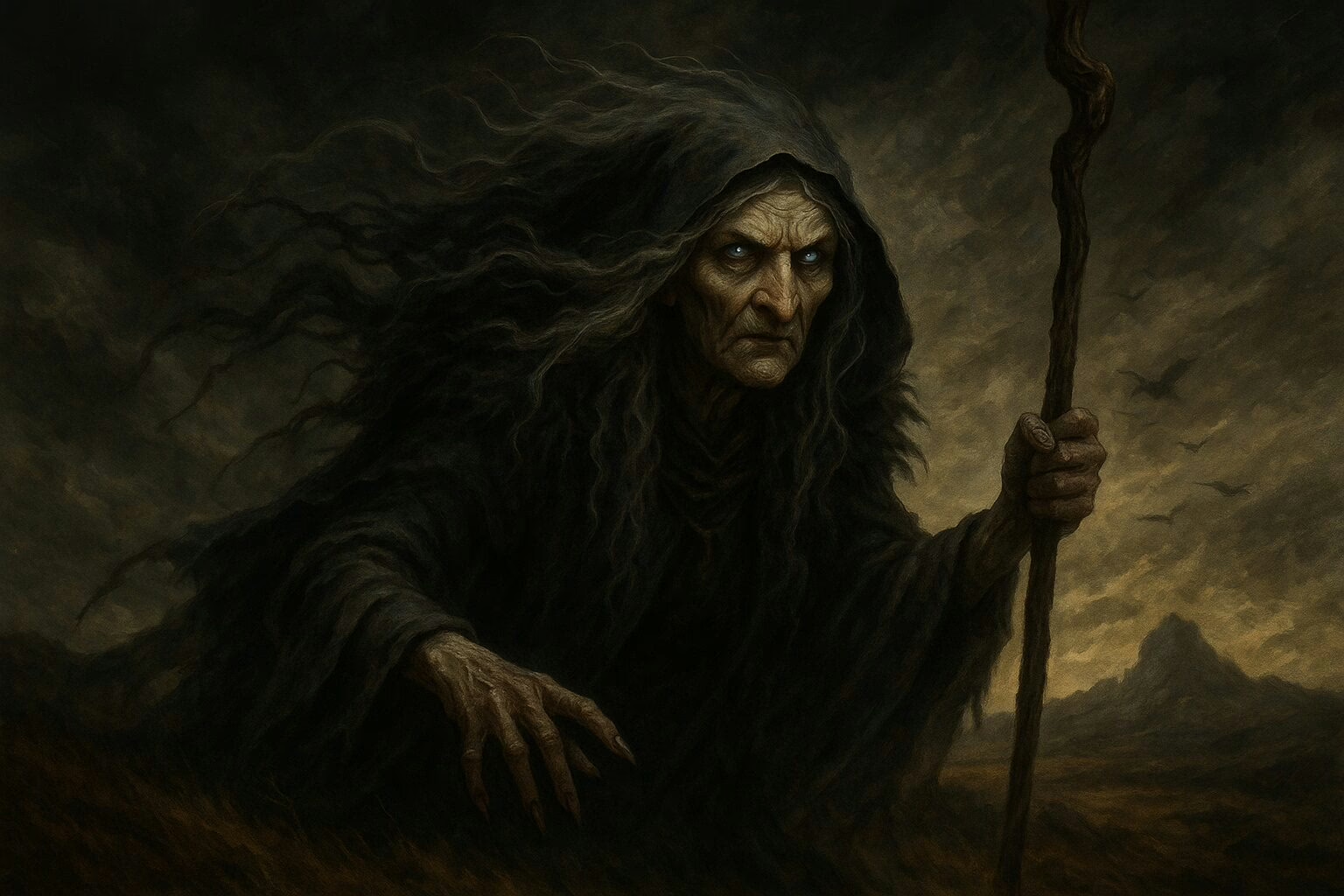
Across the windswept mountains and storm-lashed coasts of Ireland, echoes of an ancient figure endure. The Cailleach (pronounced KAYL-ee-ach) – often described as a crone, hag, or veiled woman of great age – stands as one of the oldest and most enigmatic beings in Irish mythology. She is the personification of winter, the guardian of sacred landscapes, and, in many traditions, the very embodiment of the land itself.
This post explores the complex mythology surrounding the Cailleach. Drawing on folklore, linguistics, landscape, and seasonal ritual, we will uncover her origins, transformations, and meaning. In doing so, we reveal not only the story of a mythic crone, but the enduring voice of Ireland’s ancient, untamed spirit.
This links to other Irish mythical creatures I’ve covered including the Selkies and the Merrow.
Who is the Cailleach?
The Cailleach is one of the most powerful and enduring figures in Irish mythology. She is far more than a generic crone. In folklore and myth, the Cailleach appears as a towering figure—both literally and symbolically. She is said to stride across the land, shaping the hills and mountains with her footsteps, carrying boulders in her apron, and summoning winter with a wave of her staff.
Descriptions of the Cailleach vary across time and region, but certain traits remain constant. She is typically portrayed as immensely old, often with a blue or stone-coloured face, long white hair, and eyes that see through centuries. Some traditions speak of her as a giantess or as a supernatural being who predates the coming of the Tuatha Dé Danann. In others, she is a personification of winter itself—appearing at Samhain and ruling the land until Imbolc, when her power fades and spring begins to stir.
Mythological Paradox
The Cailleach’s character blends opposites: she is both creator and destroyer, fierce and nurturing, monstrous and divine. In many local tales, she is a solitary figure who governs the wild and untamed spaces of Ireland—mountains, cliffs, caves, and bogs. While not a goddess in the classical sense, she holds a mythic status equivalent to one. Her presence suggests not only age and decay but also a deeper wisdom that comes from living beyond the normal span of human time.
Unlike many figures in Irish myth, the Cailleach does not always have a fixed genealogy or a defined role in one mythological cycle. Instead, she appears across stories from different regions—sometimes as a deity, sometimes as a landscape spirit, and sometimes as a trickster or shapeshifter. This fluidity adds to her mystique. She resists categorisation, much like the natural world she governs.
Her story reminds us that power can come with age, that the landscape holds memory, and that winter, though harsh, is a necessary part of life’s great cycle.

Etymology of the Cailleach
The name Cailleach comes from the Old Irish caillech, meaning “veiled one” or “hooded woman.” It is a word associated with age, concealment, and feminine mystery. In modern Irish, cailleach still means “old woman” or “hag,” though in earlier usage, it carried spiritual and mythic significance beyond a simple descriptor. The term suggests not just age, but power born of age—wisdom, severity, and connection to older forces of nature.
Linguistically, the word traces back to the Latin pallium (a cloak), adopted into early Irish as caille. The -ach suffix forms a noun, making cailleach literally “the one of the veil.” This veil may symbolise spiritual separation, invisibility, or the otherworld—qualities long associated with the Cailleach figure. In many myths, she is veiled not just in appearance but in meaning, standing apart from the human world while shaping it from the shadows.
Origins of the Ancient Crone of Ireland
Scholars have debated whether the Cailleach originated as a distinct pre-Christian deity or emerged later as a folkloric archetype rooted in oral tradition. Some propose that she represents a survival of an ancient mother goddess, perhaps pre-Celtic in origin, tied to the land and its fertility cycles.1 Others view her more as a personification of natural forces—especially winter, death, and geological change—rather than as a singular divine figure with a fixed mythology.2
What is clear is that versions of the Cailleach exist across the Celtic world. In Scotland, she appears as Cailleach Bheur, the blue-faced hag who shapes the mountains and brings winter storms. In the Isle of Man, she is known as Caillagh ny Groamagh, a figure who walks the land during storms. These shared traditions suggest an older pan-Celtic figure whose local expressions evolved differently across regions. Yet in each case, she remains associated with winter, stone, and sovereign landscape.
There may also be deeper Indo-European roots behind her myth. Similar crone-like figures appear in Slavic, Norse, and Greek traditions—such as Baba Yaga, the Norse Hel, or the Greek Hecate. Each blends age with mystery and connects death to knowledge. These parallels hint at a much older archetype: the wise old woman who guards thresholds, seasons, and sacred knowledge.
Table: Comparison between the Irish Cailleach & other Mythological Traditions
| Tradition | Name | Role / Domain | Similarities to the Cailleach |
|---|---|---|---|
| Irish (Gaelic) | Cailleach Bhéara | Winter, weather, sovereignty, mountains | Ancient crone, shapes the land, controls seasons |
| Scottish Gaelic | Cailleach | Winter, creation of landscape | Identical tradition; sometimes considered the same being |
| Norse | Skadi | Winter, mountains, skiing, hunting | Goddess of winter and wilderness; fierce and independent |
| Slavic | Baba Yaga | Wild nature, death, rebirth, witchcraft | Crone figure; dwells in nature; both feared and revered |
| Greek | Gaia / Hecate | Earth / magic, liminality, the underworld | Gaia is earth mother; Hecate shares crone/mystic aspects |
| Hindu | Kali | Destruction, time, transformation | Wild, ancient, powerful female force; fierce protector |
| Welsh (Celtic) | Ceridwen | Transformation, inspiration, rebirth | Wise woman/crone archetype; cauldron of knowledge |
| Baltic | Laima | Fate, childbirth, life and death | Controls destiny; often portrayed as aged and wise |
The Cailleach in Folklore and Place-Names
The Cailleach’s memory lives on in place-names, rock formations, and local legends of Ireland, many of which survive into the present day. Across the country, folklore tells of a great hag who shaped the land with her hands, dropped boulders from her apron, and turned to stone at the end of her reign.
Mountains and cliffs often bear her mark. Hag’s Head at the Cliffs of Moher is said to be her profile turned to stone, gazing out to sea. In Slieve Gullion, a tale survives of the Cailleach luring the hero Fionn mac Cumhaill into a lake, transforming his hair to white. In Kerry, the Hag of Beara (An Chailleach Bhéara) sits overlooking the coast, a weathered stone said to be her resting place. These stories link the physical world to the mythic past, suggesting that the land itself was shaped by her will.
Boulders scattered across open terrain are often said to have fallen from her apron as she journeyed across Ireland. In some versions, she was building mountains or forging valleys. In others, she fled the approach of spring, her magical stones spilling as she moved. These tales give meaning to erratic stones, glacial debris, and odd geological features—folding natural history into folk memory.
Power over the Weather
Weather patterns were also placed under her control. Storms, hail, and sudden snowfalls were blamed on the Cailleach’s rage. Farmers once watched for signs of her presence in the wind at Samhain, the time when her reign began. In parts of Ulster and Connacht, people told of how she washed her great plaid cloak in rivers—whitening the landscape with frost. Her breath was said to bring sharp cold, and her staff could freeze the ground at a touch.
In many of these stories, the Cailleach is not evil or malicious. She is formidable, yes—but also necessary. She brings winter, but winter is part of the cycle. The hardship she imposes ensures the land rests, renews, and eventually yields to spring. Even in stories where she turns to stone, she does not die. She endures, waiting to rise again when her season returns.
Place-names across Ireland still echo her presence. The words Chailleach, Calliagh, and Caillech appear in hills, caves, and valleys—many of which have local legends attached. These traces remind us that long before written myth, the land itself held stories. And in those stories, the Cailleach was always close.
Table: Usage of Cailleach in Irish Placenames
| Place-Name | Location | Meaning / Translation | Associated Feature / Tradition |
|---|---|---|---|
| Slieve na Calliagh | Co. Meath, Ireland | “Mountain of the Cailleach” | Site of Loughcrew passage tombs, linked to the Cailleach as a builder or guardian of the tombs. |
| Carn Cailleach | Co. Limerick, Ireland | “Cailleach’s Cairn” | A stone cairn traditionally linked with her burial. |
| Loughan Cailleach | Co. Roscommon, Ireland | “Cailleach’s Lake” | Nearby hills also bear her name; folklore tells of her shaping the area. |
| Beinn na Caillich | Isle of Skye, Scotland | “Mountain of the Old Woman” | Summit cairn said to be built by the Cailleach. |
| Sliabh na Cailleach | Co. Kerry, Ireland | “Mountain of the Hag” | Associated with stories of the Cailleach leaping from peak to peak. |
| Cailleach’s Well (Tobar na Cailleach) | Various locations (e.g., Donegal, Kerry) | “Well of the Cailleach” | Sacred wells dedicated to or named after the hag figure. |
| Glen Cailleach | Perthshire, Scotland | “Valley of the Cailleach” | Known for stone shrines to the Cailleach and Bodach; rituals held by Highland communities. |
Sovereignty and Transformation in Irish Mythology
At the heart of many Cailleach legends lies a deeper theme: sovereignty. In Irish mythology, sovereignty is not just political—it is sacred. It often appears in the form of a woman who grants or withdraws kingship, depending on how a ruler treats her. This symbolic figure can appear as a young maiden or as an old crone, and the transformation between the two reflects the changing seasons, the fertility of the land, and the legitimacy of power. The Cailleach embodies this tradition in its most ancient and elemental form.
In some stories, the Cailleach transforms with the turning of the year. At Samhain, she rises in her winter aspect: aged, fierce, and wild. She rules over the cold months, shaping the weather and holding the land in stasis. But at Imbolc or Beltane, she weakens. In some tales, she dies or turns to stone. In others, she transforms into a young woman—sometimes identified with Brigid, the spring goddess and saint. This duality suggests a cycle of death and renewal, winter and spring, age and youth. The Cailleach does not vanish—she renews.
This seasonal rhythm reflects older themes in Irish and Indo-European myth: the land must pass through a trial of barrenness before it can bloom again. The king or tribe must survive the hardship of winter before being worthy of fertility and abundance. The Cailleach, as guardian of that hardship, plays a central role in ensuring balance. She tests, withdraws, withholds—so that when the return comes, it is earned.
Cailleach’s Enduring Symbolism and Legacy
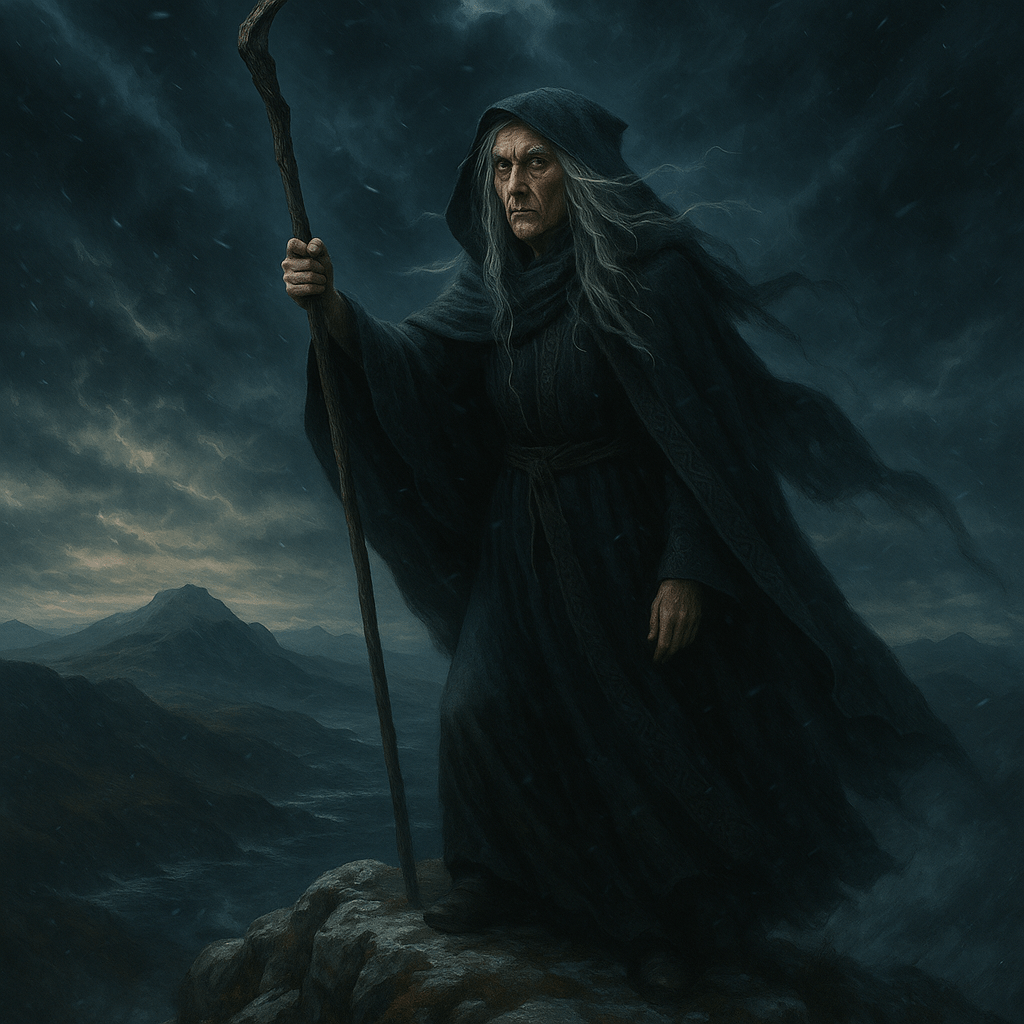
The Cailleach is among the most enduring figures in Irish tradition—not because she conforms to easy mythic categories, but because she resists them. She is not simply a goddess, nor just a crone or weather spirit. She is a complex presence tied to the land, the seasons, and the rhythms of a much older worldview.
In a time when myths were woven into the very shape of the land, the Cailleach stood as a reminder of winter’s necessity and wisdom’s authority. Her hands shaped hills and her breath brought frost, but she also carried memory—of the cycles that sustain life and the transformations that give it meaning. She ruled not through conquest but through endurance, reminding each generation that power often lies in patience, age, and the inevitability of change.
Today, her presence still lingers in place-names, in folklore, and in those quiet moments when the cold wind speaks of older things. To understand the Cailleach is to glimpse a time when myth was reality, and when the crone was not feared—but revered.
Frequently Asked Questions: The Cailleach in Irish Mythology
The Cailleach is an ancient figure in Irish folklore often described as a powerful crone or hag. She is associated with winter, mountains, sovereignty, and the natural cycles of decay and renewal.
Yes. The Cailleach remains a powerful symbol in modern folklore, feminist spirituality, and eco-conscious traditions. Her myth speaks to enduring themes of transformation, aging, and seasonal change.
The Cailleach is linked to many Irish locations, including Hag’s Head at the Cliffs of Moher, Slieve Gullion in Armagh, and the Beara Peninsula in Kerry. These sites often have legends about her shaping the land.
The word Cailleach comes from Old Irish and means “veiled one” or “old woman.” It suggests mystery, age, and a connection to hidden or otherworldly knowledge.
While not always referred to as a formal goddess in the mythological texts, the Cailleach holds divine status in folk tradition. She appears as a land-shaper, a weather spirit, and a symbol of winter’s rule.
- MacKillop, James. A Dictionary of Celtic Mythology. Oxford University Press, 2004. ↩︎
- White, Miranda J. “The Cailleach and the Landscape: An Ecological Reading.” In Celtic Cosmology and the Environment, 2011. ↩︎
YOU MAY ALSO LIKE
 Who were the Selkies in Irish Folklore & Mythology?
  What were the Irish Brehon Laws?
  Iron Age Clothing in Ireland: What People Really Wore
  What were the Irish Ollamhs? Ancient healers and herbology
  Who were the Merrow in Irish Mythology?
  Battle of the Boyne Visitor Centre Review: History, Exhibits & Tips
  Who is the Irish goddess Ériu?
  Who was the Irish god Nuada of the Silver Hand?