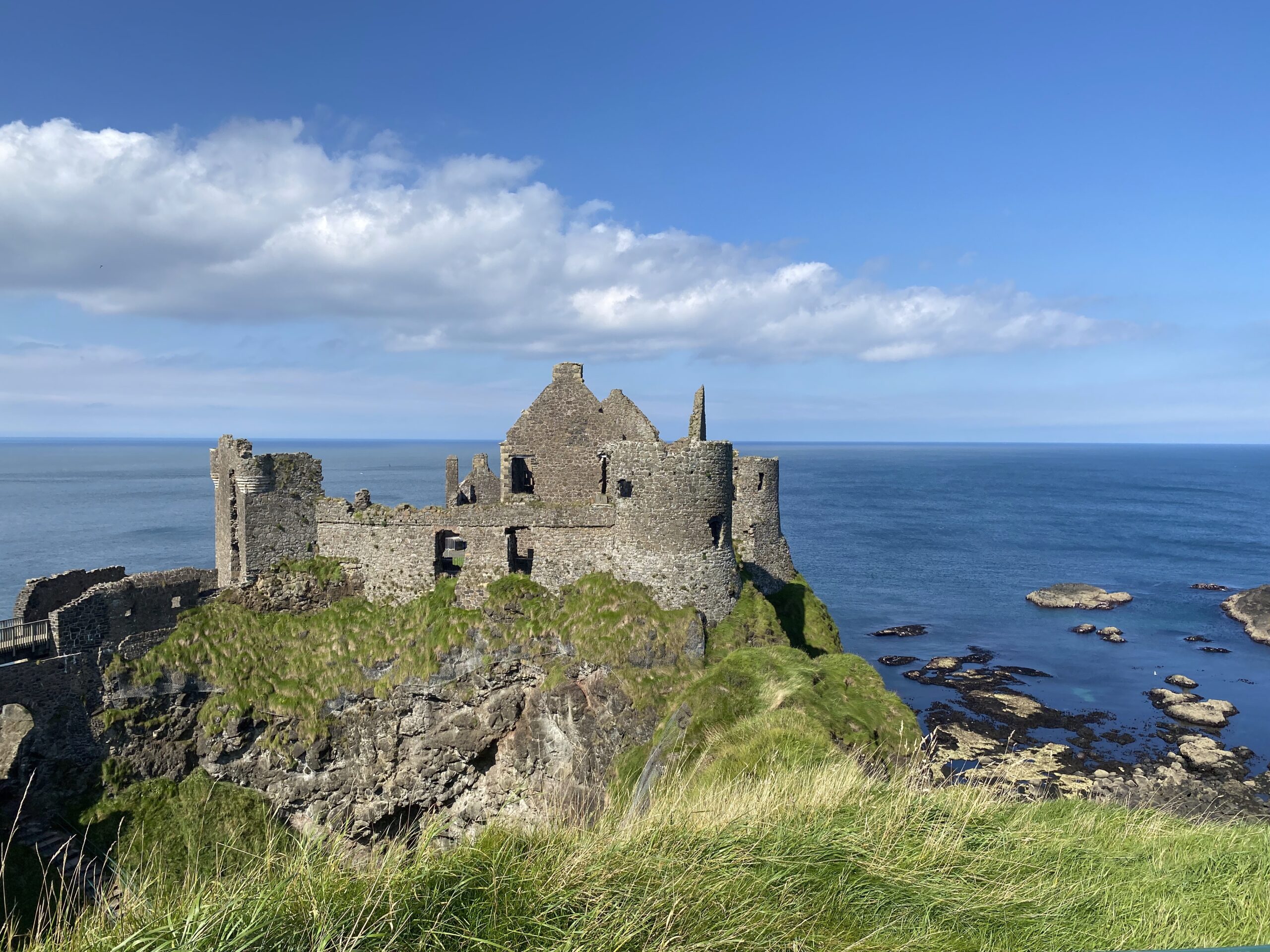
Perched precariously on a basalt outcrop, battered by the relentless waves of the Atlantic Ocean, Dunluce Castle is one of Ireland’s most breathtaking medieval ruins. Located on the north coast of County Antrim, this dramatic stronghold has witnessed centuries of war, rebellion, and legend; inspiring artists and writers for centuries, from C.S. Lewis‘ Narnia Chronicles, to poetry by Jewett, or as a backdrop in the HBO series of Game of Thrones. And yet, the history behind such an iconic landmark is even more compelling than all you can see. And most of it has only recently been discovered.
Excavations in 2011 and 2014 have literally unearthed intriguing new findings about this iconic historical monument. They reveal a complex history stretching from prehistoric settlement (some 1500 years ago) through to early medieval fortification, extensive 17th-century occupation, and eventual decline. This article weaves together this latest evidence to tell the story of Dunluce’s evolving role in Ireland’s past.
Ancient Roots of the Dunluce Site (Prehistoric – Early Medieval)
It’s hard to imagine looking at the striking castle, but long before these stones were laid, a community likely thrived on this stunning stretch of coastline. For those with the eyes to see, the signs are hard to miss: solitary standing stones, bronze age settlement remains1, and placenames which hark back to ancient linguistic roots.2
The ‘Dun’ in Dunluce – meaning Fort – suggests that the site’s strategic importance predates the early medieval period. And local archaeological evidence—such as a rock-cut souterrain found on the promontory—hints at an early fortification, though there are no further traces of what this would have looked like nor any references within ancient texts as there are for the nearby castle of Dunseverick. However, its strategic location overlooking the North Channel would have made it a natural point for both coastal surveillance and maritime trade, with links to Scotland likely even at this early stage.
Medieval Fortress and Clan Battles (13th–15th Century)
Evidence of a medieval settlement can be traced to the 13th century when it’s thought that an Anglo-Norman medieval manor was built alongside a church. The 2014 survey summarises this succinctly:
“Very few details are known about the precise location and extent of the manorial settlement but presumably it was close enough to the promontory to make use of the earlier place name. St Cuthbert’s Church, to the south-west of the castle, rebuilt in the 17th century, may be a remnant of this earlier settlement. There is no obvious enclosure associated with the church suggesting that it is unlikely to be an early medieval ecclesiastical foundation, however, the dedication to St Cuthbert, a saint associated with Northumbria, could suggest an Anglo-Norman origin for the church.”
With a manor and a church already built, it’s not a great leap to imagine the wider community which would have supported such developments; with agriculture and industry clearly following.
While there may have been a castle at this point, there’s no archaeological evidence to suggest this. In fact, it’s not until much later that the castle can be traced:
“The original castle was constructed between 1490 and 1513 by the MacQuillans…The castle was constructed on the naturally defensible promontory and consisted of a large rectangular building, within a curtain wall, with at least two corner towers and a gate house.”
The coastline is dotted with similar forts (albeit none so visually striking) together forming a formidable bulwark against invaders from across the sea. However, it was from within Ireland initially that the threats emerged. With inter-clan conflicts eventually displacing the MacQuillans with the MacDonnells. The chaos and feuding of the closing decades of the 16th century saw the castle shift ownership again between the MacQuillans and the English, before eventually returning to the hands of the MacDonnells.3
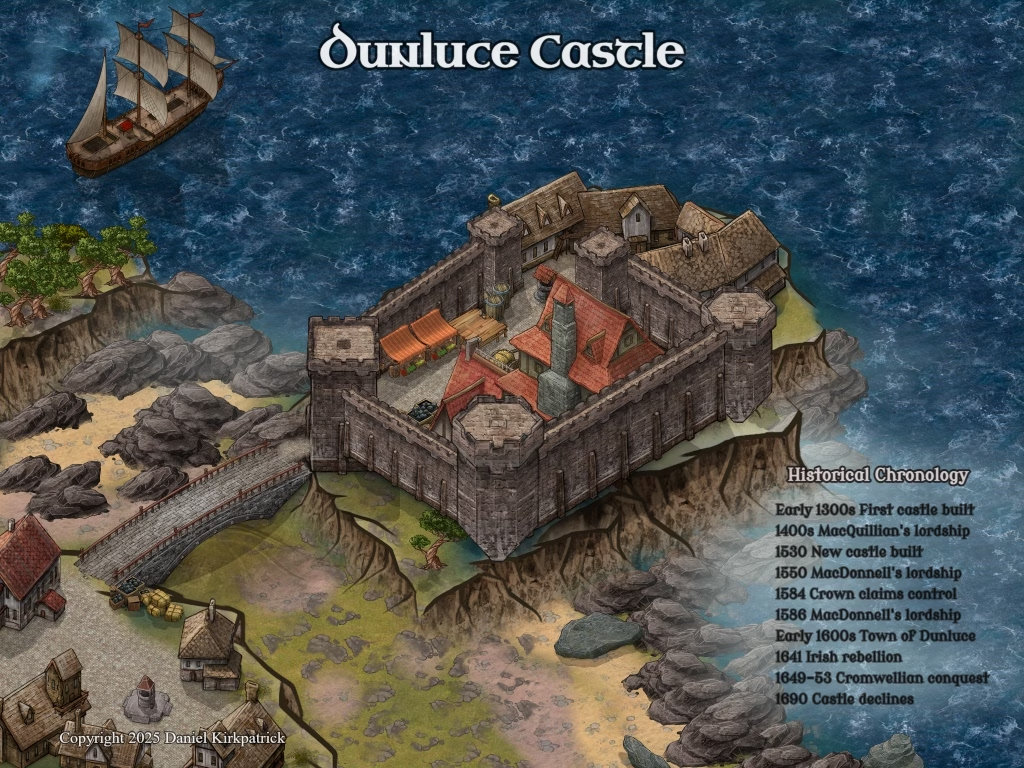
The MacDonnells transformed Dunluce into a Renaissance-style castle, influenced by the great Scottish strongholds of the time. Ornate windows, banqueting halls, and defensive towers were added, turning it into a residence fit for nobility. Under Randal MacDonnell, 1st Earl of Antrim, Dunluce reached its peak as a thriving cultural and political centre, housing merchants, soldiers, and nobles. The castle become much more than a defensive fortification; it was a thriving town.
The 17th-Century Town of Dunluce
As someone who grew up a matter of minutes from the castle (and who went cliff-jumping off the surrounding coastline), all of the above detail is familiar and well-known. What’s surprising is the extent of Dunluce, far beyond the now crumbling walls of the castle. For under Randal MacDonnell’s ownership, a phase of construction took place transforming the surrounding land into a significant settlement in its own right. The archaeological survey in 2014 explained:
“By the 1620s [Dunluce] was reported to have had 40 houses and other buildings which included a probable courthouse or jail, a mill, a smithy and a church. Between the 1620s and 1630s formal gardens were constructed in the area to the west of the lodgings block, one of the Upper Inner Ward buildings of the main castle complex. These gardens consisted of three terraces, and probably included features such as paths, raised beds and a possible bowling green.”
Beyond the archaeological evidence, other markers exist in plain site. For instance, a peak just north-east of the site is aptly named ‘Gallows Hill’ in a nod back to its darker history when there would have been the jailhouse. It’s hard to imagine such a large settlement and thriving, luxurious castle now looking at the ruins. But, whereas many other of the neighbouring forts suffered destruction in the many conflicts of this period, Dunluce appears to have a much more ‘natural’ decline.
Destruction and Decline of the Castle
The Night the Kitchen Fell (Castle Legend)
One stormy night, as the wind howled and waves crashed against the cliffs, a banquet was in full flow inside the castle. The kitchens would have been alive with activity, preparing food and drink for the many distinguished guests. But nature has a way of speaking even when we don’t want to hear.
As servants ran about their business, a crack could have been heard, like a great roar of thunder, as the kitchen split in two. The walls gave way and floor broke apart as the castle began to disappear into the sea. Screams were drowned with the unlucky servants as the waters enveloped the castle’s exposed flank. Only, as the legend goes, did a tinker escape; perched on a window overlooking the damage, he somehow managed to pull himself away just before the floor became sea.
Whether true or not, the legend reflects the undeniable decline brought on – at least in part – by coastal erosion. The perilous nature of its cliffside position meant that, over time, sections of the fortress simply crumbled away, making it increasingly difficult to maintain.
Decline and Abandonment (17th Century)
Setting aside the legend, the castle’s decline was likely due to a combination of challenges including the death of Randal MacDonnell, the changing political situation this brought about, and the castle’s physical location. Following the death of Randal MacDonnell, 1st Earl of Antrim, in 1636, the family’s fortunes became increasingly entangled in the convulsions of the Wars of the Three Kingdoms.
Although his son, Randal MacDonnell the younger, retained his earldom and Catholic allegiance, his support for the Royalist cause placed him on precarious political ground. The turmoil of the 1641 Irish Rebellion and subsequent Cromwellian conquest of Ireland (1649–1653) were particularly destructive in Ulster, and Dunluce was not immune to the wider disintegration of Gaelic and Old English aristocratic power.
By the end of the 17th century, the castle had been largely abandoned as a residence. The MacDonnells shifted their focus inland to estates such as Glenarm, where the needs of administration and comfort could be better met. Dunluce was left to weather the Atlantic winds, its walls slowly succumbing to time, salt, and neglect. By 1690, Dunluce was no longer a functioning residence, leaving only ruins to tell its story.
Dunluce Castle Today
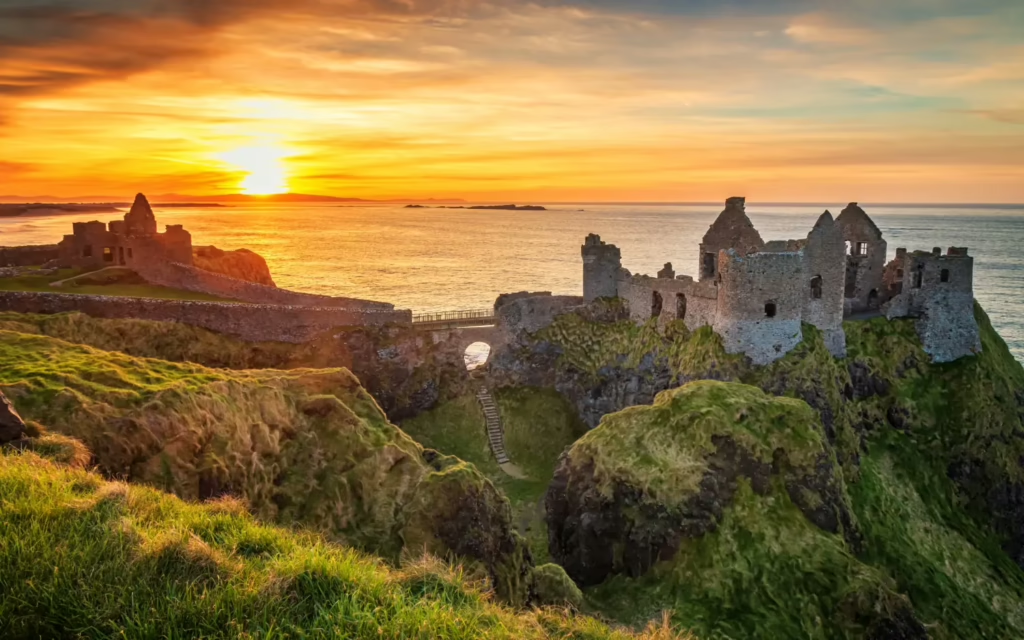
Today, Dunluce Castle stands as a stunning ruin, its walls still clinging to the basalt cliffs. Visitors can explore its great hall, towers, and gatehouse, while the breath-taking coastal views provide a reminder of its dramatic past. Dunluce Castle is more than just a ruin—it is a symbol of Ireland’s turbulent history, where Normans, Gaels, Scots, and English forces all fought for control. Its precarious position on the cliffs serves as a poignant metaphor for the shifting power struggles that shaped Ireland’s past.
But it’s more than a metaphor for me; it’s a symbol of hope and inspiration. This monument, steeped in the conflicts and violence that raged in this land, has become a rich source for creativity, decorating the walls of countless homes, filling books with inspired imaginings, and drawing visitors from across the entire world. That is the power of history. That’s one of many reasons why it matters today.
Frequently Asked Questions: History of Dunluce Castle
The first castle on the site was built around the late 15th century by the MacQuillan clan (Richard Óg de Burgh had a manor nearby in the 1200s, but the iconic castle ruins we see today date to the MacQuillans). It was later expanded by the MacDonnells in the 1600s into a larger fortification.
It was abandoned by 1690 due to a combination of factors: a portion of the castle (including the kitchen) collapsed into the sea around 1639 (as legend holds), a devastating fire in 1642 damaged the adjacent town, and the family’s fortunes declined after Randal MacDonnell’s death. Its cliffside location also made maintenance difficult as erosion took its toll.
In the early 1600s, a small town of about 40 houses grew around the castle. It included a church, courthouse/jail, mill, and other facilities, reflecting Dunluce’s peak as a bustling settlement under the MacDonnells. This “lost town” was rediscovered by archaeologists in the 20th–21st century, since little of it remains above ground today.
While not explicitly named, Dunluce Castle’s look inspired fictional castles. It’s said C.S. Lewis used it as inspiration for Cair Paravel in the Narnia chronicles. The ruins themselves were also used as a filming location backdrop for Game of Thrones (it served as Castle Greyjoy in exterior shots). This pop culture connection adds to its allure for visitors.
Yes, Dunluce Castle is open to visitors. It’s a monument managed by the local authorities (the Northern Ireland Environment Agency). There is a visitor center and access to the ruins, weather permitting. It’s one of the most photogenic castles on the Antrim coast, especially at sunset.
- Akeret, Örni, et al. “Introduction.” Corrstown: A Coastal Community. Excavations of a Bronze Age Village in Northern Ireland, edited by Victoria Ginn and Stuart Rathbone, Oxbow Books, 2012, pp. 1–12. JSTOR, https://doi.org/10.2307/j.ctvh1dq5k. Accessed 18 Mar. 2025. ↩︎
- The word ‘Dun’ suggests much earlier occupation predating the medieval buildings: https://www.qub.ac.uk/sites/communityarchaeology/PDFFileStore/Filetoupload,494665,en.pdf ↩︎
- This period of conflict in Ireland is worthy of its own post, but others have already expounded it far better than I could attempt. I’d recommend Jonathon Bardon’s A History of Ulster for a more comprehensive retelling of this storied period. ↩︎
YOU MAY ALSO LIKE
 What is the history of Dun Ailinne?
  What is the Antrim Round Tower?
  Map of Megalithic Sites in Ireland
  North Antrim Historical Sites: Interactive Map
  Iron Age Materials in Ireland: From Bog Iron to Ash-wood Spears
  What was Bangor Abbey? Irish Medieval Monastic Hub
  Hill of Uisneach – Ireland’s Sacred Centre of Myth & History