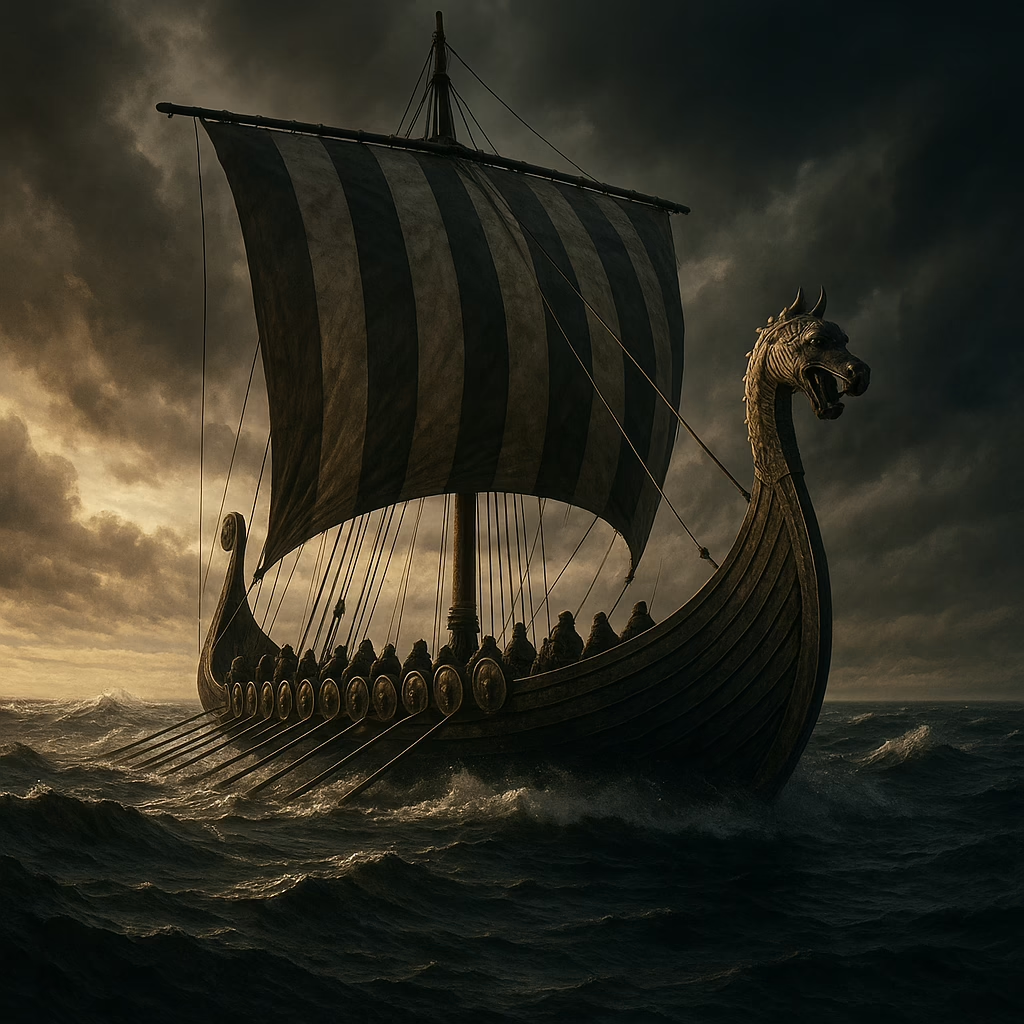
It’s widely known that the Viking’s raided Ireland, pillaging the early medieval monasteries and coastal settlements. But there’s much more to the story of these Norse invaders. For they weren’t simply raiders who came, pillaged, and left. No – the Vikings came, pillaged, and settled. From the 8th century onwards, Vikings were beginning to influence Ireland in ways that would shape its history, culture, and politics, that would endure right up to today. And it’s the Viking settlements in Ireland which provide is with the most iconic Norse legacy for us to consider.
In this post I consider the story of Viking settlements in Ireland. We’ll look at how temporary raiding camps (longphorts ) turned into towns like Dublin, Waterford, and Limerick. We’ll uncover the archaeological remains of their homes, workshops, and harbours. And we’ll follow the Norse as they became part of Irish society, blending cultures and founding new communities. From battle to intermarriage, the legacy of the Vikings remains etched into place names, myths, and modern Irish cities. So let’s start with where these settlements were.
Earliest Viking Raids on Ireland
The first recorded Viking raid on Irish soil occurred in AD 795 at Lambay Island, off the coast of Dublin. Monasteries made ideal targets — rich in silver, manuscripts, and slaves, but poorly defended. Other accounts note Rathlin island along the north coast, alongside Inishmurrary and Inishbofin along the west, were also raided in in this same year. But this was only the beginning.
Over the next few decades, Norse raiders struck sites across the Irish coast and rivers, including Armagh, Clonmacnoise, and Bangor. These early attacks were seasonal and opportunistic. The focus was on quick gains against easy targets. But by the 830s the Norse began to change tactics and establish longphorts — defended ship camps along tidal rivers and estuaries. A longphort (from the Old Irish long “ship” and port “fort” or “camp”) was a fortified riverside or coastal base where Viking fleets could anchor their ships, protect their loot, and establish temporary or permanent settlements. These camps were typically defended by earthen banks or palisades and positioned along tidal rivers that allowed ships to travel inland.
Two of the earliest and most prominent longphorts were founded simultaneously in 841 at Dubh Linn (Dublin) and Linn Duachaill (Annagassan, Co. Louth). Dublin would eventually grow into the most powerful Viking settlement in Ireland, but both sites were well chosen. Each lay at the mouth of a navigable river — the Liffey and the Glyde — with easy access to the Irish Sea and the interior. These locations offered strategic advantages: shelter for fleets, proximity to fertile land, and connections to existing trade and settlement networks. Other longphorts soon followed at sites like Waterford, Cork, and Limerick, forming a web of Norse-controlled harbours that reshaped Ireland’s coastal landscape.
Despite the violence of their arrival, the Norse quickly became more than raiders. They brought new technologies, trade routes, and seafaring skills. Their settlements began a period of cultural change that would shape Ireland for centuries.
The Founding of Viking Towns
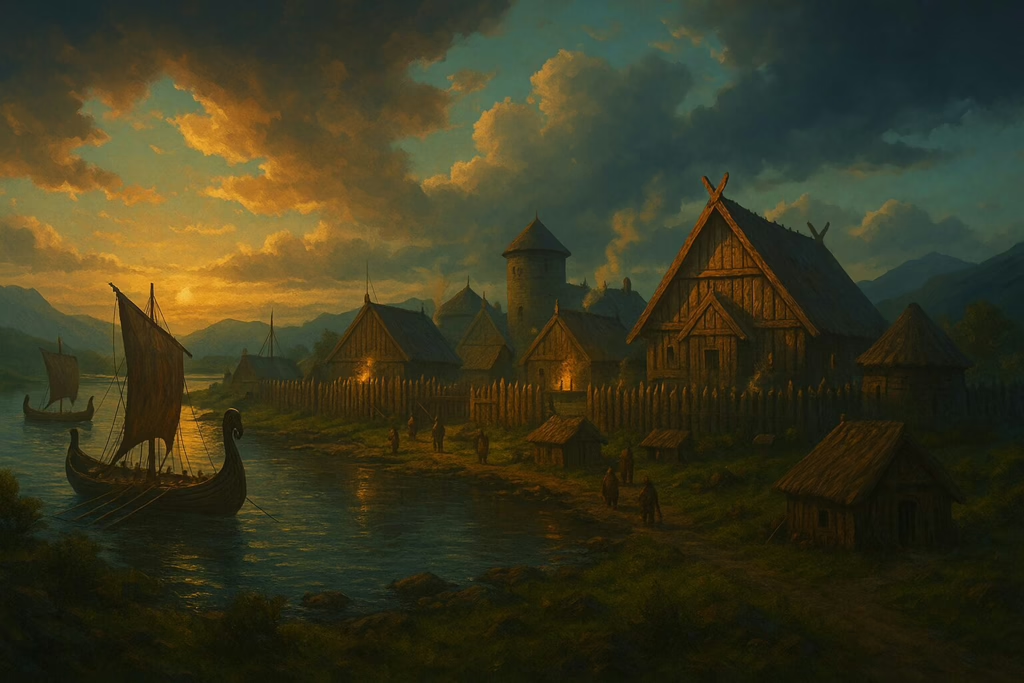
By the mid-9th century, several Viking longphorts had developed into permanent settlements. Dublin, established around 841 AD, became the most prominent. Situated at the mouth of the River Liffey, it grew rapidly into a bustling town — a hub of trade, craftsmanship, and politics. No longer were the Vikings mere foreign invaders. Trade, intermarriage, and cultural assimilation began in earnest.
Soon other settlements followed suit, with Waterford founded around 914 AD, Wexford and Cork shortly after in c. 915, and Limerick in c. 922 AD. These urban centres were unlike anything previously seen in Ireland. While early medieval Irish settlements tended to be dispersed and rural, Viking towns featured planned layouts with streets, defensive walls, quaysides, and marketplaces.
Excavations at Wood Quay in Dublin uncovered more than two hundred timber-built houses arranged along streets and yards, as well as well-defined quays running parallel to the River Liffey. Archaeologists also exposed defensive embankments and town enclosures that hint at early town planning rather than spontaneous settlement. These findings underline how Norse settlers shaped towns with intentional design, integrating domestic, commercial, and defensive functions into a coordinated urban layout.
Norse linguistic influence can still be seen in placenames such as Howth (from Old Norse Hǫfuð), Strangford (Strangr fjǫrðr, “strong fjord”), and Skerries (from sker, meaning reef or skerry). These names reflect not only settlement, but deep integration into the landscape and seascape of Ireland.
Table: Viking Settlements in Ireland
| Site | Modern Name | Date Established / Attested | Norse / Irish Name & Meaning |
|---|---|---|---|
| Dubh Linn | Dublin | 841 AD | Dyflin (Norse); Dubh Linn = “black pool” |
| Veisafjǫrðr | Waterford | 914 AD | Veisafjǫrðr = “fjord of the strong current” |
| Knarrarfjǫrðr | Wexford | 914–917 AD | Knarrar fjǫrðr = “fjord of the cargo ships” |
| Limerick | Limerick | 922 AD | Norse name unrecorded; Irish Luimneach = “bare spot” |
| Corcach | Cork | c. 915 AD | Irish Corcach = “marsh”; Norse reused monastic site |
| Strangfjordr | Strangford | c. 9th century (toponymic) | Strangr fjǫrðr = “strong sea-inlet” |
| Loch Garman | Wexford area | 819 AD (raids), 914 AD (settled) | Loch Garman (Irish); reused and Norse-influenced |
| Anagassan | Co. Louth | 841 AD | Possibly Linn Duachaill = “Duachall’s pool” |
| Inishbofin | Galway coast | 9th century | Inis Bó Finne = “Island of the white cow” |
| Carlingford | Co. Louth | 9th–10th century | Possibly from Norse Kerlingfjǫrðr = “narrow sea-inlet” |
Economic Impact of the Viking on Ireland
With the expansion of Viking settlements, the Irish economy was transformed. The breadth of archaeological finds signal vibrant trade, craftsmanship, and commerce. Excavations at Woodstown, Co. Waterford—a fortified Viking longphort—revealed over 5,000 artifacts, including silver ingots, lead weights, coins (Byzantine and Carolingian), ship nails, and tools from the 9th century, indicating both local metalworking and long-distance trade connections . These weights in particular were used to measure and exchange hack-silver, underlining a bullion economy rather than coinage exchange.
Equally significant is the discovery of Viking-age arm-rings and brooches at sites across Dublin, Kilmainham, and inland hoards. Analysis shows these objects were manufactured locally in Hiberno-Norse Dublin from melted silver—often bullion or coin-based—and served as both currency and status symbols.
Indeed, evidence of trade and exchange is shown by archaeological research into lead trade weights found across Ireland and Britain. These standardised weights, similar to those used in Scandinavia, formed part of the widespread weight-based trading network characteristic of Viking economic practices. Therefore, towns like Dublin became important nodes in a vast Viking economy that stretched from Greenland to Baghdad.
Cultural Exchange and Norse-Gaelic Identity
As Viking towns grew and the Norse presence became permanent, cultural boundaries began to blur. The result was the emergence of a hybrid identity — part Norse, part Gaelic — that shaped much of Ireland’s urban and coastal culture for generations.
Intermarriage between Norse settlers and Irish families was common, especially in trading centres like Dublin and Limerick. Norse-Gaels, as they became known, adopted elements of both cultures. Surnames of Norse origin, such as Doyle (from Ó Dubhghaill, “descendant of the dark foreigner”) and McAuliffe (Mac Amhlaoibh, “son of Olaf”), show how deep Norse roots run in Irish identity.
Moreover, several Irish words entered from Norse – particularly in trade and seafaring – pinginn (penny), margadh (market), and scing (knife). Meanwhile, Norse-Gaelic rulers such as Ímar, Sitriuc, and Amlaíb Cuaran dominated coastal kingdoms with alliances stretching to Scotland and the Isle of Man.
Culturally, this period produced a distinctive blend. Norse sagas record events in Ireland, while Irish annals mention Norse lords as both enemies and allies. Some Viking-age monuments bear inscriptions in runes alongside Ogham or Latin script, symbolising the layered identities of the time. By the 10th century, many Norse settlers saw themselves not as outsiders, but as part of Ireland. They contributed to Irish law, trade, warfare, and even monastic life. This deep cultural mingling ensured that while the Viking era ended, its legacy endured — especially in the port cities they helped build.
Clontarf and myth of Viking defeat
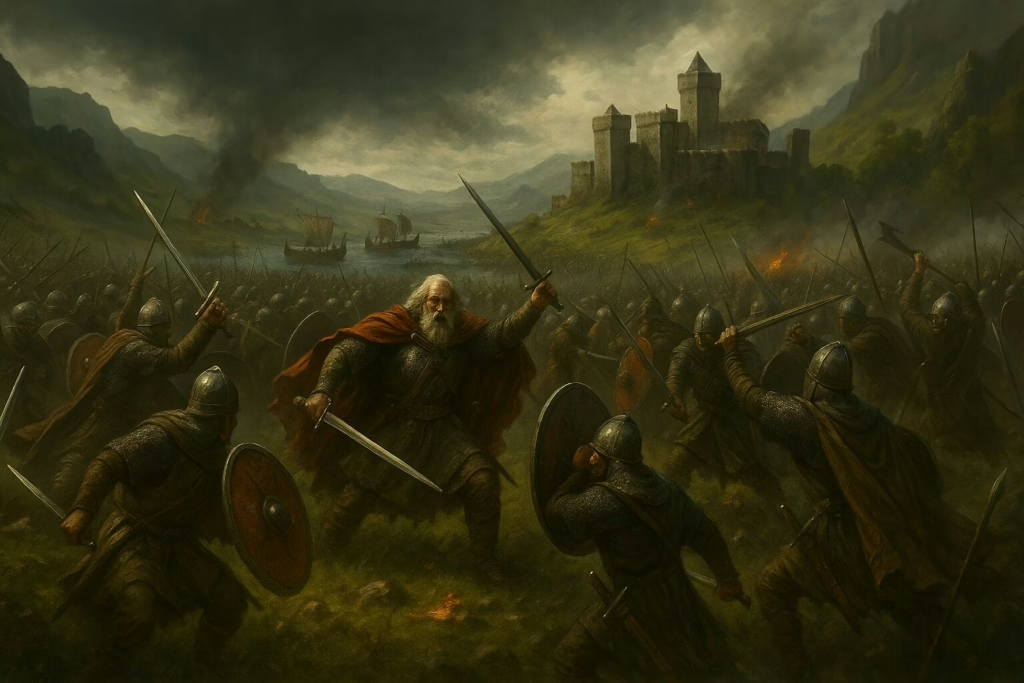
Historically, the most famous conflict came at the Battle of Clontarf in 1014. Led by High King Brian Boru, the battle pitted his army against a coalition of Norse-Gaels, Leinster forces, and external Viking mercenaries, including fighters from the Isle of Man and Orkney. For centuries, the event has been remembered in popular tradition as a decisive Irish victory — the moment the Vikings were finally driven from Ireland. But the reality, as with much of early Irish history, was more nuanced.
Rather than a simple clash between native Irish and foreign invaders, Clontarf was the culmination of decades of interwoven alliances, rivalries, and regional power struggles. Many of the so-called “Vikings” in the battle were Hiberno-Norse, born and raised in Ireland, who had long integrated into its political and economic systems. Dublin, ruled by Sigtrygg Silkbeard, was a Norse city, but one deeply connected to surrounding Irish kingdoms. On the opposing side, Brian Boru’s forces also included Norse warriors from Limerick and other coastal settlements.
The annals and sagas recount not only the bloody conflict at Clontarf but a wider pattern of strategic marriages, shifting allegiances, and mutual raids. Irish kings often allied with Norse rulers to attack domestic enemies, and Norse leaders likewise depended on Irish allies to hold power. This pragmatic diplomacy defies the simplistic narrative of perpetual war between native Irish and foreign Vikings.
Still, Clontarf gained symbolic power. Though Brian Boru was killed, his forces won the field, and the battle came to represent Irish resistance to foreign domination. In later centuries, it was woven into nationalist memory — less for its political reality than for what it came to stand for.
Timeline of Viking activity in Ireland
| Date | Event | Summary |
|---|---|---|
| 795 AD | First Viking Raid | The earliest recorded Viking attack in Ireland took place on Lambay Island off the coast of Dublin. |
| 837 AD | Major Inland Raids | Viking fleets sailed up the Boyne and Liffey rivers, raiding monasteries such as Clonard and Slane. |
| 841 AD | Founding of Dublin & Annagassan Longphorts | Permanent fortified bases (longphorts) established, marking a shift from raiding to settlement. |
| 853 AD | Arrival of Amlaíb (Olaf) | First recorded Norse king in Dublin arrives, marking the start of Norse dynastic power in Ireland. |
| 914 AD | Reoccupation & Founding of Waterford | Vikings re-establish their presence and found Waterford, a key port town. |
| 917–922 AD | Founding of Wexford, Cork & Limerick | Vikings expand along the southern and western coasts with new urban settlements. |
| 980 AD | Battle of Tara | Máel Sechnaill mac Domnaill defeats the Norse of Dublin, weakening Viking control. |
| 1014 AD | Battle of Clontarf | Brian Boru defeats Viking and Leinster forces, ending Viking military dominance in Ireland. |
Legacy and Lasting Influence
The influence of Viking settlements did not end with the decline of Norse political power. Urbanism was perhaps the Vikings’ most enduring legacy. Towns such as Dublin, Waterford, and Limerick continued to grow and prosper after Viking rule ended. These places became crucial centres of trade, governance, and religion, forming the backbone of medieval and modern Ireland.
In language, traces of Old Norse survive in Irish and English placenames, as well as everyday words related to commerce and the sea. Far from being seen as mere raiders, Norse settlers are now recognised as town-builders, traders, and key players in a formative period.
The Norse did not replace Irish culture — they became part of it. Today, festivals, museums, and cultural projects celebrate this shared history. From Viking boat replicas in Waterford to Norse trails in Dublin, the Viking legacy continues to shape how Ireland tells its own story.
Frequently Asked Questions: Viking Settlements in Ireland
The main Viking towns in Ireland included Dublin, Waterford, Wexford, Limerick, and Cork. These began as longphorts and grew into major urban centres.
The first recorded Viking raid in Ireland was in AD 795 at Lambay Island. Raids became frequent in the early 9th century, eventually leading to settlement.
Yes. Over time, Norse settlers intermarried with Irish families, creating a hybrid Norse-Gaelic culture visible in language, law, and local identity.
Their legacy includes urbanisation, placenames, Norse loanwords, surnames, and archaeological remains. Towns they founded remain key cities today.
The Battle of Clontarf in 1014 marked a symbolic defeat for Norse forces, but Norse-Gaels remained influential for decades after.
YOU MAY ALSO LIKE
 What is the history of Dun Ailinne?
  What is the Antrim Round Tower?
  Iron-Age Hillforts in Ireland: Daily Life, Purpose & Key Sites
  Who was St Patrick? Life, Miracles & Lasting Legacy
  Who was St Columba? Missionary, Monk, and Legend of Iona
  Iron Age Clothing in Ireland: What People Really Wore
  Etymology of Irish Animal Names: Myth & Language Revealed
  Was the Hill of Tara Ireland’s Seat of High Kings?