Last Updated: 11 November 2025
Most nations have a single figure who defines their national identity. From George Washington to Joan of Arc, from Mahatma Gandhi to Alfred the Great, these historical names have become synonyms for nationalism and pride. But Ireland’s great figurehead, St Patrick, is arguably unparalleled in both reach, symbolism, and importance. Few would question the magnitude of St Patrick’s Legacy, but I wonder how many question his life. Beyond the cliches of snakes and clovers, how well do we know this iconic man? I have to confess that – even having grown up in Ireland – my knowledge was sorely lacking. I enjoy the public holidays and green Guinness’s, but I have never taken the time to really understand who this man was. So join with me as I explore his life and legacy.
Who was St Patrick?
When we approach great figures in history, it’s all too easy to forget that these were ‘ordinary’ people. St Patrick is no exception.
St Patrick, Ireland’s patron saint, emerges from the mists of history through his own brief writings and later medieval legends. In his Confessio (“Confession”), he introduces himself simply: “My name is Patrick… I am a sinner, a simple country person, and the least of all believers”. His humble declaration would sit at odds with our modern self-promotion on LinkedIn or how leaders portray themselves as strong and resolute. Patrick was – like Christ before him – counter-cultural in his self-effacing approach. He’s not concerned about himself, but about pointing others to someone greater.
Patrick was born to a minor Christian family in Roman Britain in the late 4th century. His father Calpornius was a deacon in the church and his grandfather Potitus (possibly named after the early Christian saint) was a priest. Therefore, he clearly would have had a religious upbringing and in relative comfort given the authoritative positions of his family. But this only makes what came next all the more striking.
St Patrick’s Enslavement in Ireland
Patrick’s own Confessio provides the most reliable snapshot of his early years. He states bluntly that he was captured at about age 16 while living near Bannavem Taburniae in Britain. Scholars debate where exactly that was – the text hints Britain was “as though my homeland” – but no answer is certain.
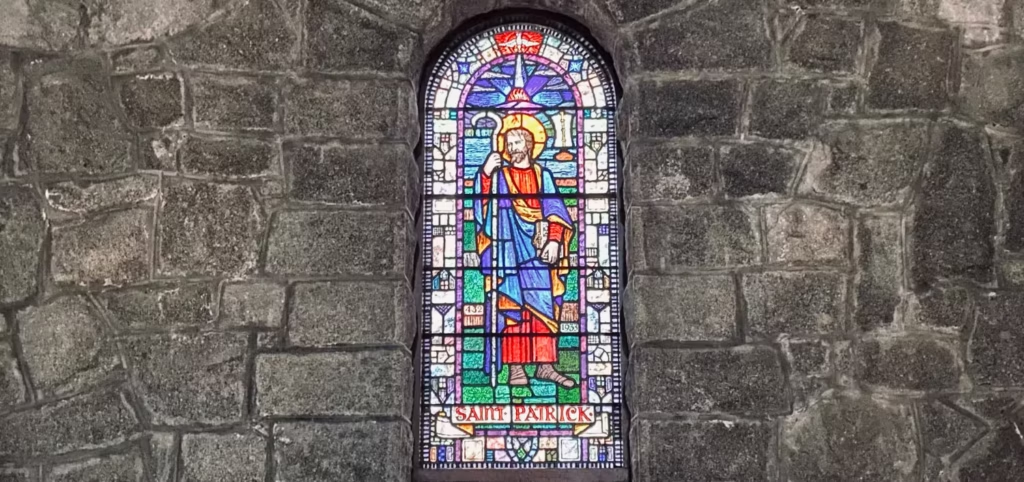
Taken with many others, he became a slave in Ireland. He tended sheep every day and prayed continuously, even in harsh weather. The isolation deepened his faith: “the Lord brought his strong anger upon us… but the Lord opened up my awareness of my lack of faith… I turned with all my heart to the Lord my God”.
In personal detail Patrick says little more about his captors or daily life, emphasising instead the spiritual transformation. One modern historian compares him to a devout young refugee, who fell back on religious devotion to survive. In fact, Patrick suggests his enslavement was justified as he “deserved this, because we had gone away from God, and did not keep his commandments.”
By his account, divine providence led to his release: in dreams he was told a ship would come for him. Alone on the road, and “in the strength of God” he made a perilous journey of over 200 miles and managed to board a reluctant ship’s crew. Even at sea he evangelised to the sailors, winning his hosts over to friendship, and ultimately reaching safety.
St Patrick’s pre-Missionary Theological Training
Back in Britain (and later Gaulish monasteries), Patrick trained in Christian theology. This formative period is mostly known from later legend; his own Confessio says only that he “came to learning” there. One medieval tale says he was ordained a bishop in Gaul and sent to Ireland, but his own voice simply declares, “I have been established a bishop in Ireland”.
He does not boast about clever speeches or miracles, but presents himself as a humble servant: he repeatedly calls himself “unlearned” and a “captive” of God’s mercy. This tone of humility is strikingly modern. In one letter he even apologises for any harsh words, saying he speaks only out of zeal for God. Such passages show Patrick as very much a real person narrating his own story, rather than a later mythologised saint.
St Patrick’s First Missioning Journey to Ireland
Upon his return to Ireland (traditionally around 432 AD), Patrick described himself as “an alien among non-Roman peoples, an exile on account of the love of God”. His devotion is strikingly personal: he even wrote, “for love of neighbours and children, for these I have given up my homeland and my parents” – he literally left all behind to “teach these peoples” the gospel.
In his own words, he was a self-described “sinner” who had nonetheless become a bishop in Ireland, preaching to Irish chieftains and commoners alike. Where Patrick led, he baptised. He states in the Confessio that he “baptised… many thousands” of new Christians – his “brothers and sisters – the children whom I baptised in the Lord”. In this he was much like a devoted teacher ushering an entire community into a new faith. To Patrick, these converts were so precious that he called them his spiritual children “whose numbers I have given birth to in God”.
Opposition to St Patrick’s Teaching
Evangelising in 5th-century Ireland was filled with challenge. Patrick’s own Letter to the Soldiers of Coroticus (an enraged open letter) shows the dangers. Writing to Coroticus – likely a British or Pictish warloard – he laments that raiders from across the sea had “sold off” many Irish Christian converts into slavery – “freeborn people…Christians reduced to slavery,” he writes with outrage.
When Patrick learned that some of his people had been captured, he begged Coroticus to return at least the baptised prisoners, but was scorned. He berates Coroticus’s men as “blood-stained with the blood of innocent Christians”. His tone here is part spiritual father, part reproachful rebel – like a worker confronting those who abuse helpless victims.
In one striking passage he describes the newly baptised—clad in white robes after their rites—being “cruelly slain” by sword. Patrick consoles himself that those martyred are at peace: “thanks to God, you who are baptised believers have moved on from this world to paradise”. In this way he emerges as much as a protector and pastor to his fledgling church as a missionary. His hand-written letter (signed in his own name) is one of the earliest examples of an Irish Christian leader rebuking violence in the name of the faith.
Miracles of St Patrick
| Miracle | Earliest source | Description |
|---|---|---|
| Driving the snakes from Ireland | Jocelin of Furness, Vita Sancti Patricii (c. 1185) | Patrick banishes all snakes into the sea—symbolic expulsion of paganism. |
| Lighting the Paschal fire on Slane Hill | Tripartite Life (9th-cent. compilation drawing on 7th–8th-cent. material) | Patrick lights an Easter fire in defiance of High-King Laegaire’s decree. |
| Mass baptisms of “many thousands” | Patrick’s own Confessio (§ 50, c. 460 CE) | Patrick claims he personally baptized “many thousands.” Later hagiographers inflate the number (e.g., “12 000 in a day”). |
| Raising the dead | Muirchú’s Vita Sancti Patricii (7th c.) & Tripartite Life | Reports vary from a single chieftain’s daughter to “thirty-three” resurrected persons. |
| Toppling the idol of Crom Cruach | Muirchú’s Vita Sancti Patricii (7th c.) | Patrick smashes the gold idol of Crom Cruach at Mag Slecht, ending its cult. |
| Miraculous healings (blind, lame, sick) | Tripartite Life & later miracle catalogues | Numerous cures by prayer, sign of the cross, holy water. |
| Converting kings & chieftains by miracle | Confessio (§ 41) plus later Lives | Kings Dichu, Angus, etc., are persuaded—often after witnessing a wonder—to accept baptism. |
St Patrick the Builder
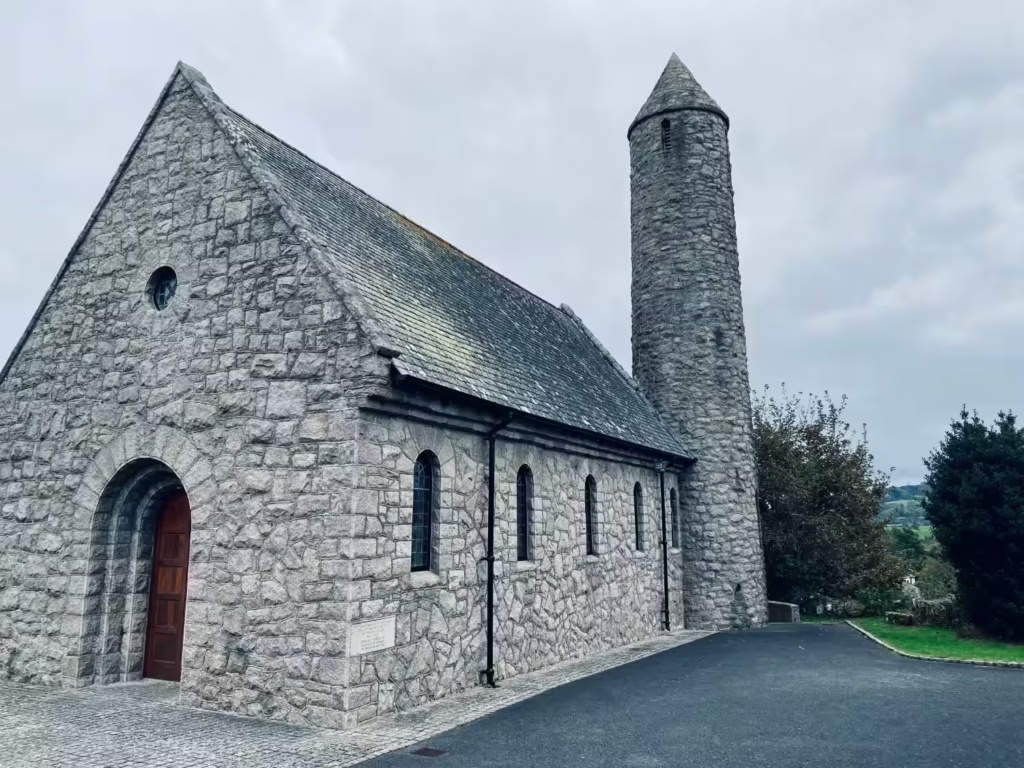
Patrick is attributed with founding many of the early Irish Christian churches and communities. Tradition says his first Irish foundation was at Saul (Co. Down) on land given by the converted chieftain Dichu. Today a modern chapel stands there, but archaeologists have confirmed Saul’s ancient role. As a recent archaeological report notes, Saul was “historically associated with St Patrick” and even mentioned in medieval annals. It became a religious centre; later texts note that in the 13th century relics of Patrick were kept at Saul.
His see (bishop’s seat) was established near the ancient hill-fort of Emain Macha at Armagh (Ard Mhacha) in Ulster. By one medieval account Patrick founded a stone church there around AD 445 and declared it to be Ireland’s chief church.1 Armagh’s hilltop was already sacred, and its 19th/20th-century cathedrals (one Catholic, one Anglican) stand atop 5th-century foundations. But such was his legacy, that even in the 12th century the Fortress of Cashel was dedicated to him to become one of the most iconic Christian sites.
The Book of Armagh itself, which preserves Patrick’s Confessio and Epistola, shows how early his legacy was valued. In Patrick’s lifetime there was no university or central church; his role in setting up monastic schools and organising bishops (as later sources claim) is unclear, but the later Armagh primacy owes much to his legendary status.
Significant Religious Sites Associated with St Patrick
| Site | Significance | Archaeological Evidence |
|---|---|---|
| Armagh | Traditionally founded by Patrick around AD 445, Armagh became the ecclesiastical capital of Ireland. | Evidence of continuous occupation from a former hillfort; later medieval relics like the Book of Armagh and St Patrick’s Bell support its spiritual status. |
| Saul | Believed to be the site of Patrick’s first mission; local chief Dichu granted his barn (“sabhall”) to Patrick. | Excavations around Saul church and round tower confirm early medieval monastic activity. |
| Downpatrick | Tradition holds that Patrick is buried here; marked by a carved stone and commemorated by Down Cathedral. | Archaeological digs on Cathedral Hill uncovered medieval abbey structures and cross-slab fragments. |
| Croagh Patrick | Site of Patrick’s 40-day fast, according to tradition; remains a major pilgrimage destination. | Stone cairns indicate prehistoric ritual use long before Christian association; the mountain’s sacred status likely predated Patrick. |
Archaeological Evidence and St Patrick
Archaeological evidence for Patrick’s personal handiwork is sparse: stone churches were built over wooden predecessors, and little 5th-century material survives. But later finds support the existence of early Christian sites, such as round towers dating back to as early as the 7th century – like Antrim’s. More specifically, a fragment of an early Christian cross-slab was discovered at Down Cathedral’s hill during recent digs. This stone, along with medieval pottery in the same layers, shows that a monastery stood there long before the Normans or English arrived. In Armagh, excavations around the cathedral reveal a complex of early medieval buildings. And in Saul, the old church ruins and round tower stand as monuments to Patrick’s legend.
Patrick’s own documentation left little beyond spiritual exhortation, so understanding his life also relies on archaeology and later texts. The Book of Armagh (c. 807 AD) is our oldest manuscript source of Patrick’s Confessio and letter, showing that by the 9th century he was already enshrined in Irish memory. The cult of Patrick grew especially around Armagh. Indeed, by the late medieval period Armagh was renowned for producing elaborate patrician shrines: the famous 11th/12th-century bell and 14th-century hand-shrine of Patrick were made there to house his reputed relics.
While archaeology has not “proved” Patrick’s exploits, it does show the heritage of early Christianity he inspired.
The Legacy of St Patrick
His feast day, 17 March, has become not only a religious festival but a global celebration of Irish identity. In fact, a modern analogy might be that Patrick is to Ireland what a founding father or independence leader is to a nation – his image and symbols (like the shamrock) are invoked in patriotic as well as religious contexts.
Ultimately, St Patrick’s legacy lives both in tangible heritage and in culture. Stone churches, cross-slabs, manuscript pages and metal shrines in Irish collections, all attest to the memory of Patrick. Archaeologically, places like Armagh, Saul and Downpatrick remain to remind visitors of the 5th-century saint. And the many Irish saints who followed him, such as St Columba of Iona, all hark back to his earlier legacy.
Yet more powerful is his symbolic legacy: to many, Patrick exemplifies the birth of the Irish church and the soul of Ireland itself. He was, as he wrote, a once-enslaved shepherd who became a shepherd of souls – a transformation remembered every year in parades, pilgrimages (to places like Croagh Patrick) and prayers. For historians and archaeologists, he is a constant reminder that behind legend there is real history to uncover and honor.
Frequently Asked Questions: The Life and Legacy of St Patrick
St Patrick was a 5th-century Romano-British Christian missionary and bishop in Ireland. Though not Irish by birth, he is widely regarded as the patron saint of Ireland and credited with bringing Christianity to the Irish people.
Patrick was likely born in Roman Britain, possibly in present-day Wales or Cumbria, around the late 4th or early 5th century. His exact birthplace is still debated among scholars.
March 17 is traditionally the date of St Patrick’s death. Over centuries it became a feast day commemorating his legacy, evolving into both a religious and cultural celebration in Ireland and among the global Irish diaspora.
While no physical remains have been verified, sites like Saul, Armagh, Downpatrick, and Croagh Patrick have long-standing associations with him and show early Christian activity dating to his era.
- The Book of Armagh, c. 807 AD ↩︎
YOU MAY ALSO LIKE
 Hill of Uisneach – Ireland’s Sacred Centre of Myth & History
  Iron Age Clothing in Ireland: What People Really Wore
  What is the Antrim Round Tower?
  Who was St Columba? Missionary, Monk, and Legend of Iona
  What is the history of Dun Ailinne?
  What were the Irish war chariots?
  Irish Placenames: Ancient History & Mythology