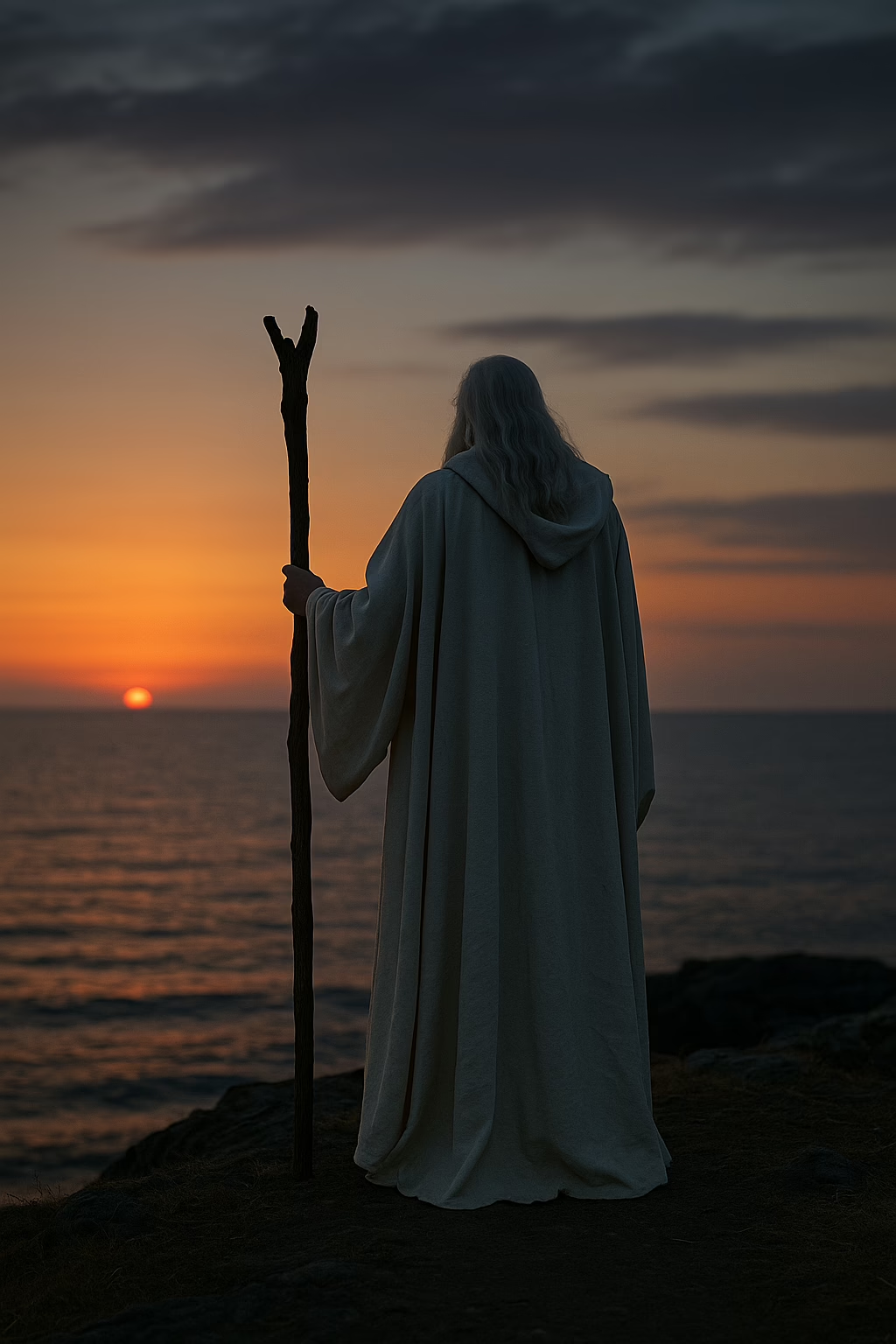
There are few historical groups that can evoke more strongly opposing interpretations than that of Irish Celtic druids, particularly those of ancient Ireland. For some, they will conjure up (see what I did there!) an image of evil or barbaric pagan traditions such as human sacrifice. For others, it’ll be the magic of modern depictions in film or video games, of shapeshifting wizards who can wield supernatural powers. But the truth – or as close as we can get to ‘a truth’ – is that druids had much more traditional roles in healing, philosophy, law, and politics, Yet these roles provide an incredible picture of a sophisticated and highly developed society; not the barbaric or naively mystical alternatives we often settle for.
This post considers these ancient roles through historical texts, archaeology, and mythology. We will compare them with other ancient traditions and consider their legacy today.
Who were the Irish druids?
In an oral society like ancient Ireland, those who held knowledge held power. The Irish Celtic druids would be the ones to turn to if sick or wounded. They’d be able to dictate the laws and rules of governance. They’d predict the future, commune with the gods, and control the elements. Even the very weather was thought to be under their power, or so the legends say. For instance, the Irish historian Joyce explains that “they were not only druids, they were judges, prophets, historians, poets, and even physicians.”1
Julius Caesar claimed that some of the druids spent up to twenty years in learning, such was the breadth and depth of their knowledge.2 Our PhD’s and modern education system seems rather brief in comparison, particularly if we account for their shortened life expectancy.
The Power of Knowledge
It’s difficult today to relate, but imagine a society in which there are no libraries, schools, or internet, a world in which you never read and rarely meet a stranger except at festivals and key events. Now imagine someone you love gets dangerously sick, which would have happened frequently. Who would you turn to? There’d be no phones to search for advise, no hospitals or doctors to call, no pharmacies to peruse. You have only two options: let your loved one die, or seek out the aid of the druids. For most, option one would be all there was; but for the rich and powerful, the druids embodied an almost godlike hope.
The druids’ knowledge, particularly of herbology and medicine, would have been invaluable in an age when a flu may have been a death sentence. Of course there would have been a rudimentary knowledge of certain cures, but the druids would have remained central as the ancient ‘health consultants’. But the druids’ role didn’t stop here.
Functions of Irish Druids
| Role / Office | Main Activities | Sources attesting the Role |
|---|---|---|
| Brehon (Judge/Lawgiver) | Interpreting customary law; mediating disputes; memorising precedents | Early Irish law tracts (Senchus Mór) |
| Fáith (Seer/Prophet) | Divination by ogham sticks, dreams, battle omens | Táin Bó Cúailnge; Caesar’s Commentarii |
| Filid (Poet-Historian) | Preserving genealogies, heroic cycles, praise poetry | Lebor Gabála Érenn; bardic schools |
| Léighes (Healer/Physician) | Herbal medicine, surgical lore, incantations | Bricriu’s Feast; medieval medical manuscripts |
| Sacerdotal Priest | Calendar rites (e.g., Samhain fires), sacrifices, treaty oaths | Classical writers (Pliny, Strabo); Irish sagas |
| Teacher / Mentor | Long oral training (up to 20 yrs); instructing nobles’ children | Classical testimony (Caesar); later monastic commentaries |
| Astronomer / Calendar Keeper | Tracking solar-lunar cycles; setting feast dates | Alignment of sites (e.g., Newgrange solstice); Coligny Calendar parallels |
| Diplomat / Envoy | Negotiating truces, safe passages; wielding ritual immunity in war | Saga episodes (Táin druids crossing lines unharmed) |
Politics of Irish druids
The Irish druids would have been deeply political, embroiled in the wars and battles for power that raged across Ireland. Seeing them as a separate group who operated above the feuding and messy business of governance completely misunderstands who they were. One academic explains this stating that:
“Irish Druidism remained stationary in cliques of race and kindred, just as was later the case with the clergy, and hence it became involved in all the endless struggles and changes of its immediate surroundings.”3
Each kingdom and chief would have had their own druids, each with a Chief among them. There would have been the leaders and disciples formed into orders. Learning and knowledge would have been jealously hoarded, likely even within druidic orders. Their success was tied to the success of whatever kingdom to which they belonged. In other words, the druids themselves were as divided as the clans and kingdoms of this time. The only exception is, perhaps, that of the High Kingship.
Much is made of the Hill of Tara as the site of the Chief Druid at the time of St. Patrick,4 but it’s possible that the close linkages between politics and the druids is one of the most critical reasons for this. In other words, the Chief druid was ‘chief’ because he was druid to the High King, not because of their power over the other druids. To suggest the latter implies a level of collective governance and religion which has little archaeological or historical evidence.
So while druids were almost ubiquitously powerful wherever we find them, they weren’t united in their power. Their power was due to the knowledge and practices of their profession, rather than because of some collective governance as was the case under the organised religions of Christianity or Islam. But this makes their power all the more intriguing.
What did Irish druids do?
Trees held a special symbolism in Irish druidic traditions. The choice of wood for staffs or carved objects and idols would have been based, not simply on their physical properties, but also their symbolism and ritual significance. For instance, Ogham – the mysterious ancient alphabet used by the druids – would have been inscribed on the branch of a yew “to reveal hidden things [druids] inscribed Ogham writing on them”.5 Archaeological evidence supports this alongside the use of yew in divination rods.6
From the Irish legends, there are many examples referring to the symbolism of trees, such as when the famed warrior Cú Chulainn cut a warning message into a piece of oak, invoking a curse on all who failed to heed its warning.7 Other revered trees included rowan, ash, hawthorn, and hazel. But these are all merely emblematic of the wider beliefs and practices of the Irish Celtic druids themselves. Whereas, later Christian monuments such as round towers replaced sacred groves as gathering places.
Whole libraries have been written about the magic and spells of druidism, but nearly all of it lacks any grounding in history. Of those we can be sure about, there is a common theme of causing insanity. For instance, druids would create a ‘madman’s wisp’ using a strand of grass or straw and then throw it at their victim.8 Cursing warriors, even whole armies, was another power the druids were said to have possessed, alongside controlling the weather to cause snowstorms or even call down fire.
What did Irish druids look like?
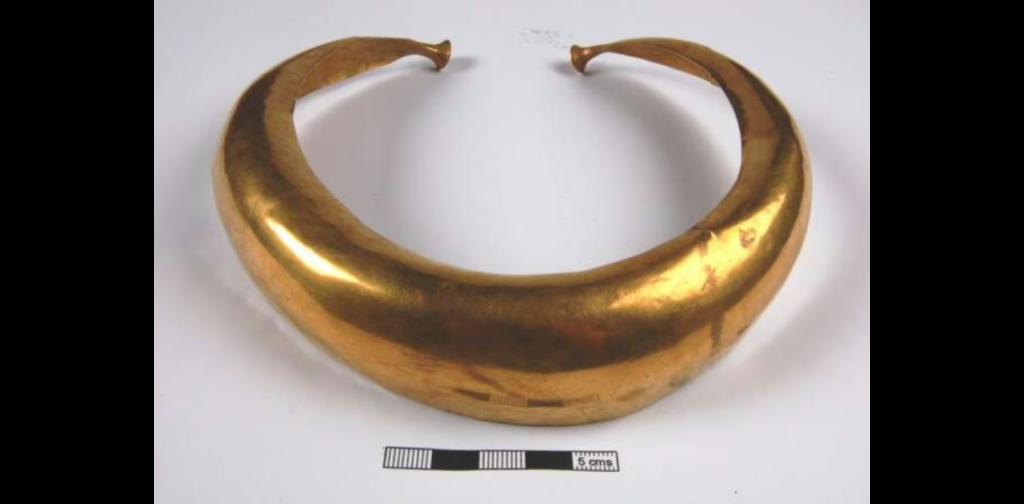
It’s clear that the Irish druids would have been ornately adorned as befit their status and political positions – wearing torques, armlets, gorgets, of gold and bronze.9 This jewelry would have been designed with intricate patterns or twisted into decorative shapes. The druids wore long robes and would have consisted of the materials commonly in use and dyed white: “Their outward appearance seems to have been distinguished by white robes of office and a peculiar tonsure.”10 We’ve already mentioned the use of a yew divination rod and there are various references to staffs of the revered trees noted above. All of this largely reflects the general portrayal of druids today, as cloaked seers with their staves of power.
While I don’t want to ruin anyone’s fantastical beliefs, this description is likely a gross simplification and the druids would have been much less uniform as typically described. Such outfits would have possibly served for special festivals like Samhain or Lughnasa, but are unlikely to have been in use by all and at all times.
Sacred Functions of Trees used by Irish Druids
| Tree (Old Irish Name) | Key Symbolism / Attribute | Typical Druidic Use |
|---|---|---|
| Oak (Dair) | Strength, sovereignty, doorway to the Otherworld | Central ritual sites; gathering place for assemblies and sacrifices; oak leaves or acorns used in blessing rites |
| Yew (Ibar) | Death, rebirth, perpetual life | Carved into ogham “staves” for divination; staffs symbolising continuity of lineage |
| Rowan (Caorthann) | Protection against evil, fire, the sun | Amulets or wands for warding; planted near dwellings or burial grounds to guard spirits |
| Ash (Uinnius) | Healing, world-tree axis, spear shafts | Medicinal bark infusions; ash rods for healing charms and oath-swearing |
| Hawthorn (Huathe) | Thresholds, fairy boundaries, spring blossom | Ritual “May” trees; sites for seasonal festivals; never cut without propitiation |
| Hazel (Coll) | Wisdom, poetry, inspiration | Nuts associated with the Salmon of Knowledge myth; hazel rods for poetic or juridical inspiration |
| Birch (Beithe) | Purification, new beginnings | Switches for cleansing rituals; first tree of the ogham alphabet, marking starts of cycles |
| Alder (Fearn) | Battle, defence, water spirits | Alder dye for warrior shields; seen as protective when crossing rivers |
Why do the Irish druids matter?
Most will enjoy learning about druids because of their modern portrayals, or in some attempt to recreate them today. But, for me, their power lies not in their supposed supernatural powers – it’s in their incredible political power.
As St. Patrick noted when he arrived in Ireland, the druids controlled much of the governance and functions of the entire society. Their command of so many disciplines and skills, alongside their ability to hoard and broker such knowledge, is a fascinating relic of history and one which this period of ancient Ireland was clearly anchored around.
Frequently Asked Questions: Irish Druids
They were the elite learned class in ancient Ireland – judges, healers, historians and priests. Contemporary accounts note druids served as judges, prophets, historians, poets, and even physicians.
They played many roles: advising chieftains, setting laws, healing the sick, and performing religious rites. Druids studied nature (e.g. tree lore), used ogham alphabet on yew sticks, and were believed to control weather and cast curses.
Romans describe druids as wearing white robes and tonsured hair. In Ireland they likely adorned themselves with gold torcs and armlets. However, such attire may have been ceremonial (e.g. festival) rather than everyday wear.
Yes. Medieval Irish sources and archaeology confirm female druids (druidesses) existed. They held similar roles in culture and religion as male druids. Some texts even refer to famous druidesses like Tiachtga of County Meath.
- P.W. Joyce (1908) A smaller social history of ancient Ireland. Dodo Press. p68. ↩︎
- Barry Cunliffe (2003) The Celts. Oxford University Press., p57. ↩︎
- Von Pflugk-Harttung, Julius. “The Druids of Ireland.” Transactions of the Royal Historical Society 7 (1893): 58. ↩︎
- Joyce, p71. ↩︎
- Von Pflugk-Harttung, p71. ↩︎
- Joyce, p69. ↩︎
- Ciaran Carson (2007) The Tain. London: Penguin University Press., pp26. ↩︎
- Joyce, p69. ↩︎
- Bonwick, James. Irish Druids and old Irish religions. S. Low, Marston, 1894., p21. ↩︎
- Von Pflugk-Harttung (1893), p59. ↩︎
YOU MAY ALSO LIKE
 Ancient Irish Proverbs and their Origins: Wisdom in a few Words
 Dun Aengus History: Ireland’s Ancient West Maritime Hub
 Iron Age Clothing in Ireland: What People Really Wore
 Iron Age Trade in Ireland: Networks, Imports, and Economic Life
 Etymology of Irish Animal Names: Myth & Language Revealed
 Irish Festival Names Explained: The Etymology of Samhain, Imbolc, Bealtaine and Lughnasadh
 The Brehon Laws: How Ireland’s Ancient Legal System Really Worked
 Ancient Irish Society: Language, Law & the Structures of Kinship