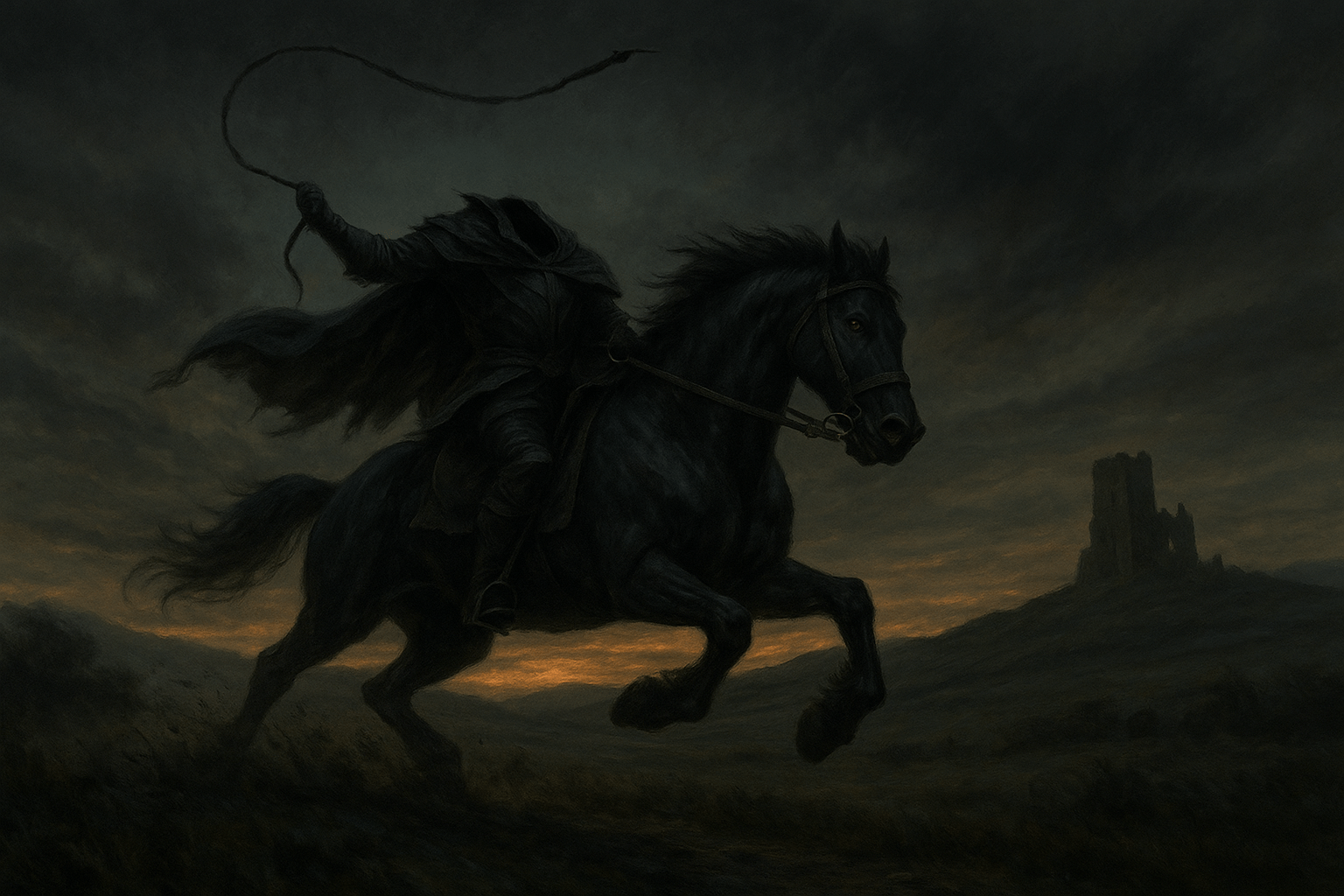
Among the many figures of Irish mythology, few inspire as much fear as the Dullahan. This spectral rider is most often described as headless, mounted on a black horse, and carrying his own severed head under one arm. Unlike the Banshee, who keens in sorrow when death approaches, the Dullahan represents something far darker. His arrival is not a lament but a sentence — a silent, chilling omen that death is already on its way.
The Dullahan belongs to the aos sí, the supernatural race that inhabits the shadowed spaces of Ireland’s folklore. He is not a benevolent figure and never brings good fortune. Instead, he emerges from the mist on lonely roads or at crossroads, instilling terror in those who glimpse him. In many tales, no lock, bolt, or barrier can keep him away. The Dullahan rides where he wills, and when he stops, it is said that someone will die.
Dullahan’s Etymology and Origins
The name Dullahan is thought to derive from the Irish dulachán, meaning “dark man” or “concealed one.” In some interpretations, it carries connotations of something hidden or obscured, which matches his unsettling appearance — a rider without a head, cloaked in shadow. The use of “dark” in the name reflects both his physical description and his association with death. However, the dullahan is a relatively modern creature with no direct references from the ancient Irish sources. But what we can find are certain themes which have likely feed into the mythology.
One of the best examples I could identify was the medieval poem taken from the Book of Leinster – Find and the Phantoms – dating to the mid-12th century. Having been captured by a giant, the poem’s protagonist finds himself confronted with a series of fearsome creatures inside the giant’s house. One of these is a headless man who appears with a hag.
“A hag abode in the great house
With three heads on her thin neck:
A headless man on the other side,
With one eye (protruding) from his breast.”
In this way, the living dead can be traced much further back into Irish history, representing evil and death. More generally, however, the beheading of enemies was a common practice within ancient Ireland termed ‘brain-balls’. This was when warriors would preserve the heads using lime as trophies. The Irish epic poem The Tain makes frequent reference to severed heads as trophies hung from the chariots of Irish warriors.
Bringing these practices together, it’s not a big leap to see how the idea of a headless horseman evolved. And like nearly all modern mythological creatures, it has cultural roots which date back into prehistory.
So this then brings us to the modern mythology of the rider today.
Who is the Dullahan?
The Dullahan is almost always depicted as a headless rider. Many variations exist, but in Irish folklore he is often said to carry the head in one hand while controlling his dark horse with the other. The head itself is grotesque, often described as having a hideous grin and eyes that roll about constantly. Its colour is said to resemble mouldering flesh, glowing faintly in the dark as though it were decayed but somehow alive.
Using the folklore archive of duchas.ie we can see many examples of such creatures. In one, the rider is said to be the ghost of a soldier who has returned home from war overseas: “Captain John Vandeleur who had his head blown off in South Africa rides through the wood every night on a horse. He is called the ‘Headless Rider.’”
Another tells of a man who’d been decapitated while riding and so returned as the ‘headless rider’ having been beaten by the devil.
“One time there was a man killed at Heavys lane Hawkswood Swanlinbar. He was coming home from the village of Swanlinbar when his horse knocked him off. The man fell against a splinter and it cut his head off. Every night for a year after the headless horseman was seen riding up and down the road. It is said that the devil and he had a fight one night and that the devil beat him.”
This is a common theme, where those who come to some unfortunate and gruesome end are said to haunt the living. Locals would tell such tales to scare their children, often by way of warning to avoid a dangerous location. In this case it was a local pass, but in others it could be a river or lake, and so on: “The pass was closed up after that and no one would go that way now.”
But while children may fear the physical appearance of the Dullahan, there was much more to the tale than simply his deathly guise.
Dullahan’s Power
The Dullahan was said to not merely be some vision or apparition of the dead, but to have supernatural power himself. In one account, he is said to have called down fire from heaven in defence of buried holy monastic treasure:
“It is not known by whom the treasure was hidden, but local tradition says, that it was hidden by the monks of Kilnamanagh Abbey, (not far from the castle). It is said to consist of golden ornaments and golden vessels. One of the men whose name was Connie Hayden, (the others are not known) was deaf.
“The three began to dig for the treasure about midnight. They had not dug very much when a red-coated headless horseman passed them by with the speed of light. The men were frightened but kept working away. Suddenly a huge ball of fire appeared over their heads. It took human shape and let out an unearthly scream. The deaf man neither saw nor heard it but the others downed tools and ran away. The deaf man kept working away but when he missed the others he too decamped leaving his tools behind him.
“When they went back next morning for their tools there was no trace of them to be found neither was there anything to show that anybody had been digging there.”
In this way, the Dullahan was portrayed as the defender of holy relics. The elements of fire were at his command. While no one is harmed, the warning was unmistakably clear.
Therefore, the Dullahan is said to appear typically on lonely country roads at night. Farmers travelling late, or villagers returning from a wake, told of glimpsing a black rider at crossroads or near old ringforts. These encounters were never casual. To see the Dullahan was to know that death lurked nearby.
Given the late night sightings, it’ll be no surprise then that accounts vary. Indeed, in one of the most prominent narratives, the Dullahan isn’t a rider at all – he’s a coach driver.
The Headless Coach
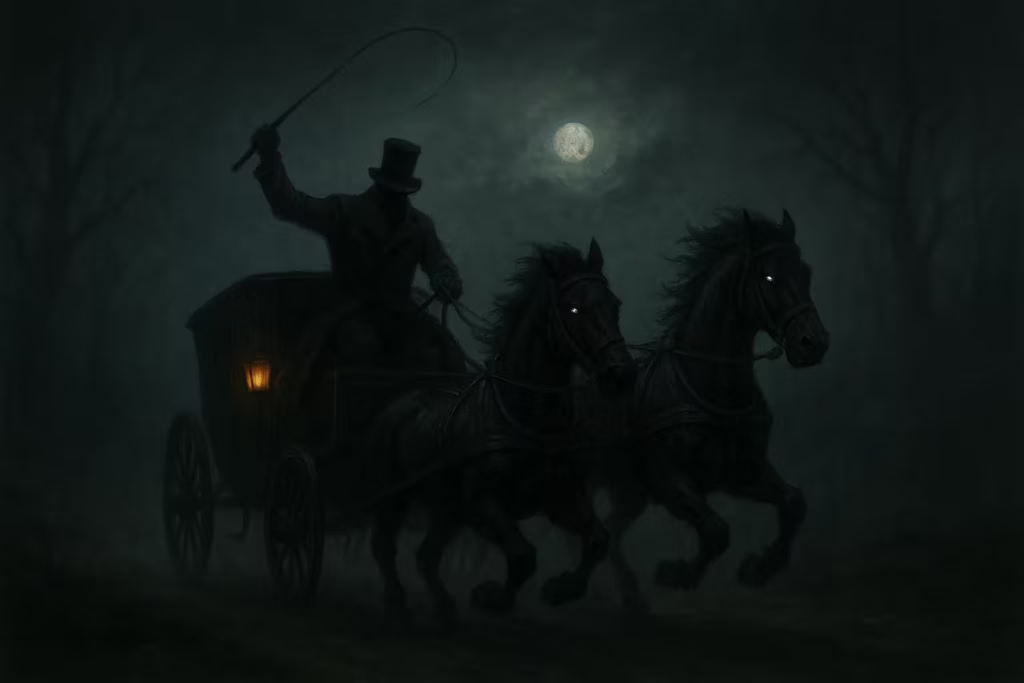
In one common variation of the Dullahan, it isn’t a rider who’s headless, but a horse-drawn coach. Again, there are various versions of the tale, some with a driver, others with only the carriage and horses. In the former, the Dullahan drives a black coach pulled by a team of spectral steeds. This coach, sometimes called the Cóiste Bodhar or “death coach,” is said to be made of human bones and adorned with funeral trappings. The rattle of its wheels was believed to herald a death in the community. In these accounts, the Dullahan cracked a whip made from a human spine.
Other accounts refer to the horses as headless rather than the driver. One of the most complete I’ve read goes as follows:
“The Headless Coach is so called because the horses are headless. It generally appears at midnight. It has been seen by several people on different nights.
The people say they feel terrified when they hear the furious driving of the horses, and all animals shiver and run off the road. The figure of the man on the drivers seat can be plainly seen, and he uses his whip. He is dressed in black with a tall hat and the horses and coach are jet black.
“The coach starts on its journey from Blackhill avenue and on down the Balladine Road, up the town and on to the Ballyroan road as far as “Oatlands” avenue. Here it disappears When Sir Admiral Poe was dying it was seen for the first time outside his own house. One of the servants say that he was seen in it, and when they went to his room he was found dead.”
Hopefully you’re sufficiently well informed to know both how to recognise and fear this wonderfully enigmatic creature. What remains is to know what to do if you meet him.
The Weakness of the Dullahan
Despite his terrifying nature, he had one weakness. The Dullahan was said to fear gold. It didn’t matter the amount, simply the presence of gold was believed to be enough to protect you. Given we rarely carry a gold in its pure form, this usually manifested through jewelry. In such tales, the would-be victim faces almost certain peril only for a ring or necklace to be their saving talisman.
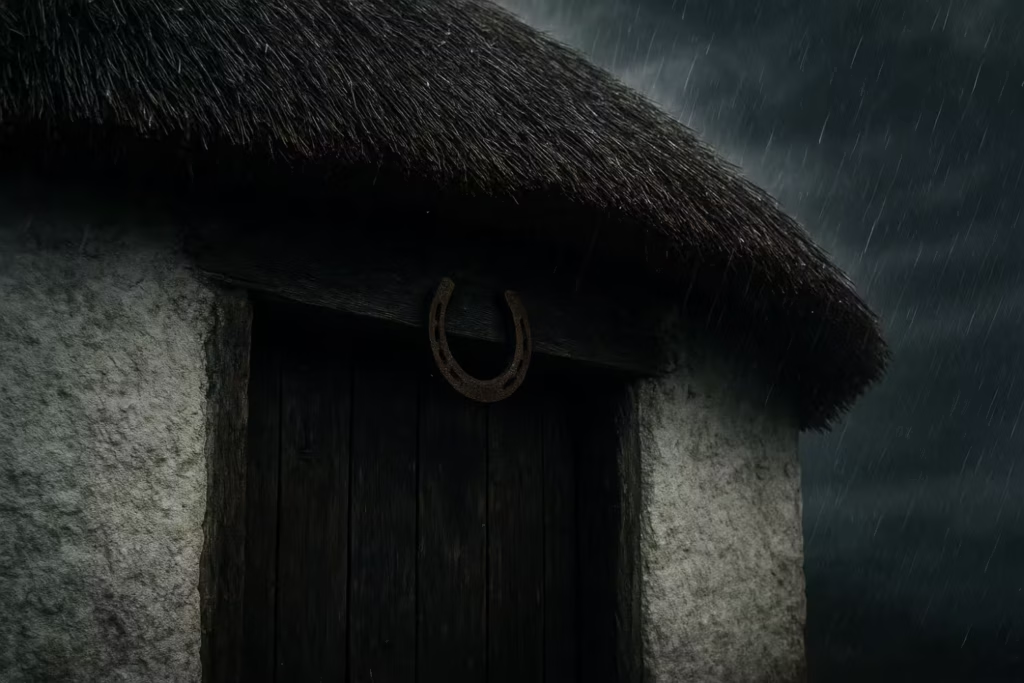
This reflects a wider folkloric tradition, whereby metals were considered protective and powerful wards against evil spirits. For instance, iron was thought to repel fairies and supernatural beings like the Aos Sí. People hung iron objects—such as horseshoes, scissors, or nails—over doors or cradles to safeguard homes and infants. Steel was also carried as a charm, often in the form of a knife or pin, during travel or childbirth. Silver, though rarer, was sometimes linked to purity and protection in later folk belief. These traditions reflect a deep-rooted association between metalworking and spiritual defence in Irish culture.
Symbolism and Cultural Legacy
The Dullahan is unique in his simple, stark symbolism of death. Unlike the Banshee, who mourns for the dying, the Selkie who represents the boundaries between life and death, the Dullahan is a figure of inevitability. He does not cry, plead, or comfort — he arrives with grim certainty. His severed head represents the final separation of life from body, a stark reminder that death is both terrifying and inescapable.
And so the Dullahan stands as one of the darkest and most chilling figures in Irish mythology. Unlike other members of the aos sí, he offers no comfort, no warning, and no chance for escape. Yet his enduring place in folklore shows how Irish communities grappled with fear, mortality, and the mysteries of the afterlife.
Today, the Dullahan continues to haunt imaginations across the world. His spectral form, riding silently through the night, captures both the dread of the unknown and the fascination with what lies beyond life’s final threshold. Whether encountered in old folklore, modern retellings, or global adaptations, the Dullahan remains a powerful reminder of how myth and storytelling shape our understanding of mortality.
Frequently Asked Questions
The Dullahan is a headless horseman from Irish folklore, often depicted riding a black horse or driving a phantom coach. He carries his own head under one arm and is considered a harbinger of death, calling out the name of those about to die.
Yes. The Dullahan is believed to have influenced Washington Irving’s The Legend of Sleepy Hollow. Irish immigrants brought the folklore to North America, where it merged with local ghost stories to form the famous American headless horseman.
Tales of the Dullahan are most common in the west and north-west of Ireland, particularly in counties Mayo, Sligo, and Donegal. Local versions differ—some describe a single rider, others a death coach (Cóiste Bodhar) driven by the headless spirit.
According to folklore, the Dullahan fears gold. People once carried small gold objects, such as coins or jewelry, to ward off the creature. The belief reflects the wider Irish tradition of using metals for protection against supernatural beings.
YOU MAY ALSO LIKE
 Iron Age Clothing in Ireland: What People Really Wore
 Irish Ollamhs and Herbology: Medicine, Learning and Healing in Early Ireland
 The Morrigan: Symbolism & History of the Irish War Goddess
 The Púca/Pooka: Shape-Shifting Spirit of Irish Mythology
 Rock Art in Ireland: Prehistoric Carvings, Meaning & Sites
 Irish Festival Names Explained: The Etymology of Samhain, Imbolc, Bealtaine and Lughnasadh
 Ogma: Irish God of Strength, Language, and Ogham
 The Dagda: Irish All-Father God of Myth, Power & Wisdom