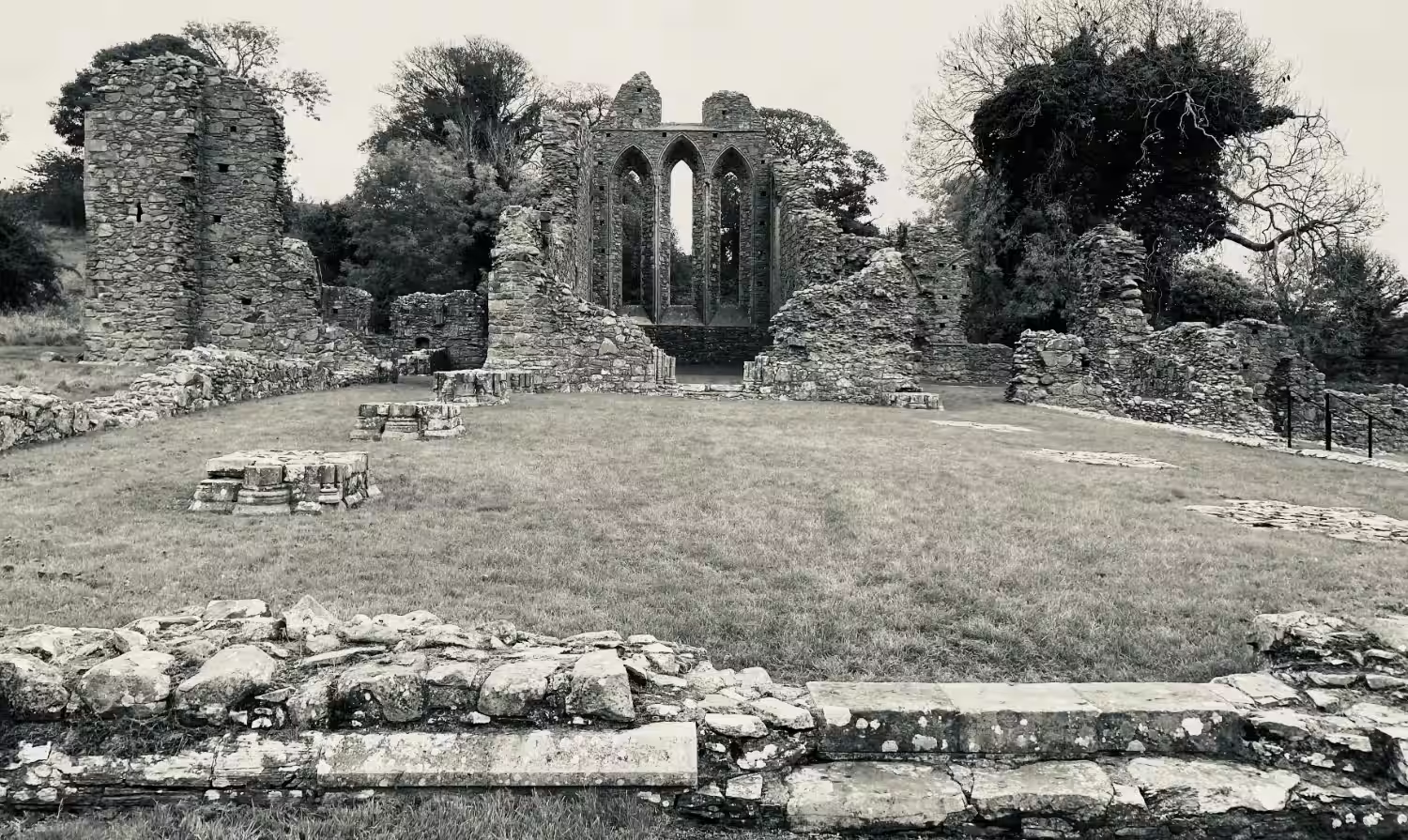
It’s amazing what regret can drive us to do. We all know the flowers and chocolates, toys and presents, the contrition and sorrow. But nestled alongside the Downpatrick lies perhaps one of the most enduring symbols of penance I’ve come across – Inch Abbey. The abbey was originally founded around 1180AD by the Anglo-Norman knight John de Courcy, who infamously conquered much of Ulster. But in his warpath and thirst for conquest, he overreached and destroyed a nearby religious house at Erenagh. In an act of penance, he therefore founded this site as the home of a Cistercian order.
The contrast between conquest and Christian peace couldn’t get much more acute. For the Cistercians sought quiet, isolated settings — places where they could live self-sufficiently through labour and prayer. The low island of Inis Cumhscraidh, from which Inch takes its name, offered exactly that. So in this post we will learn what this abbey once looked like, how life would have been, the political context, and how it evolved throughout the centuries which followed. Let’s start with the monastic context prior to Inch Abbey, for this region was one of the most significant in all of Ireland having close association with none other than St. Patrick.
The Monastic Landscape Before the Normans
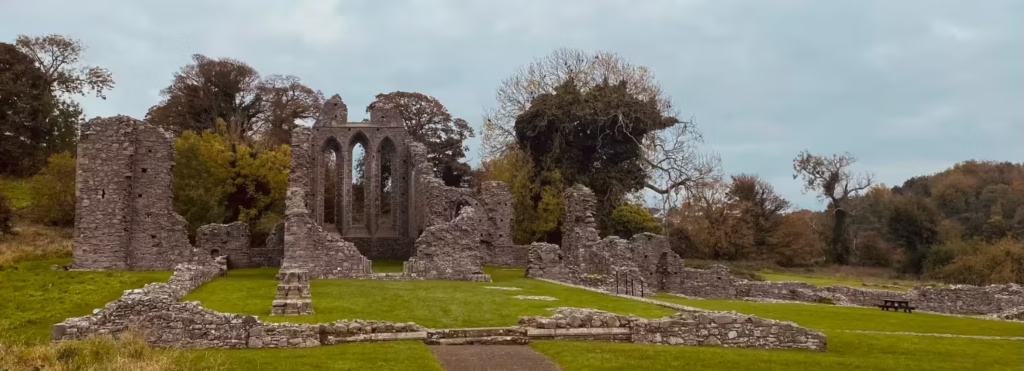
Before the arrival of the Normans in the late twelfth century, the landscape around modern Downpatrick was already steeped in religious history. For centuries, this part of County Down had been one of the spiritual heartlands of early Christian Ireland. Monastic foundations such as Saul, traditionally associated with Saint Patrick’s first church, and Downpatrick itself — known in early sources as Dún Dá Lethglas — were already centres of pilgrimage, learning, and ecclesiastical power long before Inch Abbey was built.
These early Irish monasteries differed profoundly from their later Norman counterparts. They were not cloistered communities of stone but sprawling, often circular enclosures made up of wooden churches, beehive huts, and burial grounds. Their organisation reflected the clan-based structure of early medieval Ireland where abbots were often drawn from local dynasties. Examples at Bangor, Antrim, Nendrum reflect this with large self-sufficient monastic communities which would have shaped the political landscape. Indeed, on the site of Inch Abbey was a pre-Norman church called Inis Cumhscraigh which was plundered by Vikings in 1002AD.
By the eleventh century, however, this model was beginning to shift. Reforming movements across Europe, spearheaded by orders such as the Benedictines and later the Cistercians, promoted a more centralised and austere form of monastic life. So when the Normans landed in Ulster in the 1170s, they brought with them both the military power to conquer and the ecclesiastical vision to reform. They founded monasteries not only as spiritual acts but as political statements — symbols of authority, legitimacy, and cultural alignment with the rest of Latin Christendom.
The Founding of Inch Abbey
The foundation of Inch Abbey in the late 12th century marks one of the most significant moments in Ulster’s early Norman history. John de Courcy is said to have endowed the abbey to atone for the destruction of a nearby Irish monastery at Ergall, believed to have been burned down during his campaign in Ulster. Whether the tale reflects genuine remorse or careful political calculation, it demonstrates de Courcy’s awareness of the spiritual and symbolic power of monastic patronage. Establishing a Cistercian abbey aligned him with one of Europe’s most respected religious orders, bolstering his standing among both the Norman elite and the native Irish Church.
The Cistercians, originating from Molesme in Burgundy and formalised at Cîteaux in 1098, sought a return to the simplicity and austerity of the Benedictine Rule. Their architecture, daily life, and economic organisation reflected these ideals — valuing plain design, manual labour, and agricultural self-sufficiency. By de Courcy’s time, their monasteries stretched from France to England and Wales, making them a natural choice for an ambitious Norman lord seeking both spiritual legitimacy and international recognition.
So Inch was from its foundation much more than a place of prayer. It was a symbol of Norman influence and of the new order taking root in Ulster. Its foundation solidified the fusion of continental monastic discipline with Irish ecclesiastical tradition, creating a hybrid landscape of devotion and power. And it’s location at the heart of St. Patrick’s long tradition (with over 700 years of history already), it was clearly a smart move by the clever Norman lord.
Architecture and Layout of Inch Abbey
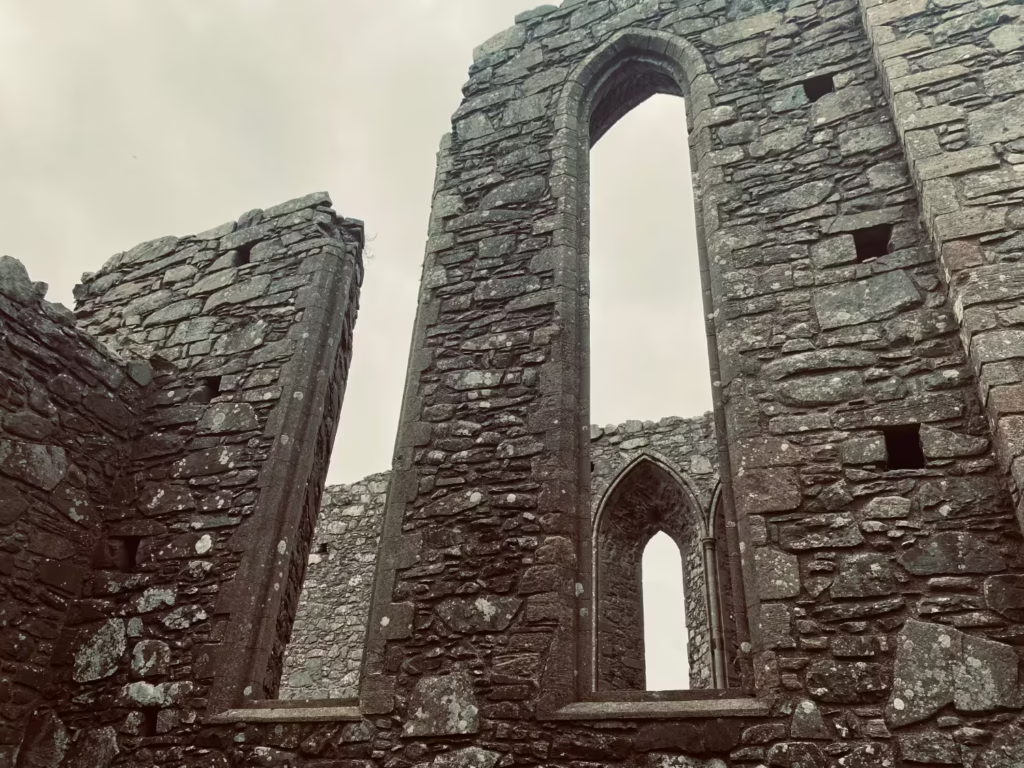
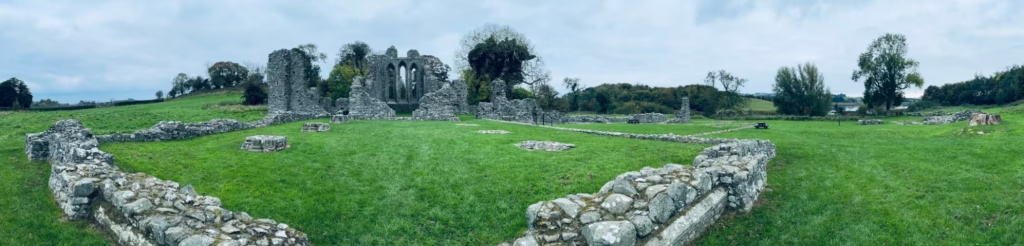
Today if you visit Inch Abbey you’ll see the remains of wonderfully romantic ruins set against the river of Quoile. But the abbey was once a beautiful work of art itself. It followed the typical Cistercian plan, oriented east–west with the church forming the spiritual and physical heart of the complex. Excavations and surviving walls reveal a cruciform church, with a long nave, transepts housing small side chapels, and a square-ended chancel where the monks gathered for prayer. The plain lancet windows and lack of elaborate sculpture show that the builders adhered to the order’s strict prohibitions against excess, though subtle decorative flourishes in the mouldings suggest later modification during the 13th century.
To the south of the church lay the monastic cloister — an open courtyard enclosed by covered walks — from which all key domestic buildings could be accessed. These included the chapter house, where the abbot presided over daily readings and discipline; the refectory, where the monks ate their silent communal meals; and the dormitory, which likely extended above the east range. To the west, the lay brothers’ quarters and workshops formed a more utilitarian area, reflecting the division of labour central to Cistercian life.
The abbey’s proximity to the River Quoile allowed the monks to construct mills and fishponds, while the fertile lands of the Inch peninsula supported both crops and livestock. Traces of field systems, enclosures, and water channels identified through archaeological survey point to a well-organised agrarian economy — a hallmark of Cistercian efficiency.
Inch Abbey was therefore a self-contained monastic world, harmoniously designed to balance labour, prayer, and contemplation. Which naturally brings us to consider what life would have been like for the monks who once lived here.
Monastic Life at Inch Abbey
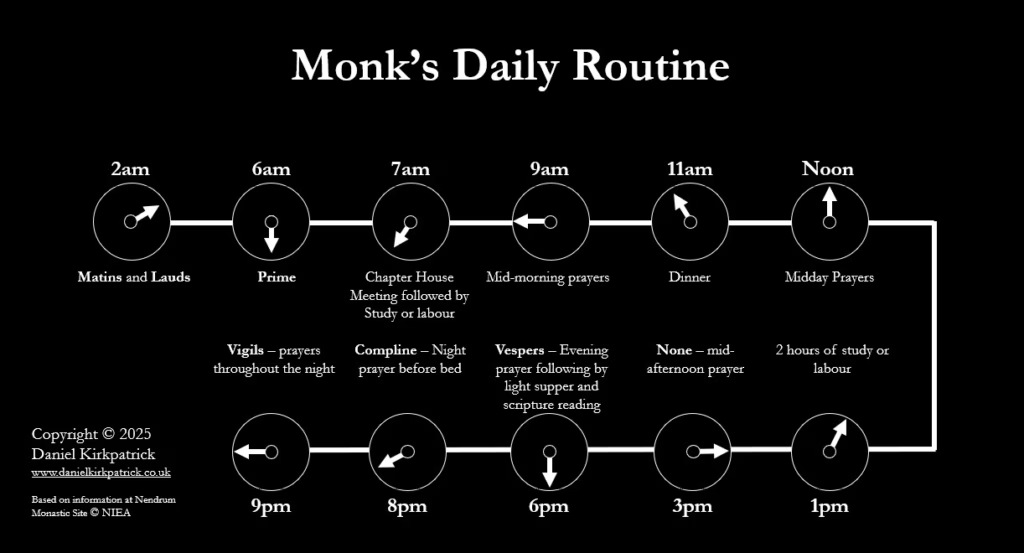
Daily life at Inch Abbey followed the rigorous rhythm of the Cistercian Rule, a framework of devotion, manual labour, and study that governed every hour of the day. The monks lived in near silence, their days structured around the Divine Office — eight services held between midnight and sunset. Beginning with Matins before dawn and ending with Compline at night, these prayers punctuated the working day, ensuring that every task, from farming to reading, was performed in the service of God.
At the heart of the community were the choir monks, men dedicated entirely to prayer and spiritual contemplation. Supporting them were the lay brothers (conversi), who handled much of the physical labour — tending fields, managing livestock, maintaining buildings, and overseeing the abbey’s economic affairs. This clear division of roles allowed Inch to function as both a spiritual centre and a self-sustaining estate.
The monks cultivated barley, oats, and rye, and raised cattle and sheep, with wool and dairy products forming important sources of income. The River Quoile provided freshwater fish, while the abbey’s mills — powered by diverted channels — processed grain for both domestic use and trade.
Like Mellifont and Boyle, Inch Abbey maintained contact with other Cistercian foundations in Ireland, exchanging both resources and personnel. These networks fostered uniformity across the order, ensuring that practices at Inch mirrored those of monasteries in England and on the Continent.
Life at Inch was austere but not without intellectual and spiritual depth. The monks copied and preserved religious texts, maintained detailed accounts, and likely served as mediators in local disputes. Their commitment to simplicity and discipline provided a counterpoint to the growing wealth and secular influence of other religious orders.
Historical Context and Political Change
Inch Abbey was founded at a time of profound transformation in Irish history. The late twelfth century saw the arrival of the Anglo-Normans, whose conquests reshaped political authority, landholding, and religious patronage across much of Ireland. Throughout the thirteenth century, Inch prospered under this patronage. Its lands stretched across the fertile Quoile valley, and documentary evidence records its holdings in mills, fisheries, and tithes. Yet the abbey’s fortunes rose and fell with the turbulent politics of the region. Following de Courcy’s downfall and imprisonment by King John in 1204, many of his foundations suffered. Inch likely faced confiscations and loss of protection, though it endured as a religious house.
In the centuries that followed, the abbey witnessed the slow Gaelic resurgence in Ulster, as Norman control weakened and local dynasties regained influence. While some monasteries fell into decline or were absorbed by native patrons, Inch appears to have retained a modest degree of continuity. It remained part of a contested frontier — a landscape where political power, faith, and landownership were deeply intertwined.
By the time of the Dissolution of the Monasteries under Henry VIII in the sixteenth century, Inch Abbey’s long history as a centre of monastic life came to an end. Its lands were seized by the Crown and granted to lay landlords, marking the close of nearly four centuries of Cistercian presence. Yet the ruins that survive today — with their pointed arches, ribbed vaults, and elegant cloisters — still speak to the ambition and endurance of de Courcy’s vision.
Comparison to Other Abbeys
Inch Abbey sits within a remarkable network of Cistercian foundations that spread rapidly across Ireland during the twelfth and thirteenth centuries. The most immediate parallel is Grey Abbey, founded only a few miles away on the Ards Peninsula by Affreca de Courcy, John de Courcy’s wife. The two abbeys form a paired statement of Norman devotion — Grey representing the spiritual piety of the noble household, and Inch its public, territorial authority.
When compared to the earlier foundation at Mellifont Abbey in County Louth, Inch appears as a product of a more mature phase of the order’s expansion. Mellifont introduced continental architectural forms to Ireland, including the use of water management systems and orderly cloister ranges. By contrast, Inch shows how these principles were adapted to local conditions — blending imported design with Irish stone and craftsmanship. Excavations have revealed the abbey’s careful integration with its environment, including channels and millraces fed by the River Quoile, demonstrating the same practical ingenuity that defined the Cistercian movement.
Further north, Corcomroe Abbey in County Clare and Boyle Abbey in Roscommon share the same restrained elegance, though their ornamentation is slightly richer. Inch is notably plainer, reflecting both the early Ulster phase of Norman colonisation and perhaps a stricter adherence to Cistercian ideals. However, like its western counterparts, Inch became a cultural bridge between Gaelic and Norman traditions. Irish patrons, artisans, and lay brothers worked alongside Norman monks, producing a subtle fusion of styles and practices that helped localise continental monasticism.
In this sense, Inch Abbey stands as both a faithful expression of the Cistercian vision and a uniquely Ulster creation.
Legacy and Significance Today
Today Inch Abbey endures as one of the most evocative monastic ruins in Ireland. Its skeletal walls rise above the Quoile marshes, surrounded by the soft sound of reeds and birdsong — a landscape that feels almost suspended in time. The abbey’s survival, despite centuries of neglect, reflects not only the resilience of its stone but also the deep cultural and historical resonance the site still holds for Ulster and beyond. As a Cistercian foundation, Inch represents a crucial chapter in the transformation of medieval Ireland. It was part of a European movement that redefined faith and rural life, introducing new systems of land management, literacy, and architecture.
In more recent decades, Inch Abbey has become a focus for heritage tourism and education. Managed by the Northern Ireland Environment Agency, the site offers one of the most complete glimpses into a twelfth-century monastic layout in Ulster. Visitors can trace the cloisters, chapter house, and refectory, still clearly defined in the grassy foundations. The surrounding Quoile River Nature Reserve adds an ecological dimension — linking heritage with landscape preservation and local biodiversity.
Its literary and cultural afterlife adds yet another layer. The abbey’s atmospheric ruins have been used as a film location, notably in Game of Thrones, which introduced the site to global audiences. Yet even without cinematic fame, Inch’s quiet dignity and open vistas evoke a timeless quality that continues to inspire artists, photographers, and pilgrims alike.
Ultimately, the significance of Inch Abbey lies not just in what remains, but in what it represents: a point of continuity between past and present, faith and landscape, ruin and renewal.
Frequently Asked Questions: Inch Abbey
Inch Abbey was founded around 1177 by John de Courcy, the Anglo-Norman knight who invaded Ulster. It replaced a nearby Benedictine monastery destroyed during earlier conflicts and was settled by Cistercian monks from Furness Abbey in Lancashire.
Yes. The abbey is managed by the Northern Ireland Environment Agency and is open to the public. It offers beautiful views over the Quoile estuary and Down Cathedral, making it one of the most evocative monastic ruins in Ireland.
Yes — the site lies close to Downpatrick, long associated with St Patrick’s burial place. Some later medieval writers even claimed that monks from Inch helped promote the cult of Patrick in Ulster.
The name comes from the Irish word inis, meaning “island.” The abbey once stood on a river island in the Quoile marshes near Downpatrick, a fitting setting for a monastic retreat dedicated to solitude and prayer.