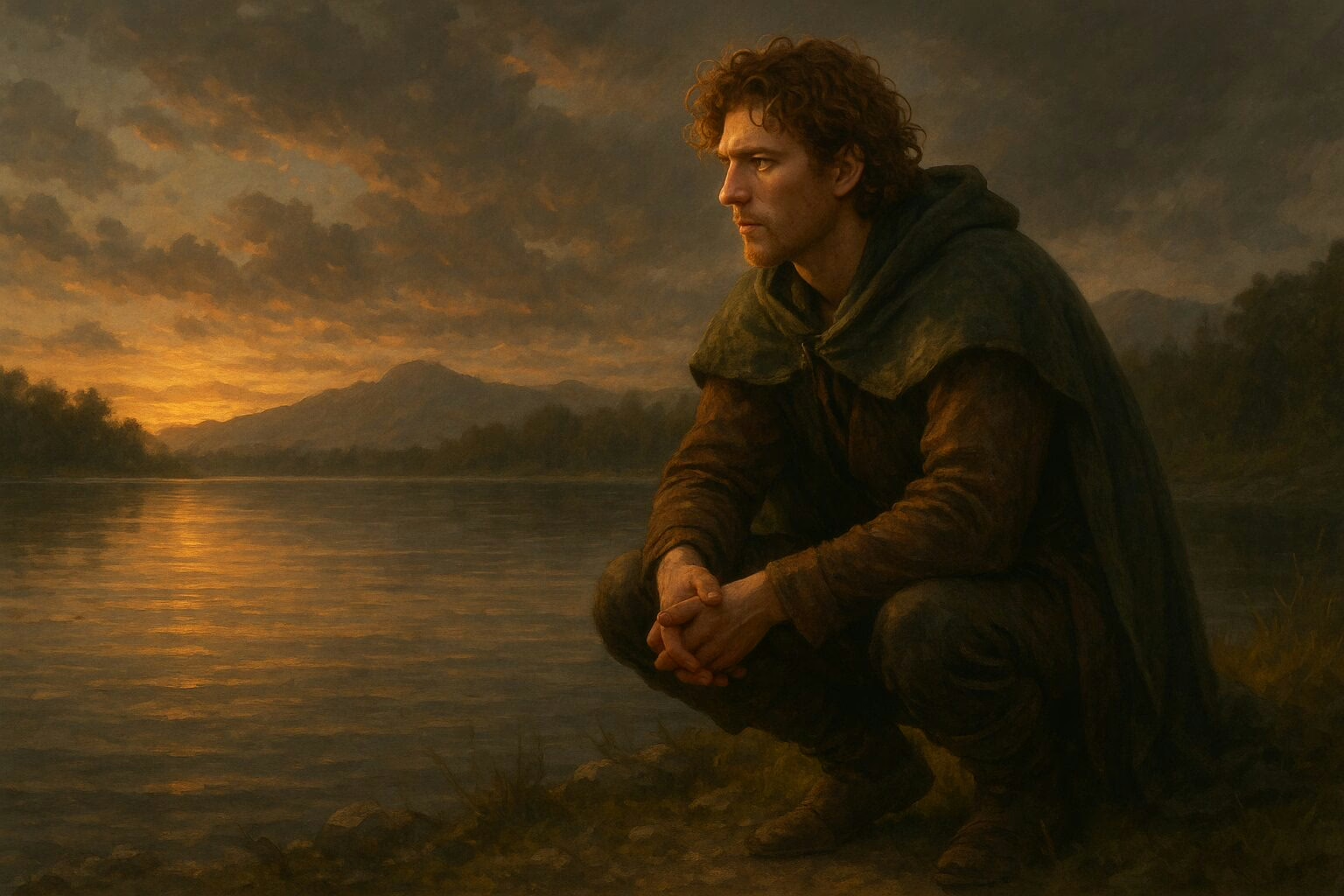
We all know the pain of unmet desire. Whether for good or for ill, we are all driven by these desires. In fact, our ability to control and harness our desire is one of the clearest distinctions between us and other animals. The ancient Irish had a complex appreciation for this as embodied in the figure of Aengus — Irish god of love, youth, and dreams. Unlike many of his divine kin, Aengus does not dominate myth through battle or law. He rules the domains of desire, inspiration, and beauty — a god whose stories speak not of conquest, but of longing, of passion, and transformation.
Aengus’s presence in Irish mythology is both vivid and enigmatic. He appears as a dreamer, a lover, and a figure of endless youth, yet beneath that elegance lies a god with deep mythological roots: son of the Dagda, fostered by Midir, tied to the sacred landscape of the Boyne Valley. His tales are shaped by longing — whether for a woman glimpsed only in a dream, or for a place to call his own within the ranks of the Tuatha Dé Danann.
This post explores the layered identity of Aengus, Irish god of poetic inspiration and timeless love. From the myth of Caer Ibormeith to his claim on Newgrange, we will trace how Aengus’s stories endure today.
Aengus’ Name, Origins, and Lineage
The name Óengus (modernised as Aengus or Oengus) derives from Old Irish elements meaning either “true vigour” or “one desire” — a fitting etymology for a god so deeply entwined with passion and poetic force. In some interpretations, the name also implies “the only choice,” which reflects both his romantic story and the singularity of his mythic identity.
Aengus was born from a secret union between two powerful figures in Irish mythology: the Dagda, chief god of the Tuatha Dé Danann, and Boann, goddess of the River Boyne. Their affair occurred while Boann was still married to Elcmar, the steward of the Brú na Bóinne (Newgrange). To protect Boann from shame and conceal the affair, the Dagda manipulated time — holding the sun still in the sky so that Aengus could be conceived, gestated, and born all within a single day.
This mythic manipulation of time places Aengus outside the ordinary world from the moment of his birth. He is a being of compressed, sacred chronology, born not through violence or conquest, but through cleverness, concealment, and divine will. In some tales, Aengus is then fostered by Midir, another god of the Tuatha Dé Danann, further linking him to the broader web of divine relations and traditions tied to the sídhe (fairy mounds or otherworldly abodes) – a theme which endures through the myths associated with Aengus.
The Dream of Aengus
Among all the stories of Aengus, none is more enduring than the tale of his dream and his love for Caer Ibormeith.
One night, Aengus sees a young woman in his sleep — a radiant figure standing by his bed, calling to him without words. When he reaches out, she vanishes. The next night, she appears again. And again the next. For a year, this dream repeats. Aengus, once carefree and light-hearted, begins to waste away with longing for a love that exists only in sleep.
His mother Boann is the first to intervene, unable to help. His father the Dagda then calls upon the help of the king of the Tuatha Dé Danann, who summons Bodb Derg, a god of knowledge and dreams. After a long search across Ireland, Bodb finally discovers the woman Aengus saw: Caer Ibormeith, daughter of a mysterious figure from the Otherworld.
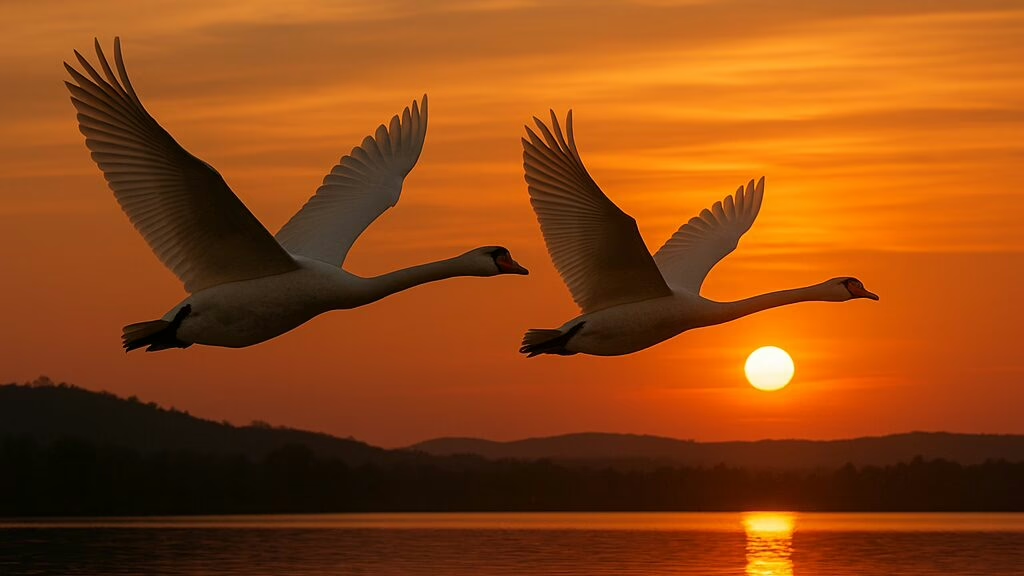
But there is a condition. Caer spends one year as a woman, the next as a swan, alternating every Samhain. When Aengus finds her at a lake known as the Dragon’s Mouth, he is told that he may only marry her if he can recognise her among 150 identical swans. He does — and to be with her, he transforms himself into a swan, and they fly away together, singing music so beautiful it puts all of Ireland to sleep for three days and nights.
And so, love drives Aengus to give up all else in pursuit of the one he desires. A wonderful love story – or cautionary tale of love.
Brú na Bóinne and the Power of Place
Among the many homes of the Tuatha Dé Danann, none is more iconic or more intimately tied to a single deity than Brú na Bóinne — the prehistoric passage tomb now known as Newgrange, and the mythic residence of Aengus.
The story of how Aengus came to possess the Brú reveals much about his nature. According to the story, Aengus visits his father, the Dagda, and asks to stay in the Brú “for a day and a night.” The Dagda agrees, unaware that Aengus intends to interpret the phrase literally: “day and night” — forever. With this clever turn of phrase, Aengus claims the Brú for himself. It is a moment of wit triumphing over authority, reinforcing his role as a god who does not fight but wins with words and subtlety.
Brú na Bóinne itself is no ordinary residence. Aligned with the winter solstice sunrise, its inner chamber floods with light once a year — a spectacle of cosmic precision. For Aengus to claim this site as his own is to claim a space where time, death, and rebirth converge. His residence within the Brú ties him to the eternal cycle of light and darkness, and makes him more than a god of fleeting desire.
Aengus in Other Tales
Though best known for his dreamlike romance with Caer and his clever claim to Brú na Bóinne, Aengus appears in several other myths, often as a helper, protector, or subtle guide. These tales deepen his character, showing that his domain extends beyond personal longing into the realm of fosterage, loyalty, and compassion.
One of the most significant examples is his role in the tale of Diarmaid and Gráinne, part of the Fenian Cycle. After Gráinne chooses the warrior Diarmaid over the ageing hero Fionn mac Cumhaill, the couple flee across Ireland, pursued by Fionn’s men. In this long and tragic saga, Aengus emerges as a protector and benefactor. He shelters Diarmaid, offers magical aid, and even intervenes after Diarmaid’s death, retrieving his body and bringing it to safety.
This role reinforces Aengus’s enduring association with love pursued at great cost. But it also shows his alignment with the underdog — with those who choose love over duty, or beauty over power. His support of Diarmaid is not merely personal; it reflects a divine allegiance to passion, freedom, and the right to choose one’s path.
Comparisons with Other Mythological Gods
In the wider context of ancient mythology, Aengus occupies a rare space: a god of love and youth whose power is neither mischievous nor tragic, but deeply idealistic.
In Greek mythology, the closest counterpart is Eros — god of desire and attraction. Yet while Eros is often impulsive, even chaotic, Aengus is contemplative. His love for Caer is measured, faithful, and transformative, not a fleeting whim. Aengus is never an agent of lust or trouble, but a guide through longing — far more like Orpheus than Eros in spirit, though with a gentler fate.
Cupid, his Roman analogue, shares the iconography of youth and affection, but lacks the emotional complexity of Aengus’s myth. Cupid wounds hearts with arrows; Aengus, by contrast, is the one who tends to wounded hearts, seeks beauty, and carries the dignity of a lover who waits and searches rather than conquers.
In Norse mythology, Aengus’s gentleness most resembles Baldur — the bright and beloved god. Yet even Baldur is framed by tragedy, while Aengus’s tales resolve in union, not death. His power lies in his persistence and his poetic voice, not in prophesied doom.
What sets Aengus apart is the balance between dream and action, desire and dignity. He is neither dominant nor passive — he chooses, loves, waits, and transforms. Where other gods of love bring turmoil, Aengus offers solace. Where others seduce, he endures.
Table: Comparison between Aengus and other ancient gods
| Deity | Shared traits with Aengus | Key differences |
|---|---|---|
| Eros (Greek) | Love, desire, youthful god | Mischievous archer; not linked to poetry or dreams |
| Cupid (Roman) | Love, matchmaking, eternal youth | Often childlike; lacks land or artistic aspects |
| Baldur (Norse) | Beauty, light, beloved by gods | Tragic death myth; no association with romantic love |
| Krishna (Hindu) | Charisma, divine lover, flute music | Full creator deity; complex theology beyond youth theme |
| Apollo (Greek) | Poetry, music, healing arts | Solar\‑prophetic focus; more formal, less romantic |
Symbolism and Modern Legacy
Aengus may belong to the mythic past, but the themes he embodies — longing, beauty, and poetic truth — are as enduring as the river that bore his mother’s name. In Aengus, we find a deity who stands not at the front of battle, but within the heart of longing — and it is this emotional core that makes his story so compelling today. Where other gods are remembered for feats of war or law, Aengus endures because he represents what it means to want something deeply and pursue it without fear.
Modern artists, writers, and musicians have often returned to Aengus as a symbol of idealised love and creative inspiration. Perhaps most famously, W. B. Yeats drew upon the myth in The Song of Wandering Aengus, capturing that same aching pursuit of something glimpsed once and never forgotten.
From his dream of Caer Ibormeith to his cunning claim of Brú na Bóinne, Aengus wields no sword, yet achieves what few others can: he finds beauty, holds on to it, and shares it with the world. His voice, his music, his flight as a swan — these are not just poetic symbols but acts of quiet power, moments when emotion changes the course of myth.
In remembering Aengus, we remember that not all strength comes from struggle. Some comes from stillness, faith, and imagination. He is the god of unspoken things: of songs that soothe, of loves that endure, and of dreams that refuse to fade.
Frequently Asked Questions: Aengus, Irish god of love
Aengus was the god of love, youth, and dreams — a son of the Dagda and Boann.
Aengus falls in love with a woman who appears to him in a dream and eventually finds her in swan form.
He claimed Brú na Bóinne as his home through trickery and dwells there eternally in myth.
YOU MAY ALSO LIKE
 Iron Age Clothing in Ireland: What People Really Wore
 Rock Art in Ireland: Prehistoric Carvings, Meaning & Sites
 Macha: Irish Goddess of War, Horses and Fate
 Brigid: Irish Goddess of Poetry, Healing and Sacred Fire
 Ogma: Irish God of Strength, Language, and Ogham
 Cailleach – Ireland’s Winter Hag and Shaper of Mountains
 The Dagda: Irish All-Father God of Myth, Power & Wisdom
 The Morrigan: Symbolism & History of the Irish War Goddess