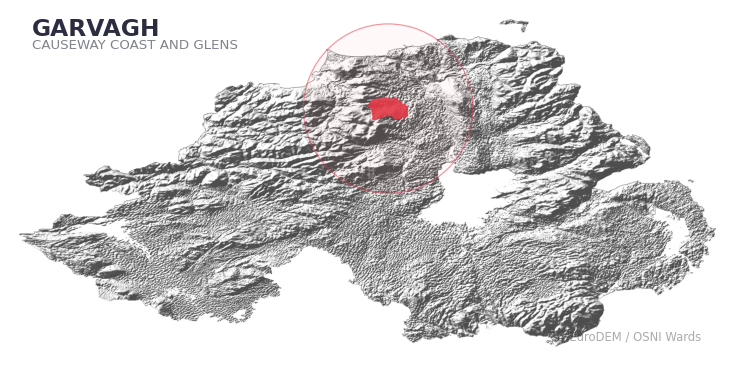
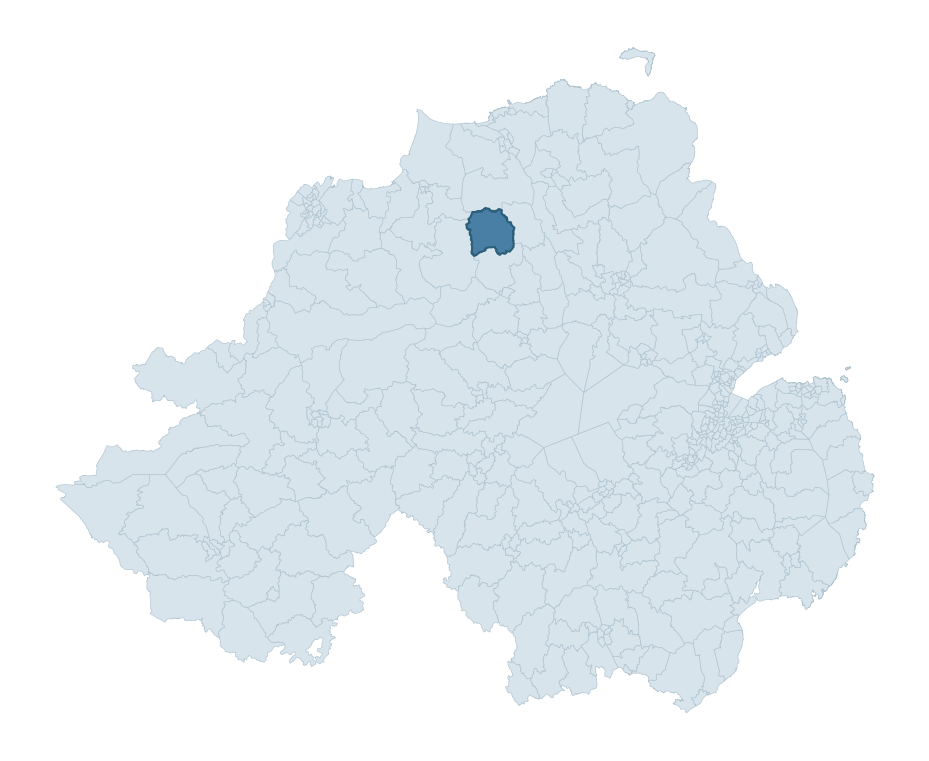
GARVAGH covers 229.1 km² in Northern Ireland. With 141 historic sites and 11 scheduled monuments on record, the ward sits at the 91st percentile across all 462 NI wards for combined archaeological heritage. It also records 43 listed buildings (HED Historic Buildings Record), the 73rd percentile for listed-building density across NI wards. Per 1,000 residents, this works out at 56.5 recorded sites — the 93rd percentile across NI wards (a measure of heritage density relative to current population). Dated archaeological evidence runs from the Mesolithic through to the Post-Medieval period, spanning 6 archaeological periods, around the NI median for chronological depth.

Heritage at a glance
Percentile rankings throughout this profile compare each ward only against the other 461 Northern Ireland wards.
Population context
The recorded heritage of GARVAGH
Of the 141 historic sites recorded, the most common are Enclosure (29, 21% of historic sites), Rath (16), and Rath (O.S. Memoir Site, Unlocated) (4). For Enclosures, this is placing the ward in the top 3% nationally for this type. For Raths, this is the 81st percentile across NI wards that record this type. Across the ward's 229.1 km², this gives a recorded density of 0.85 sites per km² (all heritage types combined). Scheduled monuments are distributed across approximately 0.04° of latitude and 0.06° of longitude within the ward, indicating dispersed rather than clustered placement.
Most common monument types
| Type | Count | Description |
|---|---|---|
| Enclosure | 29 | — |
| Rath | 16 | — |
| Rath (o.s. Memoir Site, Unlocated) | 4 | — |
Chronological distribution
Terrain and environment
A mean elevation of 161m places this ward in the top 10% of NI wards by altitude, but the ward reaches 376m at its highest point — a vertical span of more than 214m within its boundary, indicating significant topographic diversity. Mean slope is 4.5° (60th percentile across NI), giving moderately undulating terrain. The Topographic Wetness Index of 10.2 (37th NI percentile) indicates moderate drainage, balanced between upland shedding and lowland accumulation. The land cover is dominated by improved grassland (81%) and woodland (17%). In overall character, this is elevated but relatively gentle terrain — typical of plateau country, with land use dominated by improved grassland.
Terrain measurements
Where this ward sits in NI
Geology and preservation
The dominant bedrock formed during the Cainozoic era (Palaeogene period). Relatively young rock formed in the last 66 million years. In Ulster, Cainozoic basalt — the lava that created the Antrim Plateau and Giant's Causeway — dominates much of the eastern landscape. Peat covers 25% of the ward. Peat-bound ground preserves organic archaeological material that would not survive on aerated mineral soils. Bedrock composition is uniform (complexity index 0.36), with a single dominant geological unit underlying most of the ward. A uniform geology narrows the natural lithic-resource base available to past inhabitants.
Placename evidence
The combined OSNI, Logainm NI, and GeoNames sources record 44 placenames for this ward. Diagnostic heritage strata identified within these are: 3 pre-Christian defensive (rath-, dún-, lios-, caiseal-) and 1 ecclesiastical (cill-, teampall-, mainistir-, díseart-). Note: Irish-language (name_ga) forms are recorded for roughly half of NI placenames in the combined sources, so anglicised forms whose Irish original could belong to multiple categories may be misclassified.
Placename categories
Scheduled monuments in GARVAGH
Scheduled monuments are sites legally protected under the Historic Monuments and Archaeological Objects (Northern Ireland) Order 1995, designated by the Historic Environment Division (HED).
| Monument | Type | Period |
|---|---|---|
| Bivallate Rath: Farrantemple Fort | Bivallate Rath: Farrantemple Fort | Iron Age |
| Rath: Lisatinny | Rath: Lisatinny | Early Medieval |
| Rath | Rath | Early Medieval |
| Rath and attached enclosure | Rath And Attached Enclosure | Iron Age |
| Stone circle or cairn: Tamney Cromlech | Stone Circle Or Cairn: Tamney Cromlech | Neolithic |
| Cairn: Slaght Averty or Dwarf's Grave | Cairn: Slaght Averty Or Dwarf'S Grave | Early Bronze Age |
| Rath | Rath | Early Medieval |
| Rath | Rath | Early Medieval |
Recorded historic sites
| Name | Period | Type |
|---|---|---|
| A.P. SITE – cropmark | Unknown | Unknown |
| A.P. SITE – oval cropmark | Unknown | Unknown |
| A.P. SITE – small, circular cropmark | Unknown | Unknown |
| BARROW | Mesolithic | Ritual/Funerary |
| BATTLE SITE: BATTLE OF RAVELIN'S HILL, 1641 | Post-Medieval | Unknown |
| BIVALLATE RATH: FARRANTEMPLE COURT | Early Medieval | Ritual/Funerary |
| BURIAL GROUND (unlocated) | Unknown | Ritual/Funerary |
| BURIAL GROUND: DRUMSLADHE (O.S. memoir site, unlocated) | Unknown | Ritual/Funerary |
| BURIAL GROUND: GARAHAYNALANIV – garden of the infants (O.S. memoir site, unlocated) | Unknown | Ritual/Funerary |
| BURNT MOUND | Early Bronze Age | Agriculture |
Listed buildings in GARVAGH
| Address / Name | Grade | Period |
|---|---|---|
| St Paul's Church Church of Errigal Garvagh Co. Londonderry BT51 5AE | B2 | 1650 – 1699 |
| Ulster Bank 10 Main Street Garvagh Co. Londonderry BT51 5AD | B2 | 1860 – 1879 |
| Moyletra Parish Church Kurin Road Garvagh Co. Londonderry | B1 | 1780 – 1799 |
| St Mary's Roman Catholic Church Grove Road Craigavole Garvagh Co. Londonderry | B2 | 1840 – 1859 |
| St Joseph's Roman Catholic Church Brockaghboy Garvagh Co. Londonderry | B1 | 1860 – 1879 |
| 36 Glen Road Garvagh Co. Londonderry BT51 5DB | B1 | 1840 – 1859 |
| Garvagh High School 140 Main Street Garvagh Co. Londonderry BT51 5AE | B1 | 1940 – 1959 |
| Ballynameen Bridge Carnhill Road Garvagh Coleraine Co Londonderry BT51 | B2 | 1840 – 1859 |
| Killyvally Bridge Bridge Street Garvagh Coleraine Co Londonderry BT51 | B2 | 1800 – 1819 |
| Errigal Bridge Temple Rd Garvagh Coleraine Co Londonderry BT51 | B2 | 1800 – 1819 |
Discover more in Causeway Coast and Glens
- Ballykelly
- Aghadowey
- Torr Head And Rathlin
- University
- Atlantic
- Mountsandel
- Roeside
- Gortrush — Fermanagh and Omagh
- Groomsport — Ards and North Down
- Glenravel — Mid and East Antrim
See all 462 wards in the Northern Ireland Heritage Tool.

Want a deeper view?
Grounding History: 10 Maps of Northern Ireland’s Past
A spatial history report bringing together analysis of all 462 wards into one place through 10 high-quality maps — covering monument density, archaeological periods, placename heritage, terrain, wetland, and the historic landscape at first survey.
About this profile
What is a ward?
A ward is the smallest electoral and statistical geography used by the Northern Ireland Statistics and Research Agency (NISRA). The boundaries used here are the 2014 NISRA / OSNI Wards (462 across Northern Ireland), each typically covering 1-700 km² and a population of a few thousand. Wards do not align with parishes, townlands, or any historic administrative unit — they are a modern statistical convenience, used here only as a fixed spatial frame within which to summarise heritage records.
What counts as a site?
Three distinct heritage record types are reported separately, not combined: (1) Historic Sites — entries in the Northern Ireland Sites and Monuments Record (NISMR), the inventory of recorded archaeological sites and findspots, dated from prehistoric to early-modern; (2) Scheduled Monuments — sites legally protected under the Historic Monuments and Archaeological Objects (NI) Order 1995 and maintained by the Historic Environment Division (HED); (3) Listed Buildings — buildings of architectural or historic interest protected under the Planning Act (NI) 2011 and graded A, B+, B1, B2, or Record-Only by HED. A site appearing in more than one register is counted in each register independently.
Editorial principles
These ward profiles describe evidence, not history. They report what is recorded, not what occurred. Where the data is ambiguous, we say so. We do not infer historical processes — population movements, settlement expansion, periods of decline — from patterns in the record. Absence of evidence is not evidence of absence: in Northern Ireland, where antiquarian survey was uneven and modern excavation is geographically biased, a gap in the record almost always reflects the limits of recording rather than a genuine historical absence. We mark such gaps explicitly where they appear in the data.
Limits of coverage and known caveats
Several caveats apply to every ward profile: (1) NISMR coverage is uneven across NI — some areas (notably parts of the south-east and the Belfast urban fringe) have been more intensively surveyed than others, so a low recorded site count does not reliably indicate a low past density of activity; (2) period attributions in NISMR are often 'Unknown', and chronological breakdowns reported here reflect only the dated subset; (3) placename classification depends on the Irish-language form (name_ga), which is recorded for approximately 50% of NI placenames in the combined sources, so ecclesiastical and pre-Christian counts may be understated where anglicised forms remain unparsed; (4) terrain percentile ranks compare each ward only to the other 461 NI wards; they are not absolute thresholds. For absence-dominant land cover categories (wetland, water, cropland), percentile ranks are suppressed below 1% raw value, since the ranking of zero-value wards is not meaningful.
Data sources (11)
- Northern Ireland Sites and Monuments Record (NISMR) https://www.communities-ni.gov.uk/articles/nismr-public-mapviewer
- HED Scheduled Monuments Dataset https://www.opendatani.gov.uk/@historic-environment-division/scheduled-monuments-northern-ireland
- HED Historic Buildings Record https://www.communities-ni.gov.uk/topics/historic-environment/listed-buildings
- OSNI OS Open Names (Northern Ireland) https://www.opendatani.gov.uk/@ordnance-survey-of-northern-ireland/osni-open-data—50k-gazetteer
- Logainm — Placenames Database of Ireland https://www.logainm.ie/
- GeoNames https://www.geonames.org/
- Census 2021 (Northern Ireland) https://www.nisra.gov.uk/statistics/2021-census
- OSNI Open Data — Largescale Boundaries https://www.opendatani.gov.uk/@ordnance-survey-of-northern-ireland/osni-open-data-largescale-boundaries-wards-2012
- Copernicus GLO-30 DEM https://spacedata.copernicus.eu/collections/copernicus-digital-elevation-model
- ESA WorldCover https://esa-worldcover.org/
- GSNI 1:250,000 Geology https://www.bgs.ac.uk/geological-data/maps/