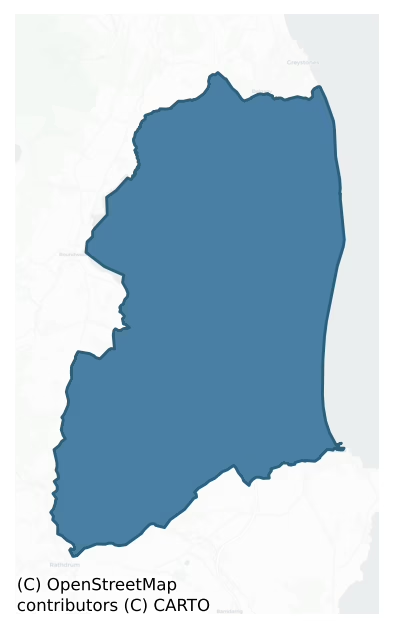
Newcastle is a barony of County Wicklow, in the historical province of Leinster (Irish: An Caisleán Nua), covering 212 km² of land. The barony records 363 NMS archaeological sites and 143 NIAH listed buildings, placing it at around the 43rd percentile among 280 ROI baronies for sites per km². This means it is in the lower half of all baronies for sites per km². Dated archaeological evidence runs from the Mesolithic through to the Modern, spanning 9 of 9 archaeological periods, placing the barony in the 92nd percentile among 280 ROI baronies for chronological depth. This means it is in the top tenth of all baronies for chronological depth. The largest dated subset of recorded sites dates to the Medieval. Logainm flags 41 placenames in the barony as carrying a recognised heritage root; the largest share — around 76% — are names associated with early Christian church and monastic foundations.
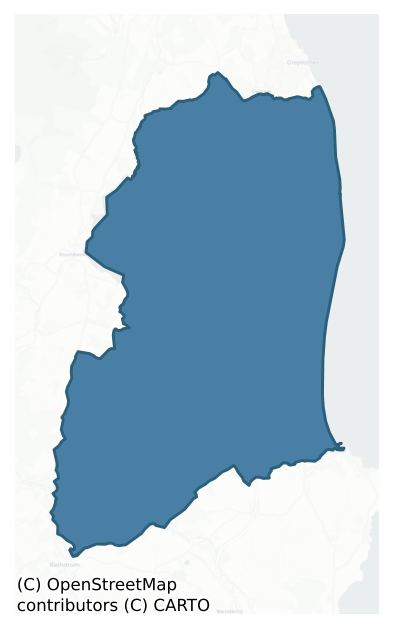

Heritage at a glance
Percentile rankings throughout this profile compare each barony only against the other 279 Republic of Ireland baronies.
The recorded heritage of Newcastle
The National Monuments Service Sites and Monuments Record (SMR) is the statutory inventory of archaeological sites for the Republic of Ireland, maintained by the Department of Tourism, Culture, Arts, Gaeltacht, Sport and Media. Sites recorded here include earthworks, ringforts, megalithic tombs, ecclesiastical remains, and post-medieval features; not every record is legally protected, but each is registered as a monument of archaeological interest.
The National Monuments Service records 363 archaeological sites in Newcastle, putting it at the 43rd percentile among 280 ROI baronies for sites per km². This means it is in the lower half of all baronies for sites per km². Of these, 270 (74%) fall within a recorded monument protection zone. The record is dominated by defensive sites — ringforts, enclosures, hillforts, and stone forts (91 sites, 25% of the total), with agricultural and prehistoric industrial sites forming a substantial secondary presence (61 sites, 17%). The most diagnostically specific type is Fulacht fia (43 records, 12% of the barony's NMS total) — compared to an ROI average of 6% across all baronies where this type occurs. Fulacht fia is a horseshoe-shaped Bronze Age burnt mound built around a sunken trough beside a water source, traditionally interpreted as a cooking site. The broader 'Enclosure' classification — which catches unclassified ringforts and field enclosures — accounts for a further 62 records (17%) and reflects the difficulty of sub-classifying degraded earthworks from surface evidence alone. Across the barony's 212 km², this gives a recorded density of 1.71 sites per km².
Most common monument types
Hover or tap a monument type to see its definition.
| Type | Count |
|---|---|
| Enclosure a banked or ditched feature of uncertain type, used as a catch-all where the original function cannot be determined from surface evidence | 62 |
| Fulacht fia a horseshoe-shaped Bronze Age burnt mound built around a sunken trough beside a water source, traditionally interpreted as a cooking site | 43 |
| Excavation – miscellaneous | 28 |
| Church a building used for public Christian worship, of any date from c. 500 AD onwards | 21 |
| Graveyard a burial area associated with a church, in use from the medieval period onwards | 17 |
| Ringfort – rath an earthen ringfort enclosed by a bank and external ditch — the most common Early Medieval farmstead, broadly dated 500–1000 AD | 13 |
| Ring-ditch a circular ditch under 20m across, often the ploughed-out remains of a barrow, ring-barrow or roundhouse | 11 |
Chronological distribution
The dated archaeological record for Newcastle spans from the Mesolithic through to the Modern, with activity attested across 9 of 9 archaeological periods. This places Newcastle in the top 8% of ROI baronies for chronological depth — few baronies record evidence across as many distinct archaeological periods. Every period from earliest to latest is represented in the record — an unbroken sequence of dated activity across the full chronological span. Activity concentrates most heavily in the Medieval (40 sites, 26% of dated material), with the Iron Age forming a secondary peak (37 sites, 24%). A further 53 recorded sites (25% of the overall NMS register for the barony) carry no period attribution — appearing as 'Unknown' in the bar chart below. This typically reflects either records that pre-date the standardised period vocabulary or sites awaiting specialist dating review, rather than a genuine absence of chronological evidence.
Sample of recorded monuments
Show 25 sample monuments (of 363 total)
A representative sample of 25 recorded monuments drawn from the barony’s 363 total NMS entries. Sites within a recorded monument protection zone and rarer site types are prioritised so the list shows a meaningful cross-section rather than only the most common type. Each entry shows the official Sites and Monuments Record reference number and the description published by the National Monuments Service.
Hillfort
Subcircular univallate hillfort (dims. c. 360m E-W; c. 220m N-S) part of which is depicted on the OS 6-inch map as a field boundary. The site encloses the summit of Downshill with steep slopes to the N, E and S and…
Subcircular univallate hillfort (dims. c. 360m E-W; c. 220m N-S) part of which is depicted on the OS 6-inch map as a field boundary. The site encloses the summit of Downshill with steep slopes to the N, E and S and gentler slopes to the W and has a commanding position on the W edge of the Glen of the Downs. The summit is now covered in forestry and the only accessible surviving part of the rampart is along the SW side where it forms part of a field boundary which skirts the plantation. The earth and stone bank (Wth 4-5m; H 1.60m) has near vertical drystone facing (probably not original). The external fosse (Wth c. 4m) was also identified to the SE in the next field in 1989 during ploughing. The SE perimeter had apparently not survived.
In 2007 two test trenches were opened across the bank and fosse on the N and W sides as part of a research excavation carried out by UCD school of Archaeology (Excavation Licence 07E0596). No dateable artefacts were recovered. (O'Neill 2007, 3)
The hillfort was recently described in the Atlas of Hillforts of Britain and Ireland as following; 'Oval shaped partial contour fort surrounding the domed summit of Downshill. In commanding position at edge of the Glen of the Downs and overlooking the Wicklow coastline to the E. Coolagad hillfort (Atlas No.0719) positioned 2.8km to NE. Univallate for its entire circuit, it has a total footprint of approximately 6.7ha. There are no recorded entrance features. No evidence for any internal features on…
Decorated stone
Reynolds and Haworth (1973, 50) noted a possible decorated stone at the church in Ballynerrin(WI013-011—-) which has not been located.
Compiled by: Claire Breen
Date of upload: 07 February 2013
Burial mound
Situated on a low rise overlooking a marked SE-facing slope. Circular mound (diam. c. 54m; H 1.8m) which when excavated in 1872, produced a rectangular cist (L 1.07m; Wth 0.61m) containing a cremation and a small bronze…
Situated on a low rise overlooking a marked SE-facing slope. Circular mound (diam. c. 54m; H 1.8m) which when excavated in 1872, produced a rectangular cist (L 1.07m; Wth 0.61m) containing a cremation and a small bronze razor. (MacEniry 1887-8, 163; Price 1934, 54; Waddell 1990, 166)
The above description is derived from the published 'Archaeological Inventory of County Wicklow' (Dublin: Stationery Office, 1997). In certain instances the entries have been revised and updated in the light of recent research.
Date of upload/revision: 17 December 2008
Castle – Anglo-Norman masonry castle
Situated at the W end of a possible ringwork (WI019-005004-) in undulating terrain; the site formed part of the medieval borough of Newcastle (WI019-005—-). The remains of a four-storey rectangular gatehouse built of…
Situated at the W end of a possible ringwork (WI019-005004-) in undulating terrain; the site formed part of the medieval borough of Newcastle (WI019-005—-). The remains of a four-storey rectangular gatehouse built of uncoursed rubble with traces of internal plaster. The core of the building is medieval but was considerably altered in post-medieval times. On the W façade above the entrance are three niches with concave limestone frames, probably for armorial plaques. This entrance leads into an E-W barrel-vaulted room with opposing doorways to the left and right (with chamfered granite portals and arches) giving access to narrower vaulted chambers to the N and S. A smaller N-S chamber extends from the NE angle of the building and appears to have been largely subterranean. A linear stairwell rises from the N wall of the main ground-floor chamber leading to a room set between the ground and first-floor levels. This has a large fireplace towards the NW angle. In the E end of the N wall is a window ope with a floor-level chute below. The main first-floor chamber (dims. 6m E-W; 5.5m N-S) is supported by the entrance vault. It has two opposing windows in the E and W walls and a brick fireplace in the SE angle. No partition between this and the previous room survives, nor does the original means of access. Access to a S chamber at this level was via a doorway in the W end of the S wall. Niches immediately above the window level were used to carry the floor supports of the second…
Designed landscape feature
Small circular copse of mature trees (diam. 30m). No encircling features other than a slight scarp on downslope side. On gentle SW facing slope. Probably a tree ring.
Date of upload: 28 September 2012
Water mill – horizontal-wheeled
Situated at the foot of a slope in a V-shaped stream valley. The remains of a horizontal mill, recently discovered during drainage operations. It consists of a rectangular pool, lined with wooden planks, with posts…
Situated at the foot of a slope in a V-shaped stream valley. The remains of a horizontal mill, recently discovered during drainage operations. It consists of a rectangular pool, lined with wooden planks, with posts which originally supported the wheel-house. The pool was fed by a leat via a wooden 'flume' or chute, which was preserved, and a second leat brought the water back to the nearby stream. The horizontally mounted mill paddles, one of which was preserved, were turned in the stream of water. A sample of wood gave a dendrochronological date of AD 744 +/-9 (Palaeoecology Centre, QUB).
The above description is derived from the published 'Archaeological Inventory of County Wicklow' (Dublin: Stationery Office, 1997). In certain instances the entries have been revised and updated in the light of recent research.
Date of upload/revision: 17 December 2008
Prehistoric site – lithic scatter
Scatter of flints with possible Later Mesolithic element found on surface of E-W moraine which is truncated by the sea. (Information Prof. F. Mitchell/ Prof. P. Woodman)
The above description is derived from the…
Scatter of flints with possible Later Mesolithic element found on surface of E-W moraine which is truncated by the sea. (Information Prof. F. Mitchell/ Prof. P. Woodman)
The above description is derived from the published 'Archaeological Inventory of County Wicklow' (Dublin: Stationery Office, 1997). In certain instances the entries have been revised and updated in the light of recent research.
Date of upload/revision: 17 December 2008
Megalithic structure
Situated on a gentle N-facing slope 130m NNW of a cairn (WI024-006—-). Two substantial standing stones (NW stone – H 1.07m; Wth 0.6m; T 0.66m; SE stone – H 1.4m; Wth 0.9m; T 0.8m) stand 7.8m apart at either end of a…
Situated on a gentle N-facing slope 130m NNW of a cairn (WI024-006—-). Two substantial standing stones (NW stone – H 1.07m; Wth 0.6m; T 0.66m; SE stone – H 1.4m; Wth 0.9m; T 0.8m) stand 7.8m apart at either end of a mound of earth and large stones (dims. 10.3m NNW-SSE x 4m NNE-SSW; H 0.3-0.7m). (Price 1967, 510)
Described by Price (1934, 40-1) as ‘the monument in the townland of Parkmore, which is called "Giant's Grave" on the Ordnance map, consists of two pillar-stones standing 26 feet [7.9m] apart. The taller of the two is 5 feet 3 inches [1.6m] high, and its greatest width is 3 feet [0.9m]; the other stands to the W.N.W. of it, and is 4 feet 3 inches high [1.3m], and about 2 feet [0.6m] square. I know of no tradition concerning this monument’.
The above description is derived from the published 'Archaeological Inventory of County Wicklow' (Dublin: Stationery Office, 1997). In certain instances the entries have been revised and updated in the light of recent research.
Compiled by: Caimin O'Brien
Date of upload/revision: 16 November 2012
This monument is subject to a preservation order made under the National Monuments Acts 1930 to 2014 (PO no. 145/1940).
House – 17th/18th century
Situated in gently undulating terrain. A late 17th-century brick house with a pediment and with pilasters on a rusticated lower storey. It has been restored recently. There is a well-preserved contemporary brick kiln…
Situated in gently undulating terrain. A late 17th-century brick house with a pediment and with pilasters on a rusticated lower storey. It has been restored recently. There is a well-preserved contemporary brick kiln 70m to the NE (Craig 1976, 70; Bence-Jones 1978, 87).
The above description is derived from the published 'Archaeological Inventory of County Wicklow' (Dublin: Stationery Office, 1997). In certain instances the entries have been revised and updated in the light of recent research.
Date of upload/revision: 17 December 2008
Historic town
The castle of Wicklow (WI025-013—-) was granted to Strongbow by Henry II in 1173 (Scott and Martin 1978, 121), which appears to indicate that there was a pre-Norman settlement at this site. The name is derived from…
The castle of Wicklow (WI025-013—-) was granted to Strongbow by Henry II in 1173 (Scott and Martin 1978, 121), which appears to indicate that there was a pre-Norman settlement at this site. The name is derived from the Scandinavian; either Vikingalo, 'meadow of the Vikings', or Vik-lo 'meadow of the bay' (Oftedal 1976, 130). The 'King's street' is mentioned in a deed of 1256-68 (MacNeill 1950, 131) and although the town went into decline having been captured in 1301 it came to prominence once again in the late 16th and 17th centuries (Bradley and King 1989, 68). Kerrigan (1995, 38) states that in 1576 what must have been earthwork ramparts were constructed around Wicklow and Arklow. In addition to the Franciscan Friary (WI025-012002-) there is a reference to a Benedictine convent having existed here from 1448 to 1470 and to a leper hospital in existence in 1578 (Gwynn and Hadcock 1970, 325, 357).
The above description is derived from the published 'Archaeological Inventory of County Wicklow' (Dublin: Stationery Office, 1997). In certain instances the entries have been revised and updated in the light of recent research.
Date of upload/revision: 17 December 2008
Religious house – Franciscan friars
Situated at the NW end of the town (WI025-012—-). Founded during the reign of Henry III (1216-72), and first referred to in 1325 (Gwynn and Hadcock 1970, 261). A section of the N wall of the nave (H c. 6m) and parts…
Situated at the NW end of the town (WI025-012—-). Founded during the reign of Henry III (1216-72), and first referred to in 1325 (Gwynn and Hadcock 1970, 261). A section of the N wall of the nave (H c. 6m) and parts of the S transept of the Franciscan friary, survives, constructed of uncoursed slaty limestone. The S wall of the transept has a round-headed three-light window, with traces of sandstone jambs. The nave has a large inserted arch, and the only original feature is part of a window splay at the E end.
The above description is derived from the published 'Archaeological Inventory of County Wicklow' (Dublin: Stationery Office, 1997). In certain instances the entries have been revised and updated in the light of recent research.
Date of upload/revision: 17 December 2008
Cross-slab
A granite cross-slab, placed against the chancel arch at the E end of the nave of church (WI013-029001-).
The above description is derived from the published 'Archaeological Inventory of County Wicklow' (Dublin:…
A granite cross-slab, placed against the chancel arch at the E end of the nave of church (WI013-029001-).
The above description is derived from the published 'Archaeological Inventory of County Wicklow' (Dublin: Stationery Office, 1997). In certain instances the entries have been revised and updated in the light of recent research.
Date of upload: 07 February 2013
Kiln – lime
Located on level ground in parkland to the NW end of the former demesne associated with Clonmannan House. Sited c. 53m N of the original Clonmannan House (WI025-005—), c. 170m N of the later Clonmannan House (NIAH…
Located on level ground in parkland to the NW end of the former demesne associated with Clonmannan House. Sited c. 53m N of the original Clonmannan House (WI025-005—), c. 170m N of the later Clonmannan House (NIAH Reg. No. 16402403; weblink https://www.buildingsofireland.ie/buildings-search/building/16402503/clonmannan-house-clonmannan-wicklow accessed 14/03/23), and c. 690m W of the coastline overlooking Wicklow Bay.
The remains of a freestanding rectangular-plan lime kiln (ext. dims. c. 5.1m NW-SE x 4.1m SW-NE) of probable early-to-mid nineteenth-century date although possibly earlier and associated with the building phase(s) of one or both of the Clonmannan Houses to the S. Constructed of rubble stone masonry with red brick section above the ground level to the NW elevation. Segmental-headed red brick arch to the oven aperture to the NW elevation at ground level; oven aperture slopes inwards towards the central firing chamber.
Date of original upload: 29/11/12
Revised by: T.J. O'Meara
Date of Revision: 14/03/2022
Architectural fragment
Described by the Urban Survey (Bradley and King 1989, 70-1) as a ‘Stone (dims. H 0.33m; Wth. 0.29m ; D 0.14m) with Romanesque Decoration. An arch stone, possibly from the Romanesque door inserted in the south wall, is…
Described by the Urban Survey (Bradley and King 1989, 70-1) as a ‘Stone (dims. H 0.33m; Wth. 0.29m ; D 0.14m) with Romanesque Decoration. An arch stone, possibly from the Romanesque door inserted in the south wall, is placed close to the font at the east of the church (C of I). It has chevron, stepped and dot patterns’.
Date of upload: 22 October 2012
Settlement deserted – medieval
Testing under licence no. 02E0226 was undertaken in April 2002 in Glebe townland, Wicklow, as part of an assessment for a route-selection study for the proposed Wicklow Port Access Road. The route passes c. 55m from the…
Testing under licence no. 02E0226 was undertaken in April 2002 in Glebe townland, Wicklow, as part of an assessment for a route-selection study for the proposed Wicklow Port Access Road. The route passes c. 55m from the protected area around an early ecclesiastical site (SMR 25:11). The assessment was in a large field, amalgamated from smaller land parcels after boundary removals in the last 170 years, that sloped steeply down to the south. Geophysics and the presence of low-relief landscape features on the hill slope south of the SMR protected area facilitated the selection of test-trench locations.
Field inspection identified hand-dug lazy-bed cultivation ridges in the far western part of the field, well outside the route of the proposed road. They lay near an extensive (sand?) quarry that has cut away most of the centre of the hill that forms much of the field. An old trackway leading from this quarry to the present R750 road was visible as a hollow way stretching south from the quarry entrance. East of this a disused field boundary was visible as a bank with an infilled fosse on either side, oriented north-north-east/south-south-west up the main hill slope. Test-trenches were positioned on a level area farther east, on the southern slope of the field (Trench 3) and over a visible platform (Trench 1). Another trench (Trench 2) was excavated upslope to the north and east of this level area, on the opposite side of a trackway visible as an earthwork lynchet/causeway that…
Industrial site
Archaeological licence no. 00E0490
An assessment of a proposed single-storey dwelling and associated services, at Killoughter, Co. Wicklow, was undertaken between 10 and 14 July 2000. The foundation trenches of the…
Archaeological licence no. 00E0490
An assessment of a proposed single-storey dwelling and associated services, at Killoughter, Co. Wicklow, was undertaken between 10 and 14 July 2000. The foundation trenches of the dwelling had been excavated without an archaeological presence on site. Once the client became aware of the archaeological condition placed on the development, our offices were contacted with a view to assessing the archaeological potential of the site. The site was visited in order to inspect the level of excavation and to determine whether any archaeological material was exposed in any of the sections. A foundation trench 1m wide and 0.7m deep had been excavated around the perimeter of the proposed dwelling (which measured 11m north-south x 8m). In addition to this, a further east-west-orientated foundation trench, 8m long and 0.7m deep, had been excavated through the centre of the floor-plan. A perpendicular foundation trench had been excavated at the centre point on the northern side of the central foundation. This was c. 3.5m long, 1m wide and 0.7m deep. Upon inspection it was apparent that significant medieval deposits had been disturbed within the central area of the proposed dwelling and that these deposits spread over an area c. 5.3m east-west x 5m. These deposits were concentrated within several cut features that may have formed part of a large trapezoidal structure. The production of lime on the site, coupled with several burnt deposits, suggests…
Cross
Inside the N wall of the nave of the church (WI019-001—-) simply leaning against the wall and obviously placed here recently is a cross-shaped stone (H 0.4m; T 0.04m; base Wth 0.12m; span of arms 0.11m; H of arms…
Inside the N wall of the nave of the church (WI019-001—-) simply leaning against the wall and obviously placed here recently is a cross-shaped stone (H 0.4m; T 0.04m; base Wth 0.12m; span of arms 0.11m; H of arms 0.05m). The cross has been crudely shaped. There are no distinctive features. There are scattered traces of mortar affixed to the stone, suggesting that it was built into the walls of the church, furthermore suggesting that it is of considerable antiquity.
Compiled by: Caimin O'Brien
Date of upload: 27 September 2012
Building
Fourteen archaeological features/deposits were uncovered during test excavation under licence no. 06E0273 in Glebe townland, Co. Wicklow. The test excavation was undertaken in advance of a proposed housing development…
Fourteen archaeological features/deposits were uncovered during test excavation under licence no. 06E0273 in Glebe townland, Co. Wicklow. The test excavation was undertaken in advance of a proposed housing development at the site. The deposit types identified in the assessment consisted of ditches (field enclosures dating from between ad 1000 and 1800) and 18th-century brick-manufacturing deposits.
The most interesting discovery was the identification of a substantial hearth within a rectangular house foundation in Trench 13. A rectangular ‘church’ building is illustrated on the first-edition of the OS as ‘site of the church of Drumkay’ (WI025-011—-) in this location. Other features and deposits such as pits, a possible corn-drying kiln and the foundations of a masonry wall were also identified throughout the remainder of the site. There was no definitive evidence to suggest that the features identified in the separate trenches were contemporary. Archaeological deposits similar to those described above were also uncovered in an assessment carried out by William O. Frazer close to the site (Excavations 2002, No. 1993, 02E0226). Significantly, no characteristic church-type deposits, burials, church masonry or ecclesiastical structural remains were found in the test-trenches.
The testing demonstrated that the church of Drumkay was not located within the RMP constraint circle, although a ‘building’ with a hearth was discovered within the constraint circle. It is clear from…
Burial ground
Situated on a low sand ridge in undulating terrain. In 1944, during ploughing, a stone lined grave orientated E-W was uncovered (Raftery 1944, 166-9). In 1963 and 1964 a further seven were discovered. These produced the…
Situated on a low sand ridge in undulating terrain. In 1944, during ploughing, a stone lined grave orientated E-W was uncovered (Raftery 1944, 166-9). In 1963 and 1964 a further seven were discovered. These produced the inhumed remains of adults, all with their head at the W end. (Lucas 1966, 12-13; Cahill and Sikora 2011, Vol. 2, 213-228)
The above description is derived from the published 'Archaeological Inventory of County Wicklow' (Dublin: Stationery Office, 1997). In certain instances the entries have been revised and updated in the light of recent research.
Revised by: Claire Breen
Date of upload: 24 July 2012
House – 16th/17th century
Situated c. 50m NE of a large possible motte (WI013-026—-). The present house, completed in 1784 by Thomas Cooley for Robert Cuningham, stands on the site of a large Mansion House' built by the Kennedys and destroyed…
Situated c. 50m NE of a large possible motte (WI013-026—-). The present house, completed in 1784 by Thomas Cooley for Robert Cuningham, stands on the site of a large Mansion House' built by the Kennedys and destroyed during the Williamite War. There is no visible trace of the earlier building (Bence-Jones 1978, 215).
The above description is derived from the published 'Archaeological Inventory of County Wicklow' (Dublin: Stationery Office, 1997). In certain instances the entries have been revised and updated in the light of recent research.
Date of upload/revision: 17 December 2008
Castle – motte
Natural circular mound (diam. c. 100m; H c. 6m) to the S of Mt. Kennedy House. The site rises steeply on all sides. Half-way up the slope there is a wide berm (Wth 9-14m). Above this the site rises to a circular flat…
Natural circular mound (diam. c. 100m; H c. 6m) to the S of Mt. Kennedy House. The site rises steeply on all sides. Half-way up the slope there is a wide berm (Wth 9-14m). Above this the site rises to a circular flat top (diam. 28.5m). The site may be a natural feature converted for use as a motte but subsequently landscaped, probably in the 18th century.
The above description is derived from the published 'Archaeological Inventory of County Wicklow' (Dublin: Stationery Office, 1997). In certain instances the entries have been revised and updated in the light of recent research.
Date of upload/revision: 17 December 2008
Castle – ringwork
Situated at the W end of an E-W ridge and forming part of the medieval borough of Newcastle (WI019-005—-). Earliest references to the castle formerly known as Newcastle McKynegan date to c. 1210-13 (Orpen 1908, 129).…
Situated at the W end of an E-W ridge and forming part of the medieval borough of Newcastle (WI019-005—-). Earliest references to the castle formerly known as Newcastle McKynegan date to c. 1210-13 (Orpen 1908, 129). Circular level platform (summit dims. 63m E-W; 62m N-S; max. base dims. 102m E-W; 88m N-S) fashioned from a natural ridge and defined by a steep scarp. There are very slight traces of an earthen bank (Wth 3-4m; max. H 0.3m) around the W, N and E edges of the platform. At the E there is a wide fosse (Wth 5m; D 1m) at the foot of the platform scarp which cuts the site off from the rest of the ridge on which it sits. The base of the fosse is 4m below the platform and less than 1m below the external ground level at the E. To the N and S the fosse levels out into a narrow terrace (Wth 5m at the S; 2-5m at the N; Wth of fosse 5-6m at the W). At the W end of the platform are the remains of an Anglo-Norman stone castle/gatehouse (WI019-005002-) which gives access to the interior of the ringwork in a similar manner to the castle earthwork at Castle Kevin (WI024-003001-). A causeway (Wth 5m) occurs directly opposite the entrance to the castle and 10m to the W of it. A possibly cobbled approach to the stone castle fans out towards the castle angles from the causeway, edged with a setting of small stones. (CUCAP, BDE 17) The cropmark of a semi-circular shaped ditch can be seen on aerial photographs which could be the remains of an outer bailey (www.bingmaps.com) (SMR…
Cist
Situated on a gentle E-facing slope overlooking marshy ground and the sea. Rectangular cist (dims. 1.52m x 0.71m) containing a crouched inhumation of an adult male (aged c. 40) on his right side with head to W…
Situated on a gentle E-facing slope overlooking marshy ground and the sea. Rectangular cist (dims. 1.52m x 0.71m) containing a crouched inhumation of an adult male (aged c. 40) on his right side with head to W accompanied by sherds of a bowl or vase food vessel. Not visible at ground level. (Anon. 1897, 189-90; Coffey et al. 1897, 559-62; Waddell 1990, 159)
The above description is derived from the published 'Archaeological Inventory of County Wicklow' (Dublin: Stationery Office, 1997). In certain instances the entries have been revised and updated in the light of recent research.
Date of upload/revision: 17 December 2008
Castle – tower house
16th century castle known as Kiltimon Castle that was modified and converted into a sham castle in the 18th century when a walled garden was constructed around the medieval fortification (Corlett 2008, 50). Situated on…
16th century castle known as Kiltimon Castle that was modified and converted into a sham castle in the 18th century when a walled garden was constructed around the medieval fortification (Corlett 2008, 50). Situated on a gentle S/SE-facing slope standing inside an 18th century circular walled garden. Rectangular structure (ext. dims. 12.5m NW-SE; 8m SW-NE; int. dims. 8.8m NW-SE; 4.8m SW-NE) built of mortared uncoursed granite and slate rubble. The walls are 1.55-2m thick with a base-batter on the NE and SE sides. There are two doorways, at the centre of the SE wall and at the S end of the NE wall. On the ground floor there are three plain niches and two windows in double-splayed opes in the SW wall with one double-splayed window in the NW wall. A straight intramural stairs (uneven and formed of rubble) opens from beside the NE door and rises through the SE wall to a landing which opens through a flat lintelled doorway onto the first-floor level which has a window (in a splayed ope) and a large niche in the NW wall. There is an intramural chamber in the S angle at this level. At second-floor level there is a single off-centre window in the NW wall. There are round corner towers rising from the roof level and simple crenellations along the top of all four walls. Both low gables survive. There are no corbels for wall-plates and no other evidence for supporting the floors. There is no cut stone in the structure and the window and door opes are built of uncoursed rubble. Corle…
Enclosure
Described in Grogan and Kilfeather (1997, 81, no. 497) as 'Situated on a gentle NE-facing slope. Circular area (diam. c. 15m) defined by a fosse visible on aerial photograph (CUCAP, BGE 83); solid circular cropmark…
Described in Grogan and Kilfeather (1997, 81, no. 497) as 'Situated on a gentle NE-facing slope. Circular area (diam. c. 15m) defined by a fosse visible on aerial photograph (CUCAP, BGE 83); solid circular cropmark (diam. c. 7m) visible off-centre.'
Subsequent archaeological excavation (Licence No. 04E0744) revealed a 5th-6th century penannular enclosure (WI013-007001-) (diam. 26m), which was partially cut by a larger 13th-14th century enclosure (WI013-007002-) (diam. c. 42m) with a SE facing entrance. (Molloy 2007, 27-44; Molloy 2009, 149-155)
Compiled by: Claire Breen
Date of upload: 15 January 2012
Listed buildings
The National Inventory of Architectural Heritage (NIAH) is a state survey appraising buildings of architectural, historical, archaeological, artistic, cultural, scientific, social, or technical interest. Each surveyed structure receives a rating from International (the highest, for buildings of European importance) through National, Regional, Local, and Record-Only.
The NIAH records 143 listed buildings in Newcastle (65th percentile across ROI baronies). The highest-graded structure include 1 of National significance. The Republic holds 937 National-graded buildings in total, so this barony accounts for around 0% of the national total. Construction dates concentrate most heavily in the Victorian (1830-1900) period. The most-recorded building type is house (61 examples, 43% of the listed stock).
Terrain and environment
Mean elevation across the barony is 118m — the 70th percentile among 280 ROI baronies for elevation. This means it is in the top third of all baronies for elevation. This is a relatively elevated landscape by ROI standards. Elevation matters for heritage because higher-altitude baronies typically favour defensive monuments — ringforts and hilltop forts placed on prominent ground — while lowland baronies are more likely to carry the dense settlement and church networks of intensive agricultural landscapes. The barony reaches 403m at its highest point — a vertical span of more than 285m within its boundary, indicating significant topographic diversity. Mean slope is 3.5° — the 47th percentile among 280 ROI baronies for slope. This means it is in the lower half of all baronies for slope. Slope is a key control on both land use and archaeological preservation: steep ground resists ploughing and tends to preserve earthworks intact, while gentle slopes favour intensive cultivation that damages or destroys surface archaeology over time. The Topographic Wetness Index averages 11.0, the 54th percentile among 280 ROI baronies for wetness. This means it is in the upper half of all baronies for wetness. Drainage matters for heritage because poorly-drained ground preserves organic archaeology (wooden trackways, leather, textiles, and on rare occasions human remains) far better than free-draining soil; well-drained ground favours arable use but destroys organic material rapidly. Urban land covers 16% of the barony (the 96th percentile among 280 ROI baronies for urban cover. This means it is in the top tenth of all baronies for urban cover). Heavy urban coverage compresses heritage analysis: many archaeological features have been buried or destroyed by development, but the surviving record is concentrated in protected city-centre cores, and the NIAH listed-buildings count is typically high. The land-cover mosaic combines improved grassland (48%), arable farmland (18%), and urban land (16%), giving a mixed agricultural and semi-natural landscape.
Terrain measurements
Where this barony sits in the Republic of Ireland
Geology and preservation
Bedrock geology shapes the landscape long before any settlement begins — controlling soil drainage, agricultural potential, the survival of upstanding monuments, and the preservation of buried archaeology. The figures below come from the Geological Survey Ireland 1:100,000 bedrock map.
The bedrock underlying Newcastle is predominantly greywacke and quartzite (53% of the barony by area), laid down during the Cambrian period (67% by area, around 540 to 485 million years ago). A substantial secondary geology of slate (29%) and greywacke, shale (13%) adds further variety to the underlying landscape. The single largest mapped unit is the Bray Head Formation (53% of the barony's bedrock).
Rock type composition
Largest mapped unit: Bray Head Formation (53% of the barony)
Placename evidence
Logainm records 41 heritage-diagnostic placenames for Newcastle, drawn from townland and civil-parish names across the barony. The dominant stratum is Early Christian ecclesiastical — cill-, teampall-, and domhnach-prefixed names that record the dense network of early church foundations established between the fifth and tenth centuries. The leading diagnostic roots are cill- (24 — church), ráth- (4 — earthen ringfort), and tuaim- (4 — burial mound). This is above the ROI average of 30.7 heritage placenames per barony. The presence of multiple heritage strata side by side indicates layered occupation of the landscape across successive prehistoric and historic periods. Logainm records 212 placenames for Newcastle (predominantly townland names). Of these, 41 (19%) carry one of the diagnostic Gaelic roots tracked above; the remainder draw on more generic landscape vocabulary that does not encode a heritage period.
Pre-Christian / Early Medieval Defensive
| Root | Count | Meaning |
|---|---|---|
| ráth- | 4 | earthen ringfort |
| dún- | 1 | hilltop or promontory fort |
Early Christian Ecclesiastical
| Root | Count | Meaning |
|---|---|---|
| cill- | 24 | church (early) |
| gráinseach- | 3 | monastic farm / grange |
| teampall- | 2 | church (later medieval) |
| tobar- | 1 | holy well |
| cillín- | 1 | unconsecrated burial ground |
Burial, Ritual, and Norse-Contact
| Root | Count | Meaning |
|---|---|---|
| tuaim- | 4 | burial mound |
Other baronies in Wicklow
About this profile
Click any section below to expand.
What is a barony?
A barony is a historic administrative unit in Ireland, broadly equivalent to an English hundred. The 280 baronies used here are from the OSi 2019 National Statutory Boundaries (generalised 20m), covering the 26 counties of the Republic of Ireland. Baronies derive from the Norman period, were formalised in the 17th century, and have not been redrawn for statistical purposes. They vary enormously in area, from compact urban baronies in Dublin to vast upland baronies in Connacht, and should not be compared by raw site count without accounting for area differences.
What counts as a site?
This profile combines three distinct heritage registers, each with its own definition of what constitutes a recordable site:
- Archaeological sites (NMS). The National Monuments Service Sites and Monuments Record (SMR) catalogues every known archaeological monument or site of archaeological interest in the Republic, from prehistoric burial mounds and ringforts to medieval churches and post-medieval defensive works. Inclusion does not require legal protection — only that the site has been identified, surveyed, and assessed as having archaeological value. A separate subset of these sites lies within a recorded protection zone, which gives them statutory protection under the National Monuments Acts.
- Listed buildings (NIAH). The National Inventory of Architectural Heritage records buildings of architectural, historical, archaeological, artistic, cultural, scientific, social, or technical interest. Each surveyed structure is appraised on a five-tier scale: International, National, Regional, Local, and Record-Only. The NIAH appraisal is informational rather than strictly statutory, but it underpins local-authority Record of Protected Structures (RPS) listings.
- Heritage placenames (Logainm). Logainm is the authoritative database of Irish placenames maintained by the Placenames Branch. This profile applies a heritage-diagnostic classifier to the Irish-language form of each townland name, flagging roots that signal defensive sites (ráth-, lios-, dún-, caiseal-, cathair-), ecclesiastical foundations (cill-, teampall-, domhnach-, mainistir-), prehistoric burial-ritual features (tuaim-, carn-, leaba-), or Norse-contact settlement (gall-). Townlands without one of these diagnostic roots are not flagged here — they may still carry historical significance, but that significance is not encoded in the name itself.
Editorial principles
The narrative sections of this profile follow several explicit principles:
- Evidential. Every claim about this barony’s heritage character is anchored in the underlying register data. Where a site count, a placename count, or a percentile rank is cited, it is computed from the source datasets at export time, not estimated.
- Comparative. Counts and metrics are reported alongside their percentile rank against the other 279 ROI baronies. A barony with 50 ringforts in absolute terms could be unusually high or unusually low depending on its size and regional context; percentile ranking removes that ambiguity.
- Transparent on limits. Where a register has known coverage gaps, survey biases, or data-quality issues that affect this barony’s figures, the profile flags them rather than presenting the numbers as definitive.
- No interpretation beyond what the data supports. The narrative does not speculate about historical events, social dynamics, or cultural meaning beyond what the recorded heritage and placename evidence directly attests.
Data caveats and limits
- NMS Sites and Monuments Record is the product of survey campaigns conducted at different intensities across different counties and decades. Some baronies have been surveyed more thoroughly than others, and absolute counts should be read in that light. Sites destroyed by development before survey are typically not represented; sites in heavily forested or upland terrain are sometimes under-recorded.
- NIAH coverage is broadly complete for the Republic of Ireland but the survey was conducted on a rolling county-by-county basis, and the most recent appraisal date varies. Buildings demolished or substantially altered after their original survey may still appear in the register; conversely, recent buildings of merit may not yet have been appraised.
- Logainm classification applies a deliberately conservative pattern-matching approach to the Irish-language townland forms. The classifier prioritises true positives over recall: a townland may carry a heritage signal that the classifier doesn’t recognise, particularly where the diagnostic root has been heavily anglicised or where the townland name draws on a less common term. The 60,000+ townland records and ~9,800 classified placenames give a substantial signal at barony scale, but individual townland names should be checked against Logainm directly for definitive interpretation.
- Period attribution. The chronological distribution reflects only those NMS sites that carry a recognised period attribution in the source data. Sites listed as “Unknown” period are excluded from the dated subset.
- Boundary changes. Some baronies have undergone minor boundary adjustments since their 19th-century definition; the OSi 2019 generalised boundaries used here are the current statutory definition and may differ slightly from historical maps in border areas.
- Bedrock geology is mapped at 1:100,000 scale, which means local variation within a barony — small pockets of different rock type, mineral veins, alluvium overlying bedrock — is generalised. The dominant-system and rocktype figures are area-weighted, so a barony reading “70% Carboniferous limestone” may still contain small but archaeologically important pockets of older or younger rock. Around 3% of GSI polygons do not match the lexicon and contribute no rocktype or system attribution.
Data sources
- National Monuments Service — Sites and Monuments Record (SMR) https://data.gov.ie/dataset/national-monuments-service-archaeological-survey-of-ireland
- National Inventory of Architectural Heritage (NIAH) https://data.gov.ie/dataset/national-inventory-of-architectural-heritage-niah-national-dataset
- Logainm — Placenames Database of Ireland https://www.logainm.ie/
- Ordnance Survey Ireland — National Statutory Barony Boundaries 2019 https://data-osi.opendata.arcgis.com/
- EURODEM — European Digital Elevation Model https://www.mapsforeurope.org/datasets/euro-dem
- ESA WorldCover https://esa-worldcover.org/en
- Geological Survey Ireland — 1:100,000 Bedrock Geology https://www.gsi.ie/en-ie/data-and-maps/Pages/Bedrock.aspx
Explore more: Search any of the 280 ROI baronies, browse by historical province, or read the methodology and data sources for the full Republic of Ireland Heritage Tool.