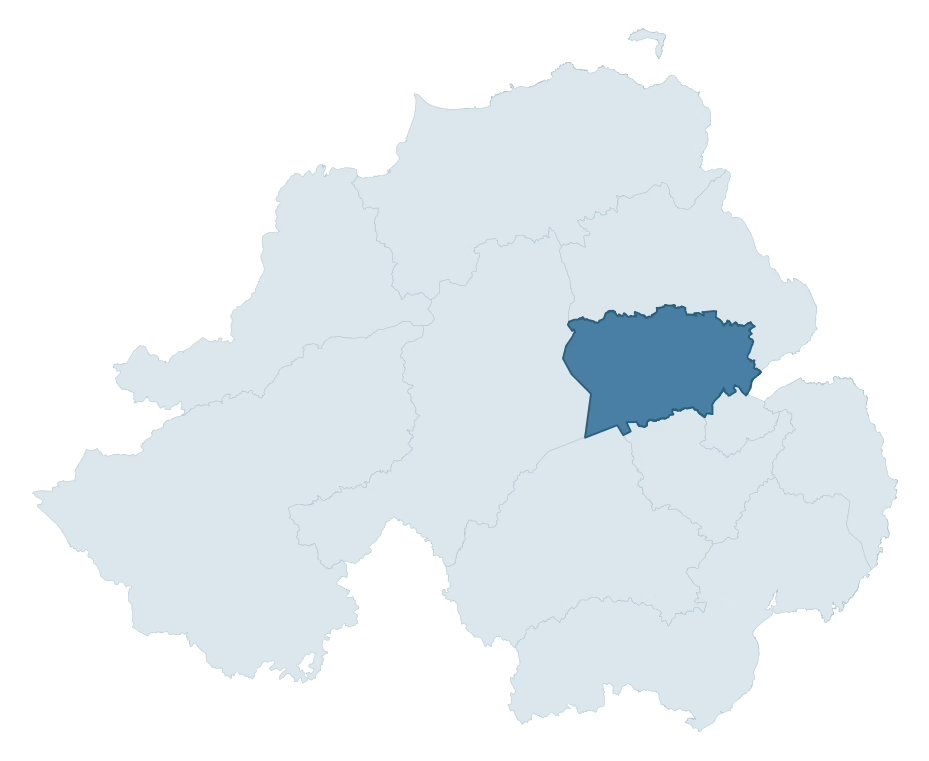
Antrim and Newtownabbey comprises 40 of Northern Ireland's 462 electoral wards, covering 2,174 km² of land — roughly 8.7% of the NI ward total. Across these wards, the combined heritage record holds 1,459 recorded historic sites, 113 scheduled monuments, and 629 listed buildings, drawn from the NISMR, HED scheduled monuments register, and HED Historic Buildings Record. That places the council at the highest recorded heritage density of NI's eleven councils (0.72 sites per km²). The 2021 Census records 143,456 residents across the council's wards. The single richest ward in the council by recorded heritage is Aldergrove (427 combined records); a complete ranked list of all 40 wards in this council appears below.
Heritage at a glance
Chronological character
Aggregated across the council's wards, the dated archaeological record contains 1,253 sites distributed across 9 archaeological periods. The Early Medieval period is the most common (471 sites, 38%), with the Iron Age period in second place (448 sites, 36%). Sparsely represented periods include Neolithic and Middle Late Bronze Age — each under 2% of the dated record. As elsewhere in NI, thin period coverage typically reflects survey gaps rather than genuine absence of activity.
Most common monument types
The table below lists the council’s most frequently recorded monument types, with the share they form of this council’s record compared to their share of the NI-wide record.
| Monument type | In this council | % of council | NI comparison |
|---|---|---|---|
| Enclosure (chart) | 176 | 28.5% | over-represented (9.5× NI average) |
| Enclosure | 158 | 25.6% | in line with NI average (1.0×) |
| Rath | 117 | 18.9% | in line with NI average (0.8×) |
| Souterrain | 40 | 6.5% | over-represented (2.1× NI average) |
| A.p. Site – Circular Cropmark | 39 | 6.3% | over-represented (3.3× NI average) |
| Souterrain (unlocated) | 20 | 3.2% | over-represented (5.3× NI average) |
Geographic character
Mean ward elevation across the council is 86m, around the NI median. Land cover averages combine 43% grassland, 22% woodland and 28% urban land, giving a varied mosaic across the council's wards.
All wards in Antrim and Newtownabbey
The complete list of 40 wards in this council. Click any ward to view its full heritage profile.
| Ward | HS | SM | LB | Total | km² | Dominant period |
|---|---|---|---|---|---|---|
| Aldergrove | 346 | 19 | 62 | 427 | 465.1 | Iron Age |
| Clady | 201 | 19 | 16 | 236 | 212.8 | Iron Age |
| Parkgate | 154 | 19 | 32 | 205 | 232.5 | Early Medieval |
| Templepatrick | 114 | 8 | 61 | 183 | 107.8 | Early Medieval |
| Toome | 92 | 3 | 41 | 136 | 254.8 | Iron Age |
| Ballynure | 80 | 5 | 31 | 116 | 129.3 | Early Medieval |
| Randalstown | 27 | 7 | 81 | 115 | 50.2 | Early Medieval |
| Shilvodan | 82 | 7 | 22 | 111 | 170.5 | Early Medieval |
| Antrim Centre | 26 | 5 | 65 | 96 | 31.8 | Medieval |
| Crumlin | 47 | 0 | 29 | 76 | 38.8 | Iron Age |
| Ballyrobert | 53 | 6 | 9 | 68 | 49.5 | Early Medieval |
| Cranfield | 48 | 1 | 13 | 62 | 173.8 | Iron Age |
| Doagh | 32 | 1 | 19 | 52 | 43.7 | Early Medieval |
| Mallusk | 36 | 2 | 7 | 45 | 50.8 | Iron Age |
| Whitehouse | 6 | 1 | 19 | 26 | 4.8 | Post-Medieval |
| Rostulla | 7 | 1 | 15 | 23 | 7.5 | Early Medieval |
| Carnmoney Hill | 16 | 2 | 1 | 19 | 10.3 | Early Medieval |
| Jordanstown | 14 | 1 | 4 | 19 | 18.5 | Early Medieval |
| Springfarm | 10 | 1 | 8 | 19 | 13.9 | Early Medieval |
| Ballyclare East | 7 | 1 | 10 | 18 | 5.5 | Iron Age |
| Stiles | 13 | 2 | 2 | 17 | 13.6 | Early Medieval |
| Glebe | 5 | 0 | 11 | 16 | 2.4 | Early Medieval |
| Mossley | 11 | 0 | 4 | 15 | 20.9 | Early Medieval |
| Fountain Hill | 3 | 0 | 11 | 14 | 5.2 | Mesolithic |
| Abbey | 2 | 0 | 10 | 12 | 2.7 | Early Medieval |
| Valley | 3 | 0 | 9 | 12 | 7.4 | Iron Age |
| Greystone | 1 | 1 | 8 | 10 | 2.8 | Medieval |
| Monkstown | 1 | 0 | 7 | 8 | 4.5 | Early Medieval |
| Steeple | 4 | 0 | 4 | 8 | 3.0 | Iron Age |
| Glengormley | 1 | 0 | 6 | 7 | 2.3 | Unknown |
| Ballyduff | 3 | 1 | 2 | 6 | 3.1 | Iron Age |
| Rathcoole | 0 | 0 | 5 | 5 | 2.0 | Unknown |
| Ballyclare West | 2 | 0 | 2 | 4 | 5.3 | Early Medieval |
| Collinbridge | 4 | 0 | 0 | 4 | 12.9 | Neolithic |
| Hightown | 2 | 0 | 2 | 4 | 2.7 | Early Medieval |
| Ballyhenry | 2 | 0 | 0 | 2 | 2.6 | Mesolithic |
| Carnmoney | 2 | 0 | 0 | 2 | 1.8 | Post-Medieval |
| Burnthill | 1 | 0 | 0 | 1 | 2.9 | Medieval |
| Fairview | 1 | 0 | 0 | 1 | 1.7 | Unknown |
| O'neill | 0 | 0 | 1 | 1 | 2.7 | Unknown |
Browse other Northern Ireland councils

Want a deeper view?
Grounding History: 10 Maps of Northern Ireland’s Past
A spatial history report bringing together analysis of all 462 wards into one place through 10 high-quality maps — covering monument density, archaeological periods, placename heritage, terrain, wetland, and the historic landscape at first survey.
About this profile
This council profile aggregates the recorded archaeological, built-heritage, terrain, and population data from each of its 40 wards. All figures describe the recorded evidence held in the public datasets listed at the foot of this page; the profile does not interpret historical processes or make inferences that are not directly supported by the data.
For full methodology — including a description of the ward geography, what counts as a recorded site, how period attributions are made, and what the limits of survey coverage mean for these figures — see the main methodology page.